El-Sayed Sharia law comments made during a Monday night interview have generated a sustained backlash online, with critics from across conservative media disputing the analogy at the center of his answer.
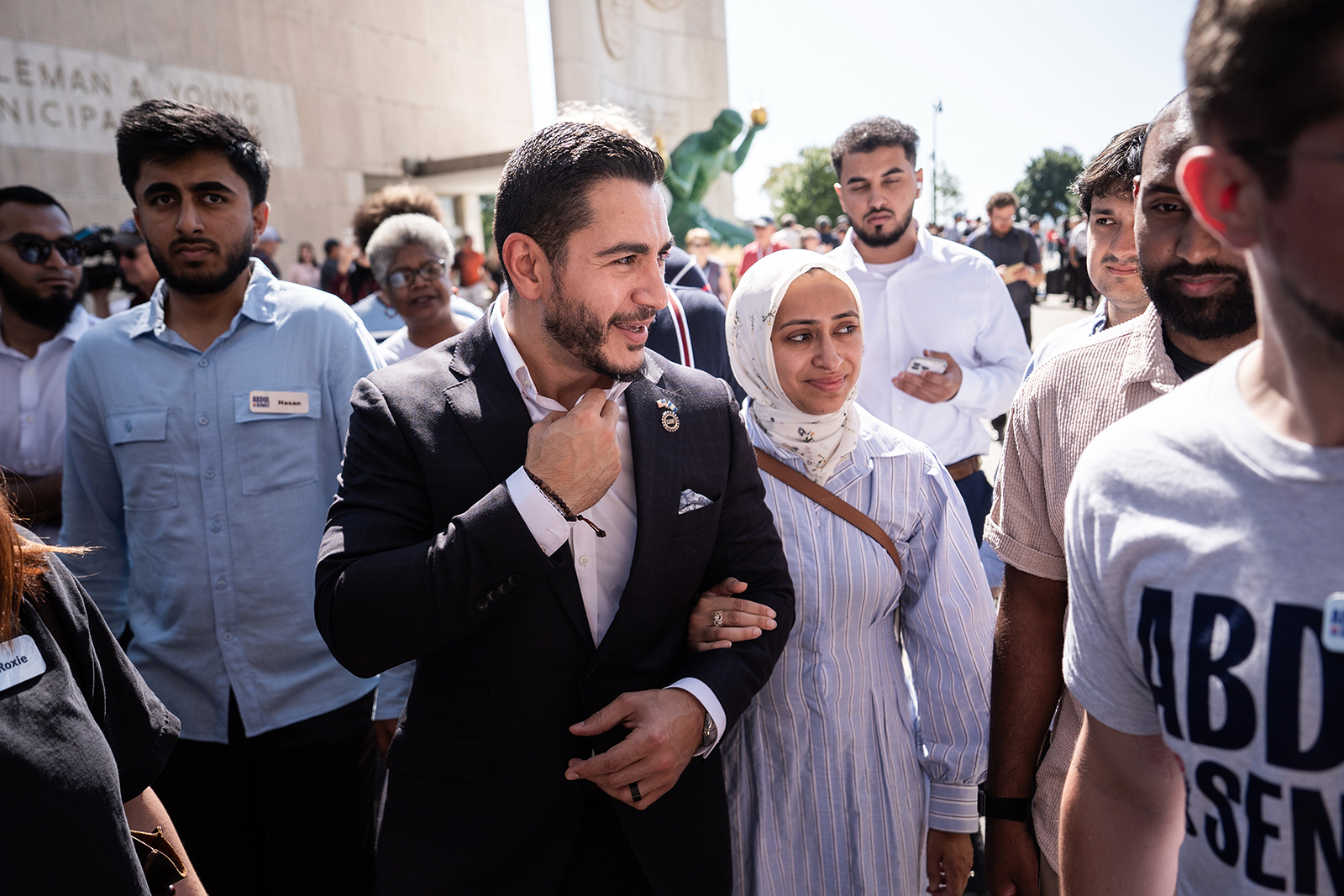
Abdul El-Sayed, the Democratic Senate candidate in Michigan, appeared opposite Fox News anchor Jesse Watters, who pressed him on prior statements characterizing efforts to ban Sharia law as rooted in white supremacy.
What Was Said
Watters put the question directly, asking El-Sayed to explain how eliminating Sharia law could amount to white supremacy.
El-Sayed’s response drew a parallel between Sharia, the body of Islamic law derived from religious texts, and Catholic canon law, which governs the internal affairs of the Church.
His argument was that nobody is attempting to impose Sharia on anyone, just as he hoped no one was attempting to impose canon law, because America guarantees freedom of religion.
That comparison became the focus of everything that followed.
The Objection Critics Raised
The most substantive pushback did not dispute religious freedom as a principle. It disputed whether the two legal traditions are comparable in scope.
Andrew Kolvet, executive producer of “The Charlie Kirk Show,” argued the equivalence is false. His characterization was that canon law addresses how Christian leaders, churches and believers conduct themselves, but stays confined to Church affairs and spiritual penalties, granting substantial autonomy to the state. Sharia, in his description, is far broader, reaching across all areas of life and, according to many contemporary Islamic clerics and historical practice, extending to matters of governance.
Pamela Geller made a related point about compulsion, contending that canon law applies to Catholics and Jewish law to Jews, both voluntarily, whereas she described Sharia as a comprehensive system claiming authority over non-Muslims as well.
Commentator Carl Jackson took a blunter line, calling Sharia incompatible with Western civilization and objecting to what he saw as El-Sayed avoiding scrutiny by claiming victimhood.
Dana Loesch argued the candidate cannot describe Sharia as merely a practice of faith when, in her view, it functions as jurisprudence intended to displace Western legal systems.
Michael Knowles used satire, mocking the analogy by juxtaposing a sacramental requirement involving blessed plant oils with a question about courts permitting polygamous marriage.
A Strategic Critique From the Right
Not all the commentary focused on theology. Some concerned campaign mechanics.
Republican communicator Matt Whitlock described the answer as a strange prepared defense, saying he had expected El-Sayed to argue the earlier remarks were taken out of context or no longer reflected his views. Instead, in Whitlock’s reading, the candidate accepted the framing and defended the position, which opens additional lines of attack.
Fox News contributor Kaylee McGhee White declared the race effectively decided, predicting a six-point win for Rogers.
Those predictions arrived within hours of the broadcast, which is worth keeping in perspective. Social media reaction on the night of an interview is a poor instrument for forecasting an election still months away.
El-Sayed’s Longer Record on the Subject
The controversy draws on statements that predate this campaign.
In a 2009 interview with The New York Times, El-Sayed described a personal sense of religious obligation regarding Sharia-compliant practices. He framed it in terms of eventual accountability before God, saying he did not want to have taken the easy path rather than the compliant one, and attributed the motivation to obligation rather than fear.
That is a statement about personal religious observance rather than public policy, a distinction his defenders emphasize and his critics contest.
The Oklahoma Argument
His position on Sharia bans is more elaborate and more explicitly political.
Speaking in 2022 about Oklahoma’s referendum amending its constitution to prohibit Sharia law, El-Sayed questioned what such a ban even meant, saying he did not know, and noting voters approved it regardless.
He then situated the measure within a longer historical sequence, arguing that the same forces that displaced Native peoples two centuries ago, destroyed Black Wall Street a century ago, and carried out a bombing decades ago were behind the Sharia ban and remain active today.
He explained his reason for reaching back to the 1830s: that a Sharia ban cannot be understood without the Trail of Tears, that efforts targeting Muslim Americans cannot be understood without the Tulsa massacre, and that present challenges cannot be understood without white supremacy.
Whatever one makes of that framing, it is a considered argument rather than an offhand remark, which is part of why it has proven durable as a line of attack.
The Contested Substance
Underneath the political fight sits a genuine scholarly disagreement.
Sharia encompasses a wide range of material, from personal devotional practice to family law to, in some historical and contemporary interpretations, criminal penalties and state governance. Traditional formulations have included capital punishment for apostasy, significant restrictions on women, and permission for child marriage.
Interpretations vary enormously across Muslim communities, schools of jurisprudence and national contexts, which is precisely why the term generates such divergent responses. Critics tend to invoke its most expansive historical applications. Defenders tend to describe personal religious observance.
Both are describing something real. They are not describing the same thing, and neither side in this dispute has much incentive to acknowledge that.
Where This Leaves the Race
Fox News Digital reached out to the El-Sayed campaign for comment.
For now, the exchange has handed opponents a clip they will use repeatedly, and has forced a Senate candidate to defend a position on religious law rather than discuss the economic and healthcare issues most Michigan campaigns are built around.
Whether it moves actual voters is a separate question from whether it moves social media, and the two frequently diverge.
Author