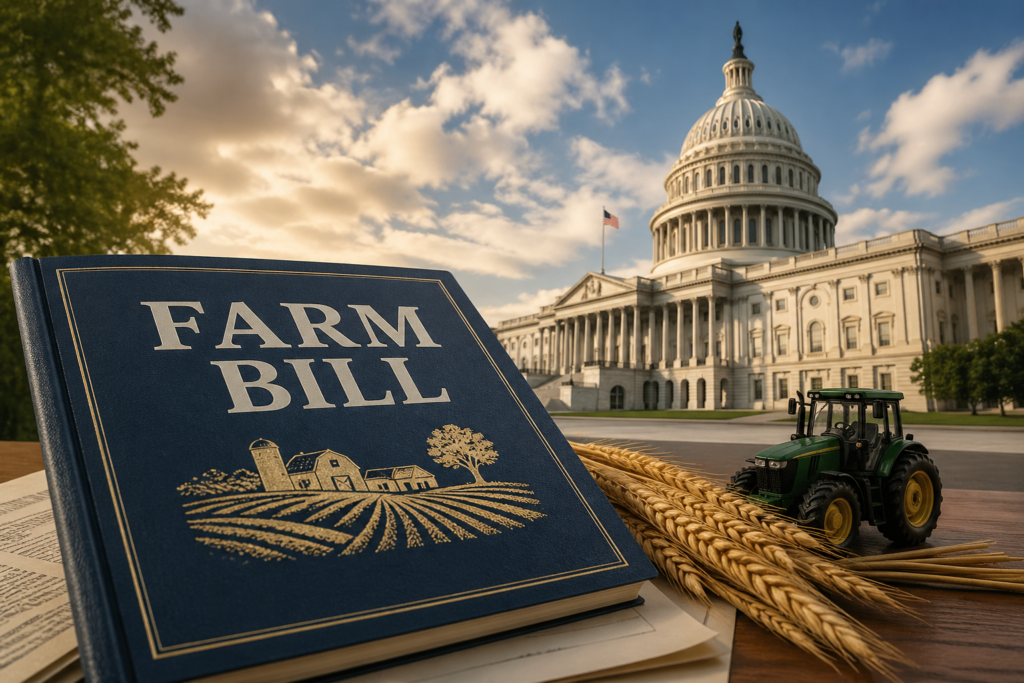
The Farm Bill failed to clear the Senate Agriculture Committee on Thursday, and Nebraska’s political figures responded within hours. The legislation would have set national policy on both agriculture and nutrition programs, and its stall leaves producers without the certainty they have been waiting on for months.
The Sticking Point
The dispute centers on the Supplemental Nutrition Assistance Program.
Democrats wanted the bill to include a delay on SNAP cost shifts, provisions that require states to shoulder part of the program’s expense depending on their rate of inaccurate payments.
That single issue, and the length of any delay attached to it, was enough to block the entire package from reaching the floor.
Agriculture Groups Register Disappointment
The Nebraska Farm Bureau framed the failure in terms of economic stability rather than partisan blame.
A spokesperson said food security begins with a strong farm economy, and that the committee’s inability to move the bill forward accomplishes nothing beyond creating additional uncertainty for the nation’s food producers.
The organization also flagged a specific casualty. Year-round sales of E15 failed to advance again, which the bureau called highly disappointing after years of sustained effort on the issue.
The group thanked Nebraska Sen. Deb Fischer for supporting the bill.
Fischer’s Response
Fischer, who sits on the committee, called the outcome disgraceful and placed responsibility squarely on Democrats.
She said Republicans had worked to secure bipartisan support for E15 and had offered a compromise on the SNAP cost share concerns.
Her sharpest argument was about what else the bill contained. She listed policies Democrats have championed publicly, including funding for food banks, improvements to rural and mental health services, expanded access to safe drinking water and broader broadband connectivity, and argued they voted against all of it.
That framing is common in committee failures. Because omnibus legislation bundles dozens of provisions, a no vote on the package can be characterized as opposition to every item inside it.
Ricketts Adds His Criticism
Sen. Pete Ricketts made a similar case, describing months of bipartisan agreement that more needed to be done for farmers and ranchers.
He said Democrats had an opportunity to support agricultural producers by advancing the bill and instead chose to play politics.
An Independent Sees It Differently
Dan Osborn, running as an independent for Senate, offered the most unusual response by distributing blame in multiple directions.
He called the failure unacceptable and attributed it to partisan politics broadly, but singled out three factors: Mitch McConnell’s absence, what he characterized as Ricketts’ indifference, and Democrats’ unwillingness to compromise.
His central claim was arithmetic. The bill failed to advance, he argued, because two senators did not show up to work.
He extended the criticism to Ricketts personally, saying Ricketts appeared unconcerned that McConnell was unable to cast his vote, and accusing him of defending McConnell’s extended leave before using Capitol Police as a shield from accountability.
The point about vote counting has substance. McConnell’s prolonged absence has narrowed Republican margins across committees all summer, meaning the chairman needed at least one Democratic vote that might not have been necessary otherwise.
Flood Points to the House
Rep. Mike Flood emphasized that the House had already acted.
He called the Senate outcome deeply disappointing, particularly given that the House passed a bipartisan version earlier this year. Farmers and ranchers need certainty from Congress, he said, and instead saw must-pass legislation blocked in committee.
He closed by urging an end to political maneuvering over the agricultural economy and calling for delivery of an updated Farm Bill.
What the Failure Actually Costs
Beyond the political exchange, the stall has practical consequences.
Farm bills govern commodity support programs, crop insurance provisions, conservation funding and rural development initiatives alongside nutrition assistance. Producers make planting, borrowing and equipment decisions based on what those programs will look like.
Extended uncertainty affects lending terms, planning horizons and the willingness of operations to make capital investments. That is why agricultural groups consistently push for timely passage regardless of which party controls the process.
The E15 provision carries particular weight in Nebraska, where ethanol production is a significant part of the state’s agricultural economy. Year-round sales authorization has been a priority for corn producers for years, and its repeated failure to advance is a recurring frustration.
Where It Stands
The bill remains in committee, which means it cannot reach the Senate floor without either a Democratic vote or a revised offer on the SNAP delay.
The gap between the two positions is not enormous in substance. What separates them is a difference in how long the cost shift requirements would be postponed.
Whether that gap closes depends on whether either side concludes that passing the bill is worth more than holding the position. For now, neither has.
Author
-
Lucienne Albrecht is Luxe Chronicle’s wealth and lifestyle editor, celebrated for her elegant perspective on finance, legacy, and global luxury culture. With a flair for blending sophistication with insight, she brings a distinctly feminine voice to the world of high society and wealth.