Autonomous weapons systems, often described in shorthand as killer robots, are no longer a hypothetical concern for arms control negotiators. On Tuesday the United Nations and the International Committee of the Red Cross issued a sharpened joint appeal urging states to adopt bans and restrictions, warning that the danger has grown since they last raised the alarm.
The message builds on an initial appeal made three years ago and on international discussions stretching back considerably further.
What the Appeal Does and Does Not Say
The statement stops short of demanding a blanket prohibition. Its position is more calibrated.
It observes that such systems are being developed, while noting that neither organisation has confirmed their use in actual combat. The argument is preventive: civilians require protection before the technology is deployed, not after.
That framing is deliberate. Arms control regimes built after a weapon becomes widespread tend to be far weaker than those established beforehand.
The Language of the Warning
The tone was notably stark.
U.N. Geneva spokesperson Alessandra Vellucci read a joint statement from U.N. Secretary-General António Guterres and ICRC President Mirjana Spoljaric, which said the world is now dangerously close to crossing a moral red line: the autonomous targeting of human beings by machines.
The statement renewed the earlier call with greater urgency, noting that while the fundamental concerns have not changed, the risks have intensified.
Both organisations argued that weapons technology is advancing at record speed, straining the international rules system and widening the distance between what machines can do and what regulation constrains.
Their assessment was blunt on timing. Autonomous weapons are not a distant prospect, they said, because a race toward greater autonomy in weapons systems is already well underway.
A Deadline in November
The appeal is timed around a specific opportunity.
Negotiators are scheduled to meet in Geneva in November to discuss strengthening the existing Convention on Conventional Weapons. The U.N. and ICRC described that conference as offering the clearest available path toward binding legal rules governing autonomous systems.
That characterisation carries an implicit admission. Years of effort to establish limits have produced little, and the November talks represent the most viable remaining mechanism rather than one option among many.
The Battlefield Context
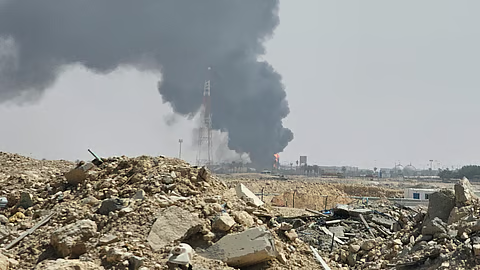
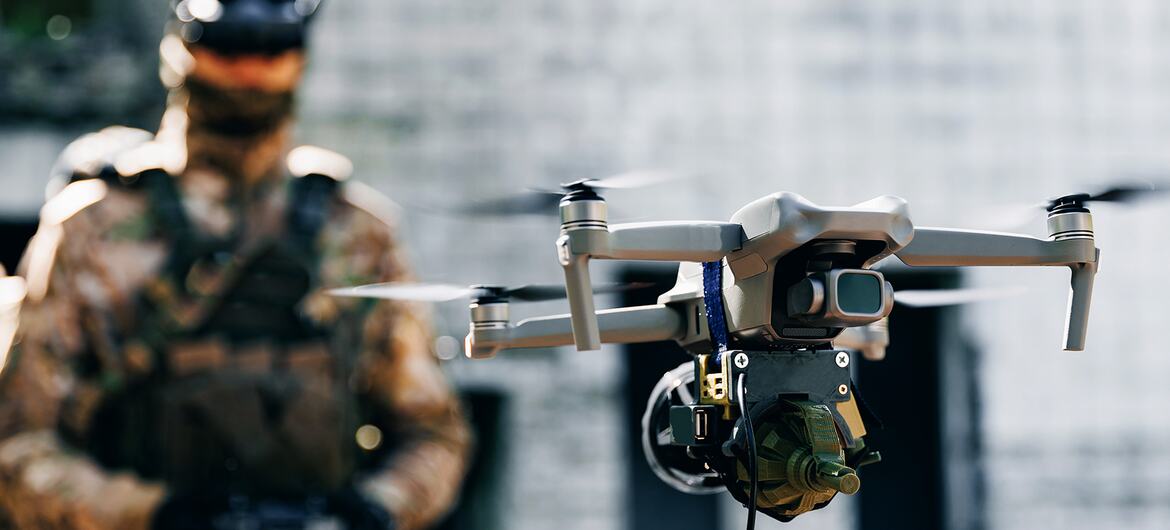
The push arrives against a backdrop of drones and related technologies appearing across conflicts as varied as the war in Ukraine, the Middle East and Sudan.
Ukraine offers the clearest window into how these systems are currently used, and the picture is more mundane than the debate might suggest.
Ground robotic vehicles have primarily carried supplies to infantry positions and conducted evacuations. The driver has been manpower conservation, since the prevalence of drones makes exposed human movement increasingly costly.
Kyiv is now attempting to scale up armed robotic systems, adding firepower to reduce the burden on infantry that is increasingly outnumbered. Those efforts remain limited so far.
That trajectory illustrates the concern precisely. Systems introduced for logistics and casualty evacuation are being pushed toward combat roles under battlefield pressure, and the step from remote operation to autonomous targeting is a matter of software rather than hardware.
An Argument From the Builders
One line in the statement stands out as the most pointed.
The organisations noted that scientists and engineers developing these systems have themselves raised the alarm, arguing that when the architects of a technology are calling for limits, states cannot afford to remain passive.
That appeal to expert consensus is doing specific work. It preempts the familiar objection that regulation reflects misunderstanding of the technology, by pointing out that those who understand it best are among the most concerned.
The statement closed by insisting this year must mark a turning point.
Why Progress Has Been Slow
The difficulty is not that anyone openly defends machines killing people without human involvement. It is that the definitions are genuinely contested.
Almost every modern weapon includes some degree of automation. Drawing the line between a guided munition, a system that selects targets from a pre-approved list, and a system that decides independently requires precision that negotiators have struggled to reach.
There is also a competitive dynamic. States pursuing these capabilities are reluctant to accept binding constraints while rivals develop the same technology, which produces a familiar deadlock.
November will test whether the urgency in Tuesday’s statement is sufficient to break it.
Author