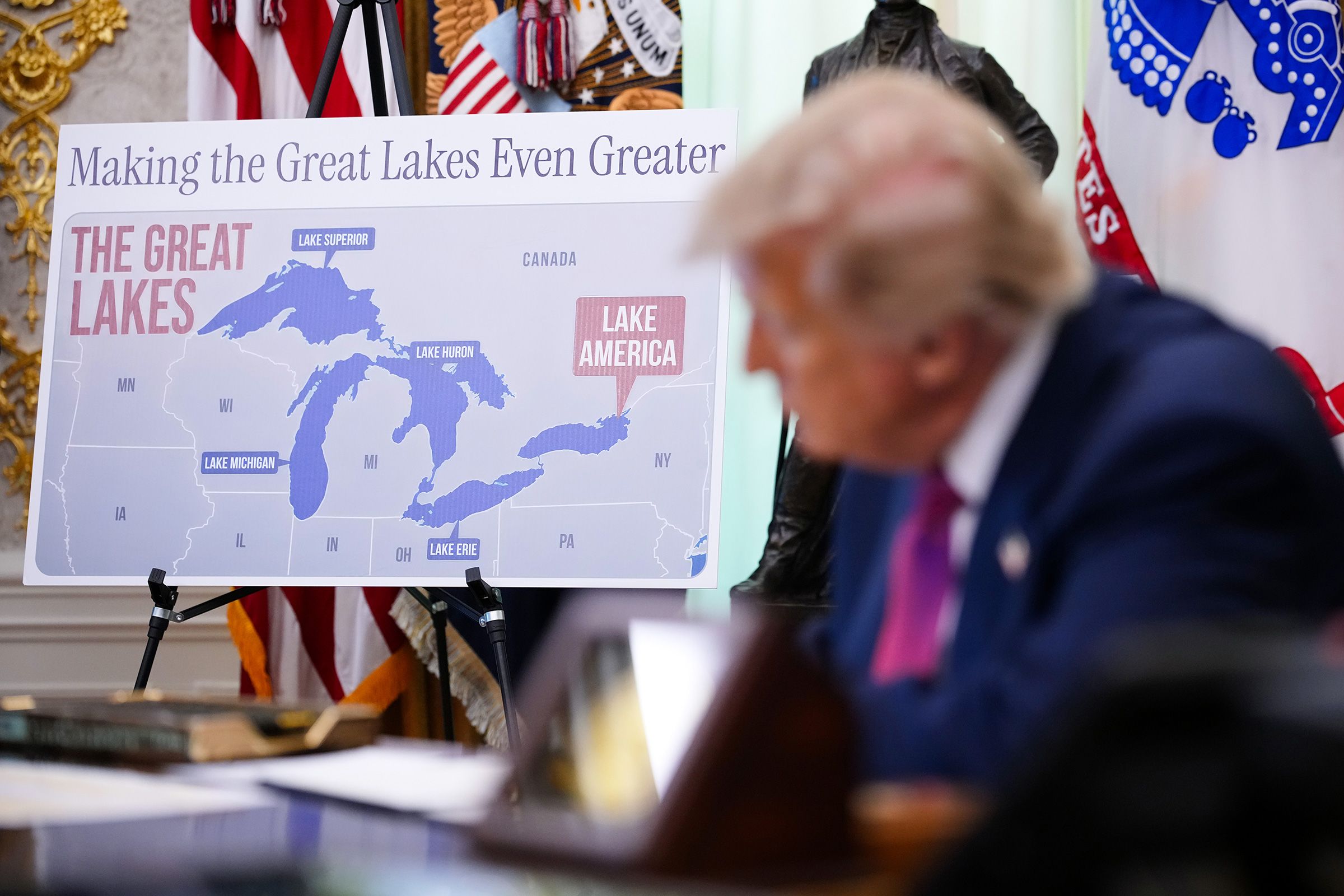
The Lake America executive order signed this week has drawn a sharp rebuke from the Seneca Nation, whose leadership says renaming Lake Ontario breaks a treaty signed more than 225 years ago and dismisses the Indigenous peoples who named the water in the first place.
Seneca Nation President J. Conrad Seneca issued a statement Friday calling for the order to be withdrawn and for the lake to keep the name it has carried for centuries.
A Direct Challenge to the Order
The core of the objection is ownership — specifically, who has any claim to a name that predates the United States entirely.
“The President cannot assert ownership over our culture or erase it through irresponsible political action,” Seneca said.
He argued that Lake Ontario’s name should stand as an acknowledgment of the Indigenous nations on both sides of the current border who lived along and around the lake long before either the United States or Canada existed as countries.
What the Order Actually Does
Trump signed the order directing the Interior Department to change the lake’s designation in the federal geographic naming service. The document specifies that the update should be completed within 30 days.
The move is not being presented as a cultural or historical decision. It sits squarely within the escalating trade dispute between Washington and Ottawa — a symbolic jab delivered through federal mapmaking rather than tariff schedules.
The 1794 Treaty at the Center of the Dispute
Seneca’s legal argument rests on the Treaty of Canandaigua, signed in 1794 between President George Washington and the Haudenosaunee Confederacy.
That agreement pledged perpetual peace and friendship between the parties. The Seneca are one of the six nations that make up the confederacy, also known as the Iroquois Confederacy, and the treaty remains recognized as a binding instrument rather than a historical artifact.
Whether a renaming falls within the treaty’s protections is a question that would likely require litigation to resolve. But the invocation itself signals how seriously the nation views the action — treaties of that era are among the strongest legal foundations tribal governments possess, and they are not raised casually.
Where the Name Came From
The word Ontario does not have English or French origins. It comes from the Huron term “oniatarí:io,” meaning lake of shining waters.
The name traveled outward from there. When the Canadian province of Ontario was established in 1867, it took its name directly from the lake — meaning an Indigenous word ended up naming both a body of water and one of the largest provinces in North America.
That lineage is part of what makes the renaming land so poorly. Replacing an Indigenous name with a national one reverses the direction of a naming history that ran the other way for centuries.
The Trade War Backdrop
The order fits a broader pattern in Trump’s approach to Canada.
He has repeatedly argued that Canada has taken advantage of the United States on both trade and military matters. He has also floated the idea that Canada should be absorbed into the United States as a fifty-first state — a suggestion Canadian officials have consistently rejected.
Against that backdrop, renaming a shared Great Lake reads less as geography and more as pressure tactics. Lake Ontario borders both countries, and its name appears on maps, charts, and official documents on both sides.
Why Names Carry Weight
Geographic naming might seem like a minor administrative matter, but it functions as a form of recorded claim.
Federal naming decisions ripple outward into maps, textbooks, navigation systems, government documents, and eventually into ordinary usage. A change made in a database in Washington gradually becomes the version people learn.
For Indigenous nations, that process has a long and painful history. Original place names across North America were systematically replaced during colonization, and the recovery of those names has been a slow, uneven effort spanning decades. Losing one of the most prominent surviving Indigenous names on the continent would run directly against that work.
The Practical Limits of the Order
There is also a jurisdictional reality worth noting. The United States can update its own geographic naming service, but it cannot compel Canada to follow suit, and Lake Ontario is a shared body of water with roughly half its shoreline on Canadian territory.
The likely outcome is a divergence — American federal documents using one name while Canadian documents, international charts, and common usage keep the other. That kind of split creates confusion in shipping, mapping, and treaty administration without producing any clear benefit.
What Happens Next
The Seneca Nation has asked for rescission. Whether that request receives any response from the administration remains to be seen, and the 30-day implementation window is already running.
The nation’s options beyond public statements include legal action grounded in the Canandaigua treaty, coordination with the other five Haudenosaunee nations, and pressure through New York state officials whose constituents live along the lake.
What is already clear is that a measure aimed at Canada has landed on Indigenous communities who had nothing to do with the trade dispute — and who have watched their languages disappear from the map before.
Author