US Iran military action has resumed after roughly a month of restraint, and the ripple effects reached the United Arab Emirates on Monday when its air force intercepted an Iranian drone over territorial waters.
The Emirati Defence Ministry described the incident briefly, saying it had dealt with a drone detected over its waters approaching from Iran.
The UAE Incident
Tehran made no immediate claim of responsibility, and no damage was reported.
The ministry issued a second statement afterwards specifically denying that Al Menhad Air Base in Dubai had been hit by Iranian missiles, contradicting reports circulating in Iranian media outlets.
That denial matters. In a conflict where both sides broadcast claims quickly, the difference between a single intercepted drone and a missile strike on a major air base is the difference between an incident and an escalation.
What Started This Round
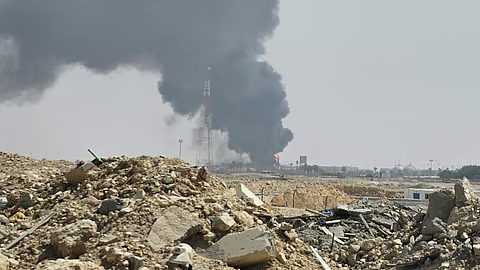
The sequence began on Sunday, 30 August, when US forces struck Iranian rocket launchers on an island in the Strait of Hormuz, ending a lull in a war now past its six-month mark.
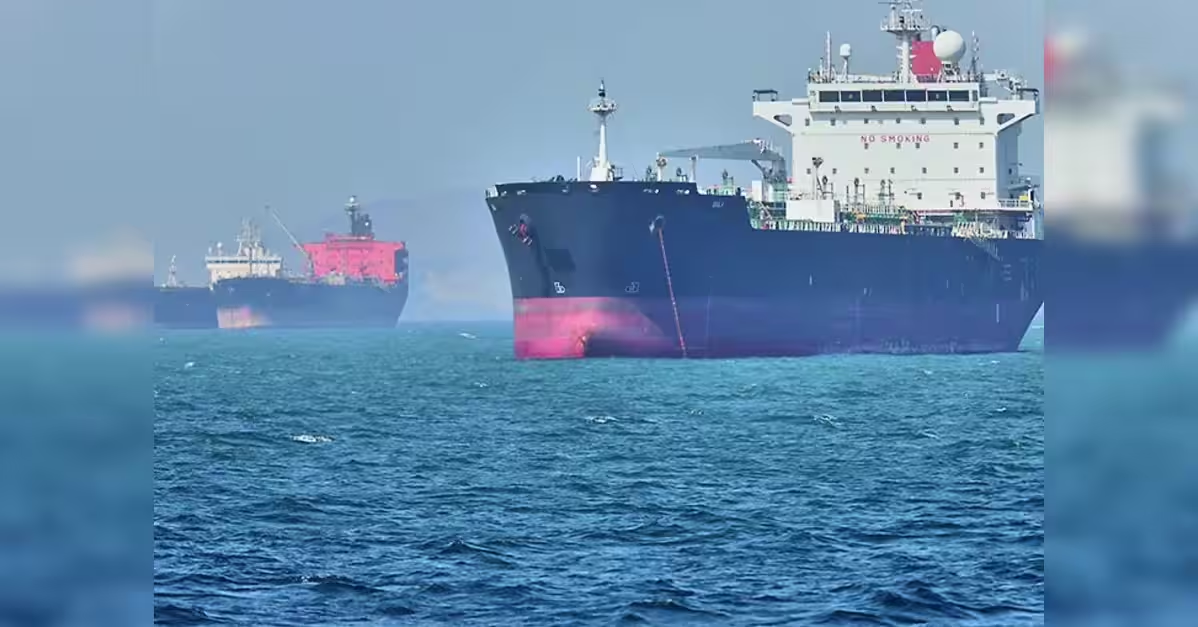
US Central Command said it acted after observing Revolutionary Guard forces preparing to fire rockets carrying sea mines into the strait. The American military had announced only last week that it finished clearing mines from the waterway’s international shipping lanes.
Semi-official Iranian outlets reported explosions near Larak Island, and the Revolutionary Guard said there were casualties.
American military officials rejected Iran’s characterisation of the strike as aggression, describing it instead as a limited and precise action against minelaying forces.
Iran’s Response
Iranian state television subsequently broadcast footage it said showed ballistic missiles being launched at American bases in Jordan. Jordan’s military reported intercepting eight missiles that entered its airspace.
Early Monday, Iran’s Foreign Ministry stated that the country would not hesitate to exercise its inherent right to legitimate defence and would respond decisively to any military aggression.
President Masoud Pezeshkian struck a similar note while preparing to travel abroad, saying Iran is not seeking war but will answer aggressors decisively. Pezeshkian has publicly favoured a negotiated end to the conflict, which makes his phrasing worth noting: he framed the response as reactive rather than as a shift in strategy.
Diplomacy Running in Parallel
Two significant gatherings are unfolding alongside the military exchange.
Pezeshkian and Foreign Minister Abbas Araghchi travelled to Kyrgyzstan for the Shanghai Cooperation Organization summit, an assembly frequently described as a counterweight to American global influence. Chinese President Xi Jinping, Russian President Vladimir Putin and Indian Prime Minister Narendra Modi are among those attending. Pezeshkian was scheduled to meet Putin on the sidelines on Tuesday, 1 September.
At the same time, US Treasury Secretary Scott Bessent was hosting G20 finance ministers in North Carolina on Monday and Tuesday. Those meetings come as Washington presses other governments to help isolate Iran economically, hoping financial pressure extracts concessions that end the war.
The contrast is striking. Iran’s president spent the day after a US strike sitting among leaders who present themselves as an alternative pole to Washington, while the American treasury secretary worked to tighten the economic net around him.
A Return to a Familiar Pattern
Washington had leaned heavily on economic measures in recent weeks rather than military ones. Sunday’s strike marked a return to kinetic action.
The timeline of recent escalation:
- 28 February: the war begins
- 29 July: US confirms a heavy wave of strikes on dozens of Revolutionary Guard targets, including coastal surveillance and defence sites
- 1 August: Trump says he will hold off on new strikes at the urging of Qatar, Saudi Arabia and the UAE
- 30 August: US strikes rocket launchers on Larak Island
- 31 August: UAE intercepts an Iranian drone
The Gulf states that lobbied for the August pause are now the ones fielding drones over their own waters. That is the recurring cost of this conflict for countries adjacent to it.
Why Gulf States Are Exposed
Iran has targeted American bases and infrastructure across Gulf countries since fighting began in February. Those nations host US facilities while sitting within easy reach of Iranian missiles and drones.
Their position is uncomfortable by design. They rely on American security guarantees, yet each escalation between Washington and Tehran plays out partly over their territory and threatens their shipping, aviation and energy exports.
That explains why Qatar, Saudi Arabia and the UAE pushed for restraint in August, and why the resumption of strikes will worry them.
What to Watch Next
The central question is whether this exchange stays contained.
Both sides have so far used language suggesting limits. Washington called its action limited and precise. Tehran framed its missiles as legitimate defence rather than the opening of a new campaign.
That framing leaves room for the situation to settle again, as it did after July. Whether it does may depend on:
- Whether Iran resumes attempts to mine the strait
- What emerges from Pezeshkian’s meeting with Putin
- Whether G20 members align with the American pressure campaign
- How Gulf states press both capitals privately
For now, one drone has been intercepted, eight missiles have been shot down over Jordan, and a month of relative quiet has ended without either side committing to something larger.
Author