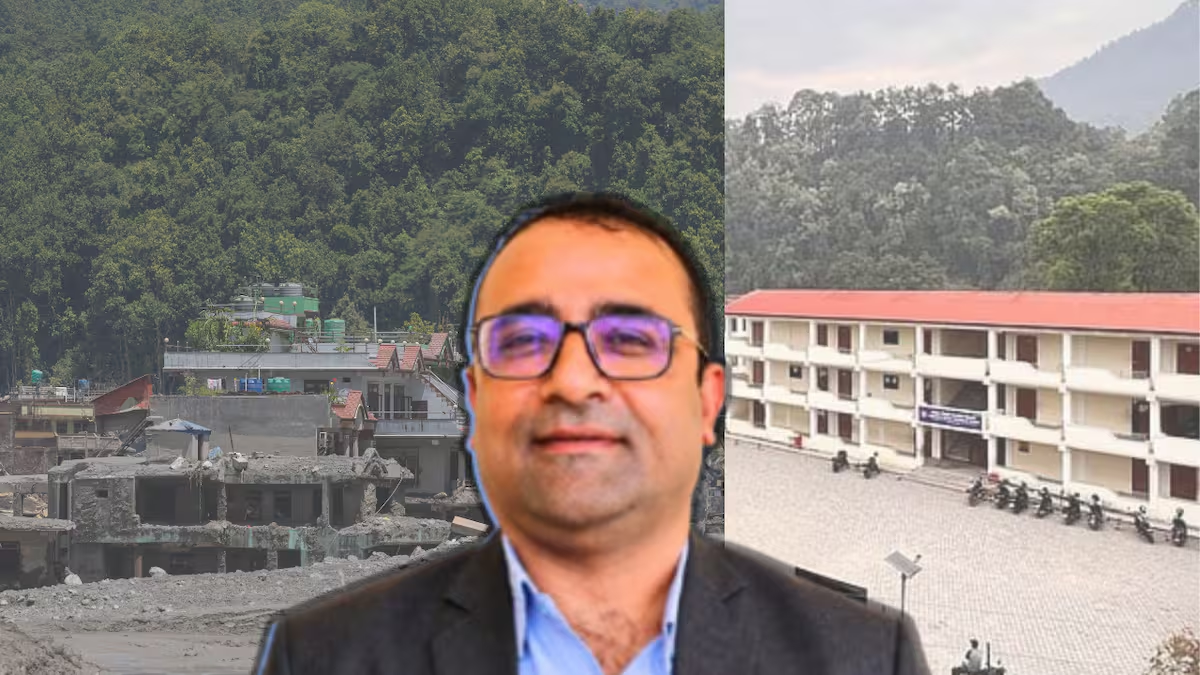
A Nepal school flood evacuation carried out with roughly ten minutes to spare saved around 1,600 students last week, at a building that no longer exists.
The decision belonged to Rajendra Dawadi, head teacher at Tribhuvan Trishuli Secondary School in Nuwakot, and it was made on the strength of a phone call and a parent’s urgency.
What the Floodwater Took
A Trishuli resident named Surinder described what stood there before.
There had been a three-storey school building facing a temple, with a market nearby. The floods, he said, swept away the entire structure. When the water arrived, the teacher had already cleared the students out.
Nothing of the building remains.
The Call That Made the Difference
Dawadi told the BBC he received warnings that disaster was approaching. What converted those warnings into action, though, was a parent arriving at the school in visible alarm.
The parent said a large flood was coming and had come to collect his daughter. Dawadi’s reasoning was simple: parents do not rush to a school without good cause, which confirmed to him that there was no time to waste.
He weighed the cost of being wrong and found it trivial. Even if no flood came, the only loss would be a single day of lessons.
His assessment of the margin was stark. Had the decision come ten minutes later, he said, neither he nor the students would have survived to talk about it.
He said he feels proud that so many lives were saved.
Saved by a Lunch Break
A second school in one of the hardest-hit areas produced a similar outcome through a mix of timing and quick instruction.
At Shree Bagheswori Madhyamik School in Galchhi, one group of children happened to be out of their classroom for lunch when the water came. Students in other classes escaped because teachers ordered an immediate evacuation moments before the flood struck.
Lakshmi Shrestha, whose child attends the school, recounted what staff told the pupils: that a flood was coming and they should leave their bags and lunch boxes behind. That instruction, she said, is what allowed them to survive.
Telling children to abandon their possessions sounds minor. In an evacuation measured in seconds, it is often the difference between everyone getting out and a bottleneck forming at the door.
Returning to the Mud
Families began going back to the Galchhi school on Sunday to search for belongings and assess what could be salvaged.
The scene they found:
- Thick brown and grey mud coating benches, walls and notebooks
- A courtyard filled with sediment
- Waterlines on the walls marking how fast the flood rose
- A pile of small mud-caked backpacks, some still carrying colourful key chains, waiting for owners
Most of the children at the school appear to have survived, according to families.
Kopila Mizar could not find her son’s backpack. Her response captured the mood among the parents there: her son is alive, and that is her greatest happiness.
The Damage to Education
The wider picture for Nepali schooling is serious.
Save the Children reports that at least 69 schools across the flood-affected districts have been destroyed or damaged, disrupting education for nearly 19,000 children. The organisation expects those figures to climb as rescue teams reach areas still cut off.
The government ordered schools and universities closed for three days following the torrential rain that triggered flash floods and landslides. University examinations have been paused.
With communities still receiving repeated warnings to move to higher ground, there is no clear timeline for classes resuming.
Why This Story Matters Beyond Nepal
The two schools survived for the same underlying reason: someone with authority acted on incomplete information rather than waiting for confirmation.
That is harder than it sounds. Evacuating 1,600 students is disruptive, and a head teacher who empties a school over a warning that turns out to be false faces awkward questions afterward. Dawadi appears to have understood that asymmetry clearly, and chose the cost he could live with.
A few practical lessons emerge from what happened:
- Local warnings from residents and parents can arrive faster than official alerts
- Instructions to abandon belongings speed up evacuations significantly
- Pre-identified higher ground makes decisions faster when minutes matter
- The cost of a false alarm is almost always lower than the cost of hesitation
Flash floods in mountainous terrain give very little warning. Water that begins as rain or ice high above can reach a valley settlement before anyone downstream sees a cloud.
What Remains
Tribhuvan Trishuli Secondary School is gone. The temple it faced and the market beside it were caught in the same surge.
But the 1,600 children who studied there are alive, and so is the teacher who made the call. In a disaster that has taken so much across northern Nepal, that outcome stands out for a simple reason: it did not have to happen that way.
Author