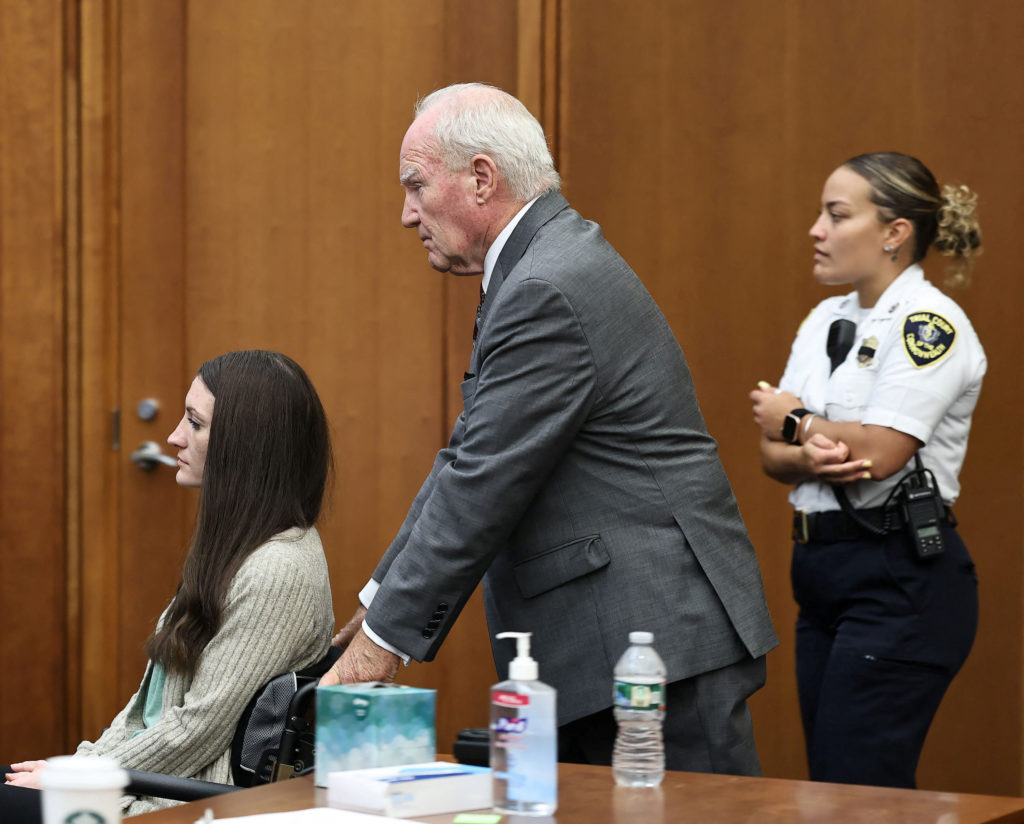
Why Lindsay Clancy Stays Locked Up No Matter How Her Case Ends
The question of Lindsay Clancy’s confinement does not depend on whether prosecutors retry her. Her murder case ended without a verdict, but she has already returned to a state psychiatric facility — and even the most favourable possible outcome at a second trial would not open the door.
Clancy was charged in the deaths of her three young children. Prosecutors argued the killings were planned. Her lawyers countered that she was in the grip of postpartum psychosis and therefore not criminally responsible for what she did.
While the Commonwealth decides what comes next, she resumes psychiatric care at Tewksbury Hospital, where she has now been held for more than three years.
The Verdict That Isn’t Freedom
There is a persistent misunderstanding about what a finding of not criminally responsible actually produces. It is not an exit.
Retired Massachusetts Judge Jack Lu, speaking on NewsNation’s “CUOMO,” said such a finding would most likely land Clancy in a maximum security mental health facility, with institutionalization lasting a number of years at minimum.
He named possible destinations: MCI Framingham, another state facility, or Bridgewater State Hospital — an institution he described as being every bit as forbidding as its reputation suggests.
Lu did draw an important distinction, though. A finding that she lacked criminal responsibility would give her something a conviction would not: a genuine path, however long, toward eventual release.
How Massachusetts Handles It
The state has a defined process, and it is deliberately slow.
Observation first. Following a not criminally responsible finding, Clancy could be held for up to 40 days of psychiatric evaluation.
Then a judge decides. Based on that assessment, a court determines whether involuntary commitment is warranted.
Six months, then annual renewals. The initial commitment period runs half a year. After that, it can be extended in one-year blocks, indefinitely, for as long as the criteria continue to be met.
There is no fixed endpoint. Each renewal is a fresh determination.
What Treatment Actually Involves
Postpartum psychosis is treatable, and the clinical picture is more hopeful than the legal one.
Dr. Katrina Furey, a reproductive psychiatrist, told The New York Times that treatment typically combines medication with, in some cases, electroconvulsive therapy — a procedure that uses electrical stimulation to induce a brief seizure.
She described the objective in plain terms: the goal is for the mother to feel like herself again.
Dr. Susan Hatters-Friedman, a forensic and reproductive psychiatrist at Case Western Reserve University, told the same outlet that patients in Clancy’s situation generally work with a large multidisciplinary team — psychiatrists, psychologists, social workers, nurses, peer advisers and additional therapists.
That structure reflects how long-term forensic psychiatric care operates. It is not simply custody with medication attached.
The Long Road to Any Discharge
Even if treatment succeeds, release is not automatic.
Dr. Renée Sorrentino, a forensic psychiatrist, explained to the Times that clinicians could eventually recommend discharge if they concluded her condition had improved and she no longer posed a danger.
That recommendation triggers a legal contest rather than an exit.
The Plymouth County District Attorney’s Office would be notified. Prosecutors could oppose the recommendation, hire their own experts to evaluate her independently, and argue in court that continued hospitalization is necessary.
A judge makes the final call.
Two Different Futures, Both Institutional
It is worth laying out the realistic possibilities side by side.
If convicted at a retrial. First-degree murder in Massachusetts carries a mandatory life sentence without parole. Confinement would be permanent, though she might serve it in a psychiatric setting rather than a standard prison.
If found not criminally responsible. Commitment to a secure psychiatric facility, renewable indefinitely, with release possible only after clinicians and a judge agree she is no longer dangerous.
If a plea to reduced charges is negotiated. A determinate prison term, with the length depending entirely on what charge prosecutors were willing to accept.
None of these produces freedom in the near term. The difference between them is measured in decades and in whether an end point exists at all.
The Clinical Question the Court Cannot Settle
Postpartum psychosis is rare and severe, affecting roughly one to two births per thousand. It typically emerges within days or weeks of delivery and can involve hallucinations, delusions, and profound disorganisation of thought.
It is also, importantly, treatable. Most women who experience it recover substantially with proper care.
That creates the tension running through Clancy’s situation. Someone whose acute illness has resolved may present very differently a few years on from how they presented at the time of the offence. The commitment framework is built to reassess exactly that — repeatedly, and with the burden on the patient to demonstrate change.
What to Watch
The immediate legal question is whether Plymouth County District Attorney Timothy Cruz pursues a second trial. That decision sits with him alone.
But the more consequential timeline runs alongside the courtroom one. Whatever happens at trial, Clancy remains in state custody, receiving treatment, subject to periodic review by clinicians who will eventually have to answer whether she is well and whether she is safe.
Those answers will take years to arrive. The court proceedings, by comparison, may be the shorter part of her confinement.
Author