Iran Moves to Police Hormuz Shipping as Oil Nears $97 and Pump Prices Set Records
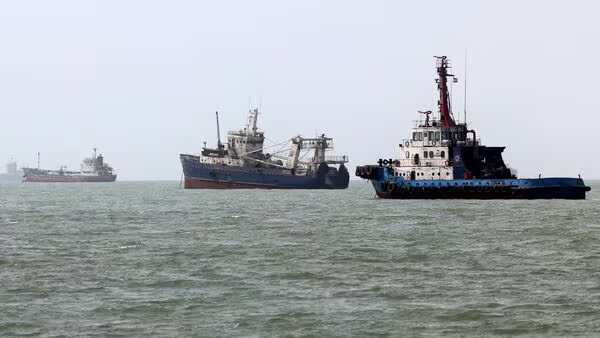
Tehran’s plan for a Strait of Hormuz exclusion zone marks a significant escalation in the energy dimension of its war with the United States. The head of Iran’s Supreme National Security Council said Monday the country intends to declare a maritime zone outside the strait where it will stop vessels attempting to pass without Iranian authorisation.
Roughly a fifth of the world’s oil moves through that waterway. Any attempt to control access to it registers immediately in global markets — and it did.
Crude Climbs Toward Highs Not Seen Since July
Brent crude, the international benchmark, briefly touched $97 a barrel early Monday, its strongest level in nearly seven weeks. That capped a run that saw prices climb 8% over the preceding week.
By Monday evening in the United States, Brent was hovering around $97 for November delivery. West Texas Intermediate, the American benchmark, traded above $92 for October.
Both sit close to their highest points since late July, when Brent pushed past $100.
The market is reflecting a simple calculation: the conflict shows no sign of easing, and the disruptions it has caused to energy flows are not being resolved.
American Drivers Are Paying for It
The pressure has moved straight through to filling stations.
AAA put the national average for regular gasoline at $4.15 a gallon on Monday, having stood at $4.14 heading into the Labor Day weekend. That is close to a dollar above the same point last year, and a record for any Labor Day weekend on record.
For a holiday defined by road travel, the timing could hardly have been worse.
Trump Predicts a Collapse in Prices
The president offered a forecast late Monday, saying oil prices would fall sharply — more than everything else that is dropping — once the United States wins its war with Iran.
He has made comparable predictions before. So far, prices have gone the other way. Global crude has stayed elevated throughout the conflict, and the last week and a half of renewed hostilities pushed it to a fresh monthly high.
Iran Warns of Harsher Retaliation
On Sunday, Iran threatened a response it described as more intense and more painful, following American strikes on three Iranian oil tankers in the Persian Gulf and the Gulf of Oman.
Targeting tankers moves the conflict onto commercial shipping directly. The proposed exclusion zone appears to be Iran’s answer in kind — an attempt to impose the same category of risk on vessels transiting the region.
Iran Raises Fuel Prices at Home
The war is squeezing Iran’s own population, and the government has now passed part of that cost to consumers.
Early Tuesday, state media reported a higher gasoline price for the heaviest users. It is the second such increase since December.
How the new system works: Anyone buying beyond a monthly quota of 110 litres (29 gallons) now pays 100,000 rials per litre — around seven cents, and double the rate in place since December.
Who it affects: Keramat Veis Karami, chief executive of the state oil distribution company, told the official IRNA news agency the change would touch 15% of consumers.
The government’s announcement referred to the current situation without naming the war, and said the additional revenue would be redistributed to households.
Why Fuel Pricing Is Politically Dangerous in Iran
This is not a routine adjustment. Gasoline price rises have a history in Iran of triggering serious unrest.
An increase in 2019 set off nationwide protests and a crackdown that reportedly left more than 300 people dead. The government is fully aware of that precedent, which explains the quota structure and the promise to return funds to households.
The broader economic picture makes it riskier still. The currency has been sliding to record lows, with the dollar trading at 2.22 million rials on Monday. Purchasing power for a population exceeding 90 million has weakened considerably.
Iranian fuel remains among the cheapest in the world in absolute terms. That does not mean the increase goes unnoticed by people already absorbing months of wartime inflation.
A Supply Gap Behind the Decision
There is also a straightforward supply problem driving the policy.
Karami said consumption hit a record 145 million litres a day in August, while domestic refining capacity stands at 122 million litres. The shortfall — more than 20 million litres daily — has to be imported.
Importing fuel during a war, under sanctions, with a collapsing currency, is expensive. Rationing demand through price is one of the few levers available.
What Markets Are Watching
Several factors will determine whether crude keeps climbing:
Whether the exclusion zone is enforced. A declaration is one thing; stopping vessels is another. Any actual interdiction would likely move prices sharply.
Insurance and shipping behaviour. War-risk premiums for Gulf transits are already elevated. If underwriters withdraw cover, traffic falls regardless of what any navy does.
Further strikes on tankers. Attacks on commercial vessels, from either side, remove supply directly and raise the risk premium on everything still moving.
The Broader Picture
Two economies are now absorbing the cost of this conflict through fuel.
American drivers paid record Labor Day prices. Iranian drivers face a doubled rate above their quota, in a country where fuel subsidies have long functioned as a form of social contract.
Neither government appears close to changing course, and the market is pricing accordingly.
Author