A US submarine drone has become the latest flashpoint between Washington and Tehran, and depending on which side you believe, it was either a sophisticated intelligence asset snared in a clever trap or an ageing piece of equipment that broke down and drifted.
Iran’s Revolutionary Guards announced on Tuesday that they had captured an uncrewed American submarine at the entrance to the Strait of Hormuz. The claim is unusual in itself, offering a rare public look at how underwater drones are actually being deployed in live military operations.
Two Accounts of the Same Object
The Guards’ Navy described the seizure in triumphant language, saying it had trapped one of the most modern and intelligent unmanned submarines belonging to what it called the terrorist American army, and adding that the vessel was fitted with the latest technologies. The statement was carried across Iranian state media.
Washington told a very different story.
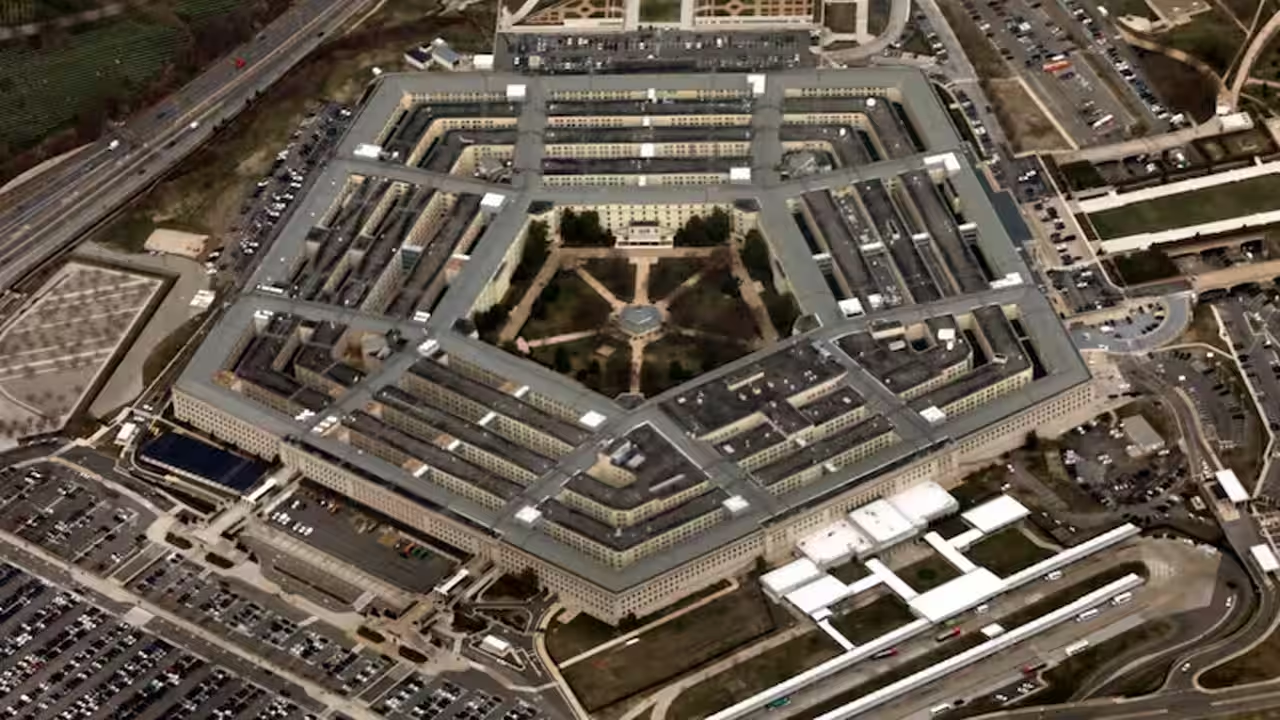
A Pentagon spokesperson said an underwater drone had malfunctioned more than a day before the announcement. The vehicle had been surveying regional waters in support of ongoing operations. Crucially, the spokesperson characterised it as an older model that gathered no sensitive data and carried no classified sonar or radar systems.
The gap between the two accounts is not just about pride. It determines whether Iran gained anything useful.
What the Vessel Actually Is
Iranian state media identified the submersible as a Dive-LD, a large autonomous underwater vehicle produced by the California defence firm Anduril.
The machine measures 19 feet, or 5.8 metres. According to the manufacturer, it handles a range of missions including mine countermeasures, seabed mapping, intelligence collection, and inspection of underwater infrastructure such as cables and pipelines.
Anduril’s specifications describe a vehicle capable of operating for as long as 10 days without returning to base and rated to dive to depths of up to 6,000 metres, roughly 19,700 feet. US military news outlet DefenseScoop reported in 2024 that each unit costs in the region of $2.5 million.
The Manufacturer’s Shrug
Anduril confirmed that one of its vessels was lost but framed the incident as something close to routine.
A company spokesperson described the Dive-LD as an attritable autonomous system, a term meaning the vehicle was designed from the beginning to operate in hazardous environments where losing it is an anticipated outcome rather than a failure.
That word, attritable, does a lot of work. It signals a deliberate design philosophy: build platforms cheap enough and replaceable enough that losing one is a cost of doing business rather than a strategic setback.
Why the US Is Building These at All
The incident sits inside a much larger shift in American naval planning.
The military has been pouring money into unmanned systems, both underwater and on the surface, driven by a fairly simple calculation. Oceans are enormous, crewed vessels are expensive, and putting sailors in contested waters carries obvious risk.
Autonomous platforms offer a cheaper way to monitor vast stretches of sea, collect intelligence, and track adversary ships and submarines. They can loiter for days, operate in areas considered too dangerous for crewed vessels, and be replaced without anyone writing a condolence letter.
That last point is precisely what Anduril was gesturing at in its response.
What Iran Might Gain
Even accepting the Pentagon’s account, a recovered vehicle is not worthless to Tehran.
Physical possession of a modern autonomous underwater platform allows engineers to study construction methods, propulsion, hull design, power systems and navigation architecture. Reverse engineering does not require classified sonar to be aboard.
But the American framing, if accurate, limits the intelligence value considerably. An older model with no sensitive collected data and no classified sensor package is a substantially smaller prize than a current-generation vehicle taken mid-mission.
Where the Truth Probably Sits
Both statements can be partly correct without either being fully honest, which is typical of incidents like this.
A drone can malfunction and still be recovered by an adversary. A recovery can be genuine while the description of it as a complex operational and intelligence achievement is inflated. And a losing party has every incentive to describe what it lost as obsolete and harmless.
What is verifiable is narrow: Anduril lost a vessel, Iran has publicised its possession, and neither side disputes that the vehicle was operating in the region.
The Strait Makes Everything Sharper
Location matters here. The Strait of Hormuz is among the most strategically sensitive waterways in the world, and it has become considerably more so amid current tensions between Washington and Tehran.
Underwater drones operating near that chokepoint are doing exactly the kind of work the Dive-LD was built for, mapping the seabed, monitoring infrastructure, and watching movement. Their presence is not accidental, and their loss, or capture, becomes a story with weight beyond the hardware involved.
The Broader Signal
Beyond the immediate dispute, the episode illustrates something about how modern naval competition is evolving. Uncrewed systems are now genuinely operational rather than experimental, they are being deployed in contested waters, and their loss has become a routine enough possibility that manufacturers build entire product categories around the assumption.
A generation ago, an incident like this would have involved captured personnel and a diplomatic crisis. Instead, the argument is over a machine, its age, and what it was carrying. Whatever else it reveals about Iran and the United States, that shift alone says a great deal about where warfare is heading.
Author