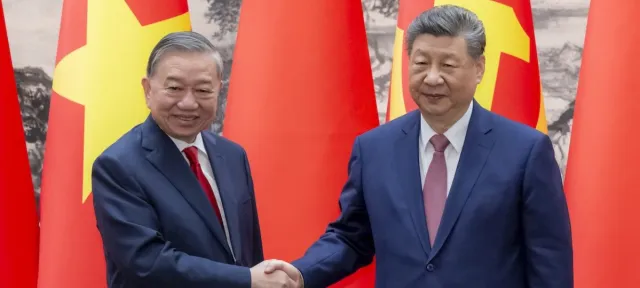
The question of To Lam Vietnam China relations has taken center stage after the country’s top leader signaled that closer ties with its powerful neighbor could strengthen peace and security across the region. Speaking in his first interview with an international outlet since assuming his current role, To Lam made clear that Vietnam intends to balance its relationships with major powers rather than align itself with any single side.
Refusing to Pick Sides
In a conversation with Reuters late on Friday, Communist Party General Secretary and President To Lam stated plainly that Vietnam does not pick sides. While he emphasized the importance of strong relations with China, he was equally clear that ties with the United States remain valuable.
This stance reflects a careful balancing act. Lam argued that there is no inherent conflict between pursuing deeper cooperation with Beijing and simultaneously working to resolve the long-standing territorial disputes scattered across the South China Sea.
In his view, dialogue is the key. He suggested that as long as good relations and open communication are maintained, even the most stubborn disagreements can eventually be settled.
Sovereignty and Cooperation Can Coexist
Lam framed Vietnam’s position in terms of mutual reinforcement rather than contradiction. Speaking through an interpreter, he explained that maintaining strong relations with China, defending national sovereignty, and resolving disputes in what Vietnam calls the East Sea are goals that support one another rather than compete.
He also reaffirmed Hanoi’s long-held commitment to settling disputes on the basis of international law, pointing specifically to the United Nations Convention on the Law of the Sea as the appropriate framework.
These comments carry real weight given the underlying tensions. China’s sweeping claims over large portions of the South China Sea are deeply felt in Vietnam, which asserts its own claims over the Chinese-occupied Paracel Islands and the entire Spratlys archipelago to the south.
The dispute extends well beyond these two nations. The Philippines, Malaysia, Brunei, and Taiwan are also competing claimants in this strategically vital trade corridor. With naval deployments steadily increasing, the region has become an ever more sensitive flashpoint.
A More Active Diplomatic Profile
Lam’s remarks arrive as he moves quickly to elevate Vietnam’s standing on the world stage. He appears intent on strengthening relationships with China, the United States, and other major powers all at once, while pursuing an ambitious economic agenda at home.
He characterized the rivalry between Washington and Beijing as an objective reality, something to be acknowledged rather than feared. Notably, he stressed that Vietnam does not view its relationships with major powers primarily through the lens of security.
This approach embodies Vietnam’s well-known philosophy of bamboo diplomacy, flexible yet rooted, bending without breaking. As Lam put it, good relations with major countries are essential for tackling shared and important challenges together.
A Leader Under Close Watch
Having recently taken on the dual roles of both party chief and president, Lam has emerged as arguably the most powerful Vietnamese leader in decades. His combined mandate grants him room to play a far more prominent diplomatic role than his predecessors.
Regional diplomats are paying close attention as he shapes a more dynamic and adaptable posture for a country once regarded as cautious and reserved in its foreign dealings. Vietnam’s tradition of collective leadership had long produced a more measured diplomatic style.
Some analysts, however, have raised a note of caution. Consolidating so much authority in a single figure could push the one-party state toward greater authoritarianism, even as it allows for faster, more decisive action.
At 68, Lam is described as soft-spoken yet firm. His career rose through Vietnam’s internal security apparatus, a powerful but discreet institution not typically known for producing diplomats, which makes his current diplomatic prominence all the more notable.
Addressing the World’s Crises
Lam spoke to Reuters shortly after delivering the keynote address at the Shangri-La Dialogue in Singapore, Asia’s largest defense gathering. It marked the first time a Vietnamese party chief had taken on that role.
Before an audience of defense ministers, military officials, intelligence officers, and academics, Lam outlined what he sees as the major challenges facing the world today:
- An erosion of international rules and law.
- A crisis of development models, including slowing growth and climate change.
- A growing crisis of trust among nations.
Yet he struck an optimistic tone, insisting that these three crises are not inevitable conditions the world must simply accept. He called for reinforcing international law, building inclusive and sustainable engines of growth, and prioritizing dialogue and transparency.
Ambitious Economic Goals
Seated in a hotel function room after his speech, dressed in shirt-sleeves and a burgundy tie, Lam turned to Vietnam’s economic ambitions. He acknowledged that the country’s growth targets are demanding, but insisted they remain achievable.
Vietnam is aiming to reach fully developed, high-income status by 2045. To get there, it has set a target of 10% GDP growth this year, with double-digit increases expected in the years ahead, driven largely by science, technology, and digital transformation.
Lam admitted that when these goals were first set, some of today’s difficulties had not yet emerged. Even so, he noted that Vietnam had anticipated certain headwinds and learned from the experiences of other nations, leaving the leadership optimistic.
When asked whether external pressures, such as the Iran crisis, might force a downward revision of these targets, Lam was unequivocal. The core objectives, he said, remain within reach, and Vietnam will not lower its ambitions.
He concluded with a firm declaration of resolve, stating that there is simply no alternative path. In his words, failing to meet these targets would mean falling short of the broader aspirations Vietnam has set for its future.
Author