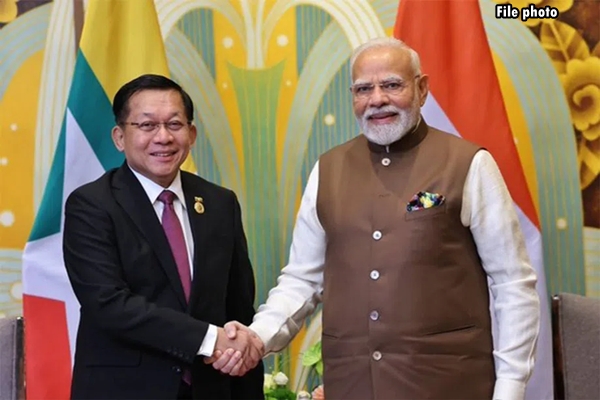
The Min Aung Hlaing India visit has drawn significant international attention, as Myanmar’s newly installed president embarks on his first foreign trip since taking office. According to India’s foreign ministry, the visit to neighboring India will run from Saturday through Wednesday, marking an early and notable step in Myanmar’s evolving diplomatic posture.
A Carefully Watched First Trip
During his time in India, Min Aung Hlaing is set to hold talks with Prime Minister Narendra Modi as well as with prominent Indian business leaders. He is also expected to meet with India’s President Droupadi Murmu, signaling the seriousness with which both governments are treating the visit.
This trip carries weight beyond its diplomatic agenda. It represents Min Aung Hlaing’s first international journey since he was sworn in as Myanmar’s president in April. Those elections, however, have been widely dismissed by Western governments and human rights groups as a sham, casting a long shadow over his newfound legitimacy.
A Controversial Path to Power
To understand the significance of this visit, it helps to recall how Min Aung Hlaing rose to the presidency. In 2021, while serving as chief of Myanmar’s armed forces, known as the Tatmadaw, he overthrew the elected government led by Aung San Suu Kyi. That coup ignited a brutal civil war that has now stretched on for roughly five years, with no clear end in sight.
Despite the ongoing violence, the military pressed ahead with elections regardless. The result was a deeply flawed process in which millions were effectively disenfranchised by the war, and Aung San Suu Kyi’s party was barred from participating altogether.
Ahead of the trip, New Delhi struck a positive tone, stating that the visit was expected to strengthen and deepen the multifaceted relationship between the two nations.
Why India and Not China?
Perhaps the most intriguing aspect of this visit is where it is happening. Many analysts had anticipated that Min Aung Hlaing’s first foreign trip would be to China, long considered the Myanmar military’s strongest backer and a supporter of the recent election.
Yet that trip did not materialize, at least not first. One explanation points to Chinese leader Xi Jinping’s preoccupation with high-profile state visits from both President Trump and Russia’s Vladimir Putin. Myanmar analyst Min Zaw Oo offered another reason, suggesting that both sides simply needed more time to prepare the agenda for discussion.
Morgan Michaels, a Myanmar analyst at the International Institute for Strategic Studies in Singapore, said he was not surprised India came first. He noted that India has largely maintained its relationship with Myanmar’s capital since the coup, having concluded that the Tatmadaw was there to stay. India even sent its minister of external affairs to Min Aung Hlaing’s swearing-in ceremony in April, a clear sign that New Delhi is willing to engage with the new regime. Michaels also pointed out that China’s Foreign Minister Wang Yi had visited Myanmar just a month earlier.
A Packed Agenda
There is no shortage of issues for the two countries to address. At the top of the list are shared security concerns along their porous border, which stretches roughly 1,000 kilometers. Each side has its own anxieties: Myanmar worries about resistance to military rule, while India is focused on insurgent groups operating in its northeast.
Other pressing matters likely to surface include:
- Drug and arms smuggling across the border.
- Human trafficking concerns affecting both nations.
- India’s interest in accessing Myanmar’s extensive rare earth deposits.
The rare earths question is particularly delicate. While New Delhi would welcome access to these valuable resources, China controls much of the rare earths supply chain in the region and is unlikely to agree to arrangements that benefit a rival.
A Military on the Offensive
This diplomatic outreach comes at a pivotal moment on the battlefield. After enduring two years of heavy losses to opposition forces, Myanmar’s military has begun to regain ground. Analysts attribute this shift to new tactics and improved drone capabilities, bolstered by technology and components from Russia and, to a degree, China.
Michaels described a dramatic reversal in the conflict’s trajectory. According to him, the military is now mounting a comeback, pushing deep into opposition strongholds. Where the resistance once held the initiative, it is now the opposition forces that find themselves in serious trouble, with some positions even beginning to collapse.
Seeking Legitimacy Abroad
Beyond the battlefield, the military-backed regime appears focused on shoring up its standing internationally, even as it remains reluctant to engage with Western journalists.
Richard Horsey of the International Crisis Group explained that diplomatic consolidation is a key priority. The regime is eager to restore normal relations with the Association of Southeast Asian Nations, from which it has effectively been suspended. It is also working to reclaim Myanmar’s seat at the United Nations in New York, which is still held by the ambassador appointed under Aung San Suu Kyi’s government.
There are signs that ASEAN’s resolve may be softening. At Thailand’s urging, the group recently agreed to a virtual meeting with Myanmar’s new foreign minister, Tin Maung Swe, a development that some rights groups view as the start of a worrying slide toward acceptance.
The Legitimacy Concern
This is precisely what troubles critics. Some within ASEAN and among Western governments fear that developments like the India visit, combined with renewed regional engagement, could help legitimize Myanmar’s military-installed government.
The stakes are considerable. As this diplomatic normalization unfolds, Myanmar’s military continues to wage a brutal war against its own citizens, a conflict that has already claimed the lives of tens of thousands of combatants and civilians. With much of the world distracted by other crises, the concern is that the regime may gain acceptance even as the suffering on the ground persists.
The Min Aung Hlaing India visit, then, is far more than a routine diplomatic exchange. It sits at the intersection of regional security, economic ambition, and a deeper struggle over whether a contested government will ultimately win the legitimacy it seeks.
Author