Who Decided To Station Police At Sons of Jacob On Yom Kippur? A Question That Deserves An Answer
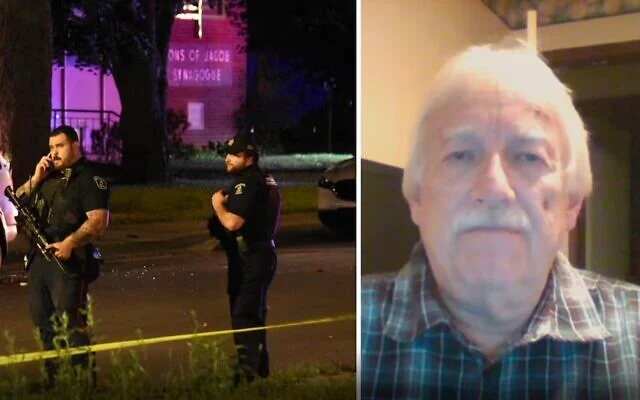
Const. Jeff Smith of the Belleville Police Service sat waiting in an unmarked car outside Sons of Jacob Synagogue on Sunday evening when, according to Ontario’s police watchdog, a man armed with a shotgun opened fire on him. His presence there that night is the primary reason roughly 25 people walked out of Kol Nidre services unharmed.
What Happened Inside And Outside The Synagogue
Approximately 25 congregants had gathered inside for Kol Nidre, the service that opens Yom Kippur, when gunfire erupted outside. The synagogue’s president, Norm Weddum, says the congregation had never received any specific threat prior to that night. Belleville, a city of roughly 55,000 people located about 110 miles east of Toronto, has what Weddum describes as a small Jewish community. Someone within the local police department made the decision that this particular synagogue, on this particular night, warranted having an armed officer stationed outside anyway, a decision that ultimately saved lives.
Ontario Premier Doug Ford called Smith a hero who prevented a genuine tragedy from unfolding. That assessment seems accurate, which makes it worth asking exactly who made the call to position Smith there in the first place.
According to Weddum’s account of what happened inside, he heard the initial gunshots and watched as some congregants instinctively moved toward the doors. When a second round of shots rang out, he redirected everyone back into the sanctuary, sealed the wooden doors to prevent anyone from being visible from the entrance, and instructed the congregation to get down on the floor. Bullets came through the windows during the exchange, leaving one stained-glass window with approximately 20 bullet holes.
Doug Lobel, a congregant present that night, described the terrifying uncertainty they experienced while sheltering on the floor, wondering whether the gunman might breach the doors and begin targeting those inside directly.
The Exchange Of Gunfire
Smith returned fire when confronted by the armed suspect, and a second officer also discharged their weapon during the encounter. Both Smith and the suspect were struck during the exchange, with houses and vehicles along the street sustaining damage from the gunfire. Smith, a 13-year veteran of the police force, is currently listed in critical but stable condition. The suspect, 29-year-old Sean Ward from neighboring Quinte West, remains in life-threatening condition. Fortunately, nobody inside the synagogue itself was injured during the incident.
Official Statements Remain Frustratingly Vague
The initial statement from Belleville police described an officer having encountered an individual near an intersection, without explaining why the officer had been stationed there in the first place. Since that initial statement, the police force has offered nothing further, as Ontario’s Special Investigations Unit, the civilian agency responsible for investigating whenever police discharge weapons at someone, has formally invoked its mandate over the case.
Belleville Mayor Neil Ellis told CBC he hopes the SIU investigation uncovers the root cause of what happened, and he appeared genuinely shaken, admitting he cried upon hearing the news. However, the SIU’s actual mandate is narrower than that, its job is determining whether Smith and his colleague were legally justified in firing their weapons. The separate question of why a 29-year-old showed up at that corner carrying a firearm remains unanswered, and it’s unclear who bears responsibility for investigating that broader question.
Authorities haven’t clarified what led to the shooting or confirmed whether the synagogue was actually the intended target. The SIU initially described the weapon involved as a rifle before later revising that description to a shotgun. With at least three people firing weapons on a residential street that night, nobody has yet clarified whose bullets actually penetrated the stained-glass window.
A Painful Pattern Of Underfunded Security
In June, Prime Minister Mark Carney stood inside Toronto’s Holy Blossom Temple and acknowledged that Canada’s civic compact is failing Jewish Canadians, an unusually direct admission for a sitting prime minister to make publicly. He noted that more than two-thirds of religiously motivated hate crimes recorded the previous year had targeted Jewish Canadians, despite this group representing only about 1 percent of the country’s population. Carney announced an additional 75 million dollars in security funding, while also expressing genuine pain that such a commitment had become necessary in the first place.
That sentiment, while understandable, reveals something troubling about how the underlying program actually functions. The funding flows through the Canada Community Security Program, which describes itself explicitly as time-limited funding intended for communities facing risk of hate-motivated crime. The program covers up to 70 percent of eligible costs, an improvement over the previous program’s 50 percent match requirement, but any expenses incurred before a formal funding agreement is signed go unreimbursed. Security guards only qualify under the program as time-limited third-party licensed personnel.
From the perspective of someone managing a synagogue’s finances, similar in scale to Sons of Jacob, this creates a genuinely difficult process: raising the remaining 30 percent independently, completing extensive application paperwork, and waiting for a signed agreement before spending any money at all. Then comes hiring guards on an ostensibly temporary basis, as though officials at Public Safety Canada possess some special knowledge of exactly when a particular threat will expire. The program’s entire structure assumes communities can demonstrably prove they’re at risk, yet according to its own president, Sons of Jacob had never actually received any threat before Sunday’s attack.
Ford acknowledged this underlying tension directly on Monday, telling reporters he was grateful such an experienced officer had been stationed at the synagogue, before adding candidly that there’s never truly enough security available. As Ontario’s premier, Ford holds more authority than almost anyone else in the province to determine what constitutes adequate security funding going forward.
Separately, Toronto Mayor Olivia Chow stated Sunday night that Jewish congregants shouldn’t need police presence simply to observe Yom Kippur. Nobody disputes that sentiment in principle, but it offers little practical guidance to a synagogue treasurer trying to decide whether to apply for security funding this year.
Considering The Counterarguments
The strongest challenge to everything argued above comes from taking Chow’s position seriously. A country that responds to antisemitism by permanently stationing police outside synagogues has, in some sense, accepted antisemitism as a permanent fixture of society. Every dollar spent on security guards represents a dollar not spent on earlier intervention, stopping someone before they ever pick up a weapon in the first place. Supporters of Canada’s newer federal hate crime legislation might argue that such laws address this problem through slower, more systemic means. They may well be correct, though none of that legislative framework would have helped the people lying on the floor of Sons of Jacob during Sunday’s attack.
A more difficult objection centers on the use of armed force itself. During Yom Kippur last year, at Heaton Park Hebrew Congregation in Manchester, England, worshippers attempted to prevent an attacker from entering their building. Armed police ultimately shot the assailant roughly seven minutes after the first emergency call was placed, though one of the two men who died in that incident appears to have been struck by a police bullet rather than the attacker’s.
In Belleville’s case, at least three people discharged firearms on a residential street. Should it emerge that some rounds that penetrated the synagogue’s window actually came from police weapons, this argument becomes considerably harder to defend. Still, a meaningful distinction exists: Manchester’s police had to arrive after an attack was already underway, while Belleville’s officer was already stationed outside before anything began. Crucially, nobody inside the synagogue was injured in either the shooting or the exchange of gunfire that followed.
What The Jewish Community Actually Needs
Expect increased calls this week for Jewish communities abroad to consider aliyah, the Hebrew term for immigrating to Israel. Some individuals who found themselves lying on that sanctuary floor may indeed choose that path eventually, and Israel should stand ready to welcome them when that decision comes. But such a significant life decision, about where to raise children and build a future, shouldn’t be made while lying on a synagogue floor during an active shooting. What Belleville’s Jewish community actually needs right now is support in pressing their own government for protections they’re rightfully owed, not political pressure to relocate entirely.
Concrete Steps Forward
Queen’s Park, Ontario’s provincial legislature, should commit to providing police presence at every synagogue throughout the province during the High Holidays, with the province covering these costs without requiring formal threat assessments beforehand. This commitment should extend to Purim as well, given that gunfire struck Toronto’s Temple Emanu-El during that holiday back in March.
Meanwhile, Ottawa should eliminate the 30 percent matching requirement and the time-limited funding condition specifically for smaller congregations. A synagogue hosting two dozen worshippers for Kol Nidre shouldn’t need professional grant-writing expertise just to secure basic security coverage.
Ontario’s prosecutors owe the public a clear explanation regardless of how this case ultimately unfolds. The Combatting Hate Act, which took effect July 18th, specifically criminalized hate-motivated crimes and created a distinct offense for intimidating people to prevent them from accessing places of worship, carrying penalties of up to 10 years imprisonment. When earlier shootings struck synagogues in Vaughan and Toronto back in March, before this act took effect, prosecutors filed charges of reckless discharge of a firearm, mischief relating to religious property, and conspiracy instead. If evidence ultimately shows Ward acted out of hatred, authorities should charge him under this newer law. If the evidence doesn’t support that conclusion, officials owe the public a clear explanation why.
Finally, Belleville police need to explain why Constable Smith was specifically stationed outside Sons of Jacob that Sunday night, who made that decision, based on what information, and whether the synagogue received any bill for that protection. Whoever made that particular call got it right. But nobody else across Canada can replicate that success until they understand exactly what informed it.
Author