The Boys Series Finale Reveals Butcher and Homelander Were Always the Show’s True Story
Warning: This article contains major spoilers for The Boys season 5, episode 8, “Blood and Bone.”
After five intense and chaotic seasons, The Boys has officially come to an end, and its finale made one thing absolutely clear: this entire journey was always about Billy Butcher and Homelander. The series finale, “Blood and Bone,” wrapped up their twisted relationship in a way that was as brutal as it was emotionally complicated, leaving fans with mixed feelings, raw emotions, and a deeper understanding of what this superhero satire truly stood for.
A Long-Awaited Showdown
For most of the series, viewers waited eagerly for the moment Butcher would finally bring down Homelander. The murderous, narcissistic, lab-created “hero” had spent five seasons committing horrifying acts, slaughtering innocents, and showcasing the absolute worst traits of humanity. Killing him was the only acceptable outcome unless the world wanted to spiral into a pseudo-theocratic dystopia ruled by a man-child with laser eyes.
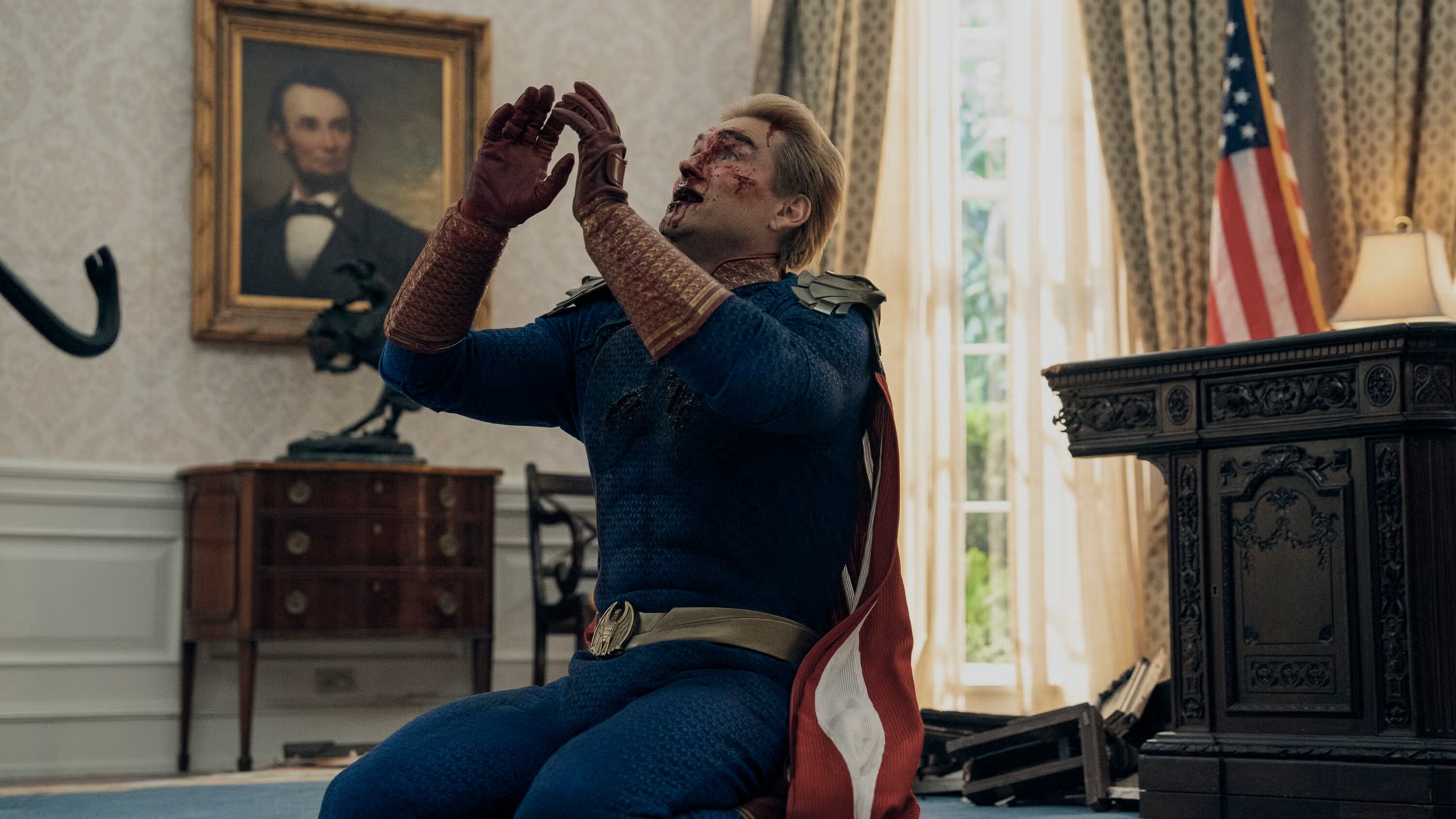
So when Butcher finally pried open Homelander’s skull with the wedge of a crowbar in the Oval Office, the moment should have felt like pure triumph. Instead, it left an unmistakable bitter taste. The murder was not glamorous, not heroic, and certainly not heroic in the traditional cinematic sense.
A Grim and Silent Execution
There were no triumphant orchestrals, no big hero music. Just the sickening squelch of Butcher tearing Homelander’s brain out of his head. Homelander begged for his life, sobbed, and finally realized that without his powers, he was just a man. Without flight, without invincibility, he was nothing.
His final moments revealed exactly what fans had suspected all along. Beneath the bravado, the threats, and the violence, Homelander was always just a terrified little boy desperate for control. Antony Starr’s performance throughout the series mined every inch of that vulnerability, and when his end came, it carried more sadness than victory.
The other characters in the scene, including M.M., Hughie, Starlight, Kimiko, and Ryan, all reacted with relief, but not joy. Their faces seemed to acknowledge a deeper truth. They had defeated one monster, but there was still another one in the room, and his name was Butcher.
Butcher and Homelander as Mirror Images
From the very beginning of the series, Butcher and Homelander were positioned as foils to each other. As the seasons progressed, however, the show subtly transformed their dynamic. Instead of being opposites, they became mirrors. Both were obsessed with destroying the other while simultaneously needing each other to define themselves.
The two men shared similar drives, similar levels of brutality, and a willingness to hurt anyone in their path. Whether it was friends, family, or innocents, neither Butcher nor Homelander hesitated when their goals were on the line. They were two sides of the same coin, and the finale finally made that undeniable.
The Final Plan
“Blood and Bone” set a strict timer on their long-running conflict. The Boys had tried countless times to bring Homelander down, with each plan ending in failure. So naturally, the most desperate and dangerous plan was the one they ultimately chose: using Kimiko as a homegrown depowering weapon, similar to Soldier Boy back in season 3.
The series had already shown this method fail before in the iconic “Herogasm” episode, but this time, Kimiko had something different on her side. A vision of Frenchie appeared to her at the last moment, giving her the emotional strength to act. With love as her source of power, Kimiko succeeded where Soldier Boy had failed.
The Fall of The Seven
Homelander wasn’t the only member of The Seven to meet his end in the finale. Starlight sent The Deep flying into the ocean, where he had been forbidden by Xander (voiced in a brilliant cameo by Samuel L. Jackson) after his role in the Vought oil pipeline disaster. A swarm of marine animals delivered swift justice, ending with The Deep being impaled by an octopus tentacle.
Black Noir’s counterpart, A-Train, and others had already met their fates earlier in the season. Daveed Diggs’s character, Oh Father, was killed in a darkly comedic moment using his own voice, in a sequence that subtly echoed the comic-style death of his Marvel counterpart, Black Bolt.
With nearly all remaining threats neutralized, only Homelander stood in the way of true peace, until Butcher took matters into his own hands.
A Death That Echoes the Comics
When Butcher finally killed Homelander, he did it in a style closely inspired by Garth Ennis’s original The Boys comic books. The execution was grotesque, slow, and emotionally distant. The series chose to keep the gore raw and uncomfortable, refusing to give viewers the kind of satisfying cinematic moment they were expecting.
In the comics, however, the situation was very different. Butcher killed a clone of Homelander, not the original. That clone had been created as a backup plan in case the real Homelander ever became a threat. The clone, not Homelander himself, killed Becca and committed many of the horrific acts later blamed on the real Homelander.
In the comic book version, viewers were meant to feel acceptance rather than emotional conflict. But the show’s version of this moment is far more layered, complex, and morally heavy.
Ryan’s Heartbreaking Truth
The emotional weight of the finale hit hardest in a quiet moment between Ryan and Butcher. Ryan, who had spent much of the series caught between father figures, finally spoke the truth that the entire show had been building toward.
“I know what my dad was,” Ryan said to Butcher, “and it’s better that he’s gone. But you’re not a good person either.”
That single line cemented the central message of the series. Butcher might not have been as evil as Homelander, but he was just as broken, just as dangerous, and just as lost.
Butcher’s Final Mission
After being rejected by Ryan and losing his dog, Terror, Butcher’s purpose vanished entirely. Without Homelander to chase, he was left empty. So he gave himself a new mission, one that would have caused unimaginable harm: planning to release the remaining dose of the anti-supe virus into the sprinkler tank at Vought Tower, potentially wiping out a huge portion of supes around the world.
In typical Boys fashion, the only person who could stop him was Hughie. The series had spent years carefully developing their unlikely bond, and that emotional connection ultimately became Butcher’s undoing.
Hughie Pulls the Trigger
When Hughie confronted Butcher in the finale, Butcher hesitated. He thought of his younger brother, Lenny, when he looked into Hughie’s face. That brief flash of humanity gave Hughie just enough time to pull the trigger and stop Butcher from causing mass destruction.
Butcher’s death was sudden, quiet, and emotionally complicated. He had finally reached a point where his obsessions had hollowed him out completely. In some ways, his ending feels like a miscarriage of justice, but it also feels deeply fitting. He had become so consumed by his mission that he could no longer separate himself from the monsters he hunted.
The Show’s Lasting Legacy
The Boys was never just a satirical superhero show. It was always a story about cycles of violence, the seduction of power, and the slippery moral lines that all humans walk. By tying Butcher and Homelander’s fates together so tightly, the show argued something powerful: these two characters were never going to escape each other.
Their fates were sealed from the beginning, not because of fate or destiny, but because they each lacked the ability to imagine themselves outside of their hatred. Without Homelander, Butcher had no identity. Without Butcher, Homelander had no foil. Their lives only made sense in the context of each other.
A Bittersweet Ending
The finale of The Boys didn’t deliver the satisfying, victorious ending that many fans expected. Instead, it gave something far more meaningful. It gave us tragedy, complexity, and a reminder that defeating monsters often requires confronting the monstrous parts of ourselves.
By killing both Butcher and Homelander, the show refused to crown a hero. It refused to let viewers walk away with a clear sense of triumph. Instead, it left audiences thinking, reflecting, and questioning what real heroism looks like in a world dominated by power, fame, and propaganda.
What This Finale Means for the Franchise
While The Boys has officially ended, its universe lives on through spin-offs like Gen V and the upcoming animated and live-action projects in development. The themes explored in this series, especially through Butcher and Homelander, will continue to influence the way audiences understand superhero storytelling for years to come.
The Boys series finale didn’t just end a story. It cemented Butcher and Homelander as two of the most fascinating and tragic characters in modern television. Their twisted bond, painful flaws, and complex humanity will be remembered as the heart of the show’s lasting legacy.
In the end, The Boys reminded us all of a simple but powerful truth. Monsters are not always born with capes. Sometimes, they are made by trauma, by obsession, and by the refusal to let go. And sometimes, the line between hero and villain is much thinner than we want to believe.
Author