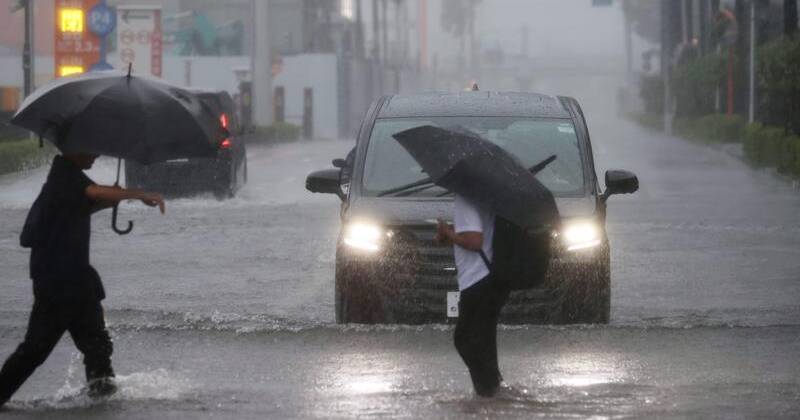
Typhoon Dujuan Kills Four In Japan After Battering Tokyo With Destructive Winds And Torrential Rain
Typhoon Dujuan Japan has left four people dead after the powerful storm slammed into Tokyo and surrounding prefectures, bringing torrential rainfall and destructive winds that caused widespread damage across the region, according to local reports.
Storm’s Impact Across Japan
The typhoon cut electrical power for approximately 50,000 people and forced the suspension of hundreds of flights as it moved across the country. Most evacuation orders were lifted Tuesday as the storm system pulled away from Japan’s eastern coastline, offering some relief after a harrowing weekend.
At the height of the storm Monday, authorities issued urgent warnings describing an imminent threat to life, urging approximately 1.9 million people to relocate to emergency shelters as the powerful weather system bore down on the region.
The four confirmed fatalities resulted from landslides that struck Kanagawa and Chiba prefectures. Public broadcaster NHK reported that six additional people remain missing following the storm’s passage through these areas.
Dujuan carried sustained winds reaching 130 kilometers per hour, roughly 81 miles per hour, with gusts reaching an even more powerful 194 kilometers per hour during the storm’s peak intensity.
Part Of A Broader Pattern Of Pacific Storms
This typhoon represents the latest in a series of powerful storms sweeping through the Pacific region, storms that have grown more intense due to what meteorologists are calling a super El Niño, a phenomenon that has significantly warmed ocean waters and fueled more powerful storm formation throughout the region.
Authorities had previously advised the public to closely monitor weather information as the storm approached. Notably, Dujuan marks Japan’s 25th typhoon of the year, and its arrival coincided with a five-day national holiday period, forcing the cancellation of numerous scheduled events across the country.
Among the disruptions, concerts scheduled for Monday at the Rock in Japan music festival were cancelled entirely, while the Tokyo Game Show, a major video game industry convention, also cancelled its Monday programming due to the severe weather conditions.
Prime Minister Responds While Continuing International Travel
Japan’s Prime Minister Sanae Takaichi offered condolences to those who lost loved ones in the typhoon through a post on social media, before confirming she would proceed with her previously scheduled trip to the United States as planned. She indicated that she had instructed Chief Cabinet Secretary Takehara and Minister Hosono to respond to the crisis with utmost preparedness and urgency, before confirming she had boarded her flight bound for America.
Takaichi is scheduled to address the UN General Assembly in New York on Tuesday and will also meet with US President Donald Trump during her visit, continuing with these diplomatic commitments despite the domestic crisis unfolding back home.
Individual Tragedies Behind The Statistics
The Yokosuka City Fire Department provided the BBC with details about one victim, a woman in her 60s from Kanagawa prefecture who was believed to have been buried alive after a landslide swept through the house where she lived. Following an extensive search conducted by rescue crews, she was ultimately found inside the collapsed home and pronounced dead, according to NHK’s reporting.
In a separate incident, the Sodegaura City Fire Department in Chiba prefecture told the BBC that a man in his 50s had been rescued after becoming trapped while working to clear debris at a landslide site. According to the department, the worker fell into a bamboo thicket alongside heavy machinery equipment during the incident. He was subsequently transported to a hospital, where his death was later confirmed according to local reports. Police are currently investigating the full details surrounding this particular incident.
The Climate Change Connection
Some research suggests Japan has become increasingly exposed to destructive storm systems in recent years, though climate change isn’t believed to be increasing the overall global number of these storms, and could potentially even make them somewhat less frequent in certain regions of the world.
However, as global temperatures continue rising, typhoons that do form are likely to become more intense on average. Warmer ocean waters provide storms with additional energy, which can translate directly into higher wind speeds during storm events. Additionally, because a warmer atmosphere holds greater moisture capacity, these storms increasingly bring heavier rainfall totals when they make landfall.
This particular year, El Niño, the natural weather phenomenon that brings warmer water temperatures to portions of the tropical Pacific, represents another significant contributing factor. While El Niño doesn’t demonstrate a clear, consistent effect on the total number of typhoons forming each season, it can meaningfully influence where typhoons actually form, how strong they ultimately become, and which specific countries end up in their path. Some El Niño patterns may particularly expose Japan to stronger typhoon systems, exactly the kind of scenario that appears to have unfolded with Dujuan.
What Comes Next
The typhoon continues traveling along Japan’s Pacific coastline, currently heading north away from the areas hit hardest during its initial landfall. Given the ongoing nature of the storm’s path and the scope of damage assessment still underway, the full extent of destruction caused by Typhoon Dujuan may not become completely clear until Tuesday, as authorities continue evaluating the storm’s impact across the affected regions.
Author