The Belfast riots that erupted this week have left residents of the city horrified, and for those born and raised in north Belfast, the scenes unfolding on familiar streets carry a particular sting. What began as a response to a brutal attack has spiraled into something darker, fueled in large part by people who have never set foot in the city and who appear to see the chaos as an opportunity.
This is the perspective offered by Belfast journalist Amanda Ferguson, writing from the heart of the unrest. Her account captures both the immediate fear on the ground and a deeper frustration at how far-right figures in England, the United States, and online are seizing on a local tragedy for their own ends.
A Tragedy at the Center of It All
Before anything else, the focus belongs with the victim. Monday night’s knife attack was savage and traumatic, leaving a man with serious wounds. The thoughts of decent people are first and foremost with him and his family as they recover from such a dreadful ordeal.
A 30-year-old has been charged in connection with the attack and is now before the courts. As Ferguson stresses, the justice system must be allowed to do its work and take its proper course. That principle, however, has been trampled by what followed.
When Grief Curdles Into Violence
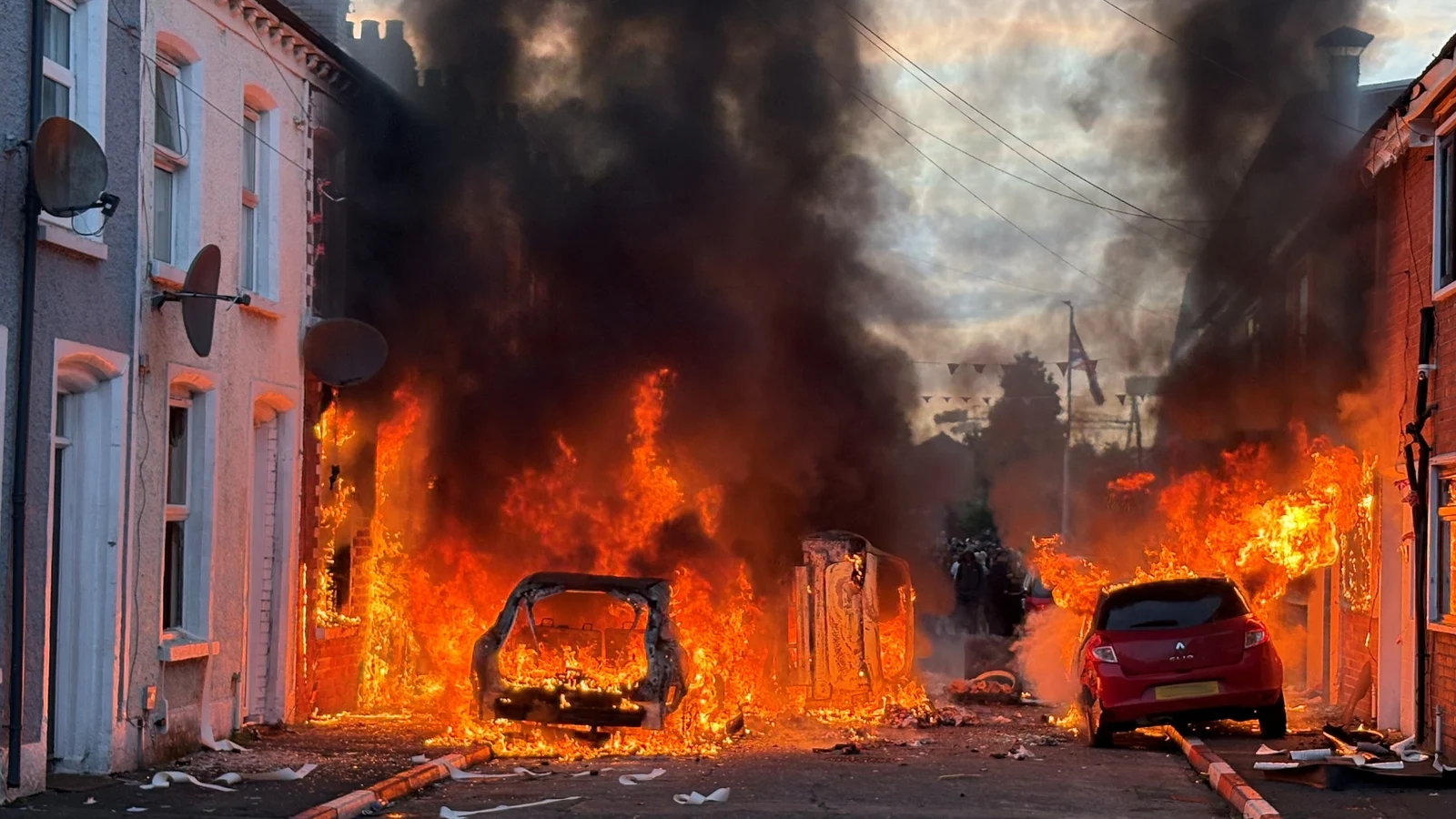
The disorder that swept through Belfast and beyond cannot be justified by any measure. As Ferguson described the scene, emergency services were stretched dealing with properties and vehicles set ablaze, while the city itself braced for trouble.
The signs were there well before nightfall. Businesses shut their doors early and workers headed home ahead of schedule, anticipating that the pleas for calm from police and politicians would go unheeded. Those fears proved well founded. The peaceful demonstrations that some had hoped for quickly gave way to:
- Burning barricades blocking roads
- Bins and debris set alight, sending thick black smoke into the sky
- Police sirens echoing through residential streets
- A helicopter hovering overhead as officers issued instructions to crowds
Even the rain, Ferguson noted, failed to deter those intent on destruction. Driving through her own neighborhood, she found herself confronted by roadblocks near her home, surrounded by the sounds and signs of a city in turmoil.
The cost, she argues, will far exceed the physical damage. Once the ashes are swept away and the roads reopened, the harder reckoning will be with everything the violence has revealed.
Two Sources of Horror
What troubles right-thinking people, in Ferguson’s telling, is not one thing but two. They are appalled by Monday’s knife attack, and they are equally appalled by the ugly, dangerous scenes that have flowed from it.
The unrest has handed a platform to those eager to exploit it. Racists, both online and in person, including some politicians, have used the moment to reveal their true agenda. Far-right online figures and racist elements in England and the United States have latched onto the events to justify spreading their message of hatred.
The bitter irony is that so many of these voices have no connection to the city at all. People who know nothing of Belfast, and who have likely never visited, are using the violence to advance their own narratives. Whether it is politicians speaking out of both sides of their mouths or anonymous online agitators cynically capitalizing on tragedy, the pattern is the same: exploitation dressed up as concern.
The Hypocrisy of the ‘Protectors’
Ferguson reserves particular scorn for those who claim to be acting in defense of women and girls. That crowd, she observes, has thought nothing of hurling abuse at journalists like her, exposing the hollowness of their stated motives.
The result is genuinely frightening. Non-white residents of the city now fear for their safety because of people, online and in the real world, who are eager to spread hate. Watching burning barricades while neighbors live in fear is a deeply depressing sight for anyone who loves the city.
Not the Whole Story of a City
Crucially, Ferguson insists that this disorder does not represent Northern Ireland as a whole. Such violence is not unique to the region, and while local emergency services may be more accustomed to handling it, the same lesson applies here as it does when unrest flares in Cardiff, Dublin, Edinburgh, or London.
Outbreaks of violence in any city are not a reflection of all its people or of the wider society. There is also an uncomfortable truth she acknowledges: for some, this kind of disorder has become a grim recreational pastime, an obscene way to pass a summer evening rather than any sincere expression of grievance.
A Reflection on Irish Identity
The column also carries a pointed reflection on what it means to be Irish. For hundreds of years, Irish people have made their homes across the globe, driven by famine, conflict, economic hardship, love, and sometimes simply the search for better weather.
That history is why an Irish pub can be found in nearly every country, and why so many people around the world proudly claim Irish heritage. Given that legacy of migration and welcome, Ferguson argues, you simply don’t get to be both racist and Irish, even if some are giving it a determined try.
Conversations That Won’t End
In recent days, Ferguson writes, she has had countless discussions about violence, poverty, housing, policing, racism, sectarianism, and more. Those conversations, she makes clear, will continue long after the immediate crisis fades.
As she finished writing, with the rain growing heavier outside, she expressed a hope that travels more on optimism than on experience: that the violence will finally stop.
The Wider Picture
The events in Belfast did not occur in isolation. Far-right and anti-immigration figures called for protests across the United Kingdom after video of the attack spread online, and the suspect’s nationality became a focal point for those seeking to inflame tensions. Police in Northern Ireland have appealed repeatedly for calm and for space to conduct a full investigation, while political leaders have condemned both the original attack and the violence that followed.
For Belfast, a city long familiar with division, the challenge now is to ensure that a single act of violence is not allowed to define it, and that the voices stoking hatred from afar do not drown out the many who simply want their city to heal.
Author