Iran Targets US Bases in Bahrain, Jordan, and Kuwait as Conflict Escalates
The latest round of Iran US strikes has pushed an already volatile conflict into dangerous new territory. Iran’s Islamic Revolutionary Guard Corps (IRGC) announced that it launched attacks on American military installations across the Gulf, including the US Fifth Fleet in Bahrain, an airbase in Jordan, and a base in Kuwait. The strikes were framed as direct retaliation for earlier American attacks on southern Iran, marking another sharp turn in a rapidly intensifying standoff.
The exchange of fire underscores how quickly the situation has deteriorated, with both sides now engaged in open military confrontation rather than the cautious posturing seen in earlier phases of the crisis.
How the Escalation Unfolded
The chain of events traces back to a confrontation over the Strait of Hormuz. According to the US military’s Central Command (CENTCOM), American forces carried out what they described as self-defense strikes against Iran in response to Iranian forces downing a US Army helicopter over the strait.
CENTCOM said those strikes hit Iranian military infrastructure, including air defense systems, ground control stations, and surveillance radar sites. From Washington’s perspective, the operation was a measured answer to a direct attack on US personnel.
Iran, however, viewed the American strikes as an act of aggression and a violation of its sovereignty, setting the stage for the retaliatory barrage that followed.
What Iran Claims It Hit
In statements carried by state media, the IRGC laid out the scope of its retaliation in striking terms. According to Iranian accounts, the operation targeted:
- The US Fifth Fleet in Bahrain
- The Ali Al Salem airbase in Kuwait
- An airbase in Azraq, Jordan, struck with long-range missiles
The Guards said they hit 21 US targets across the region and claimed to have destroyed four of them, including what they described as an F-35 fighter jet hangar and a command-and-control center at the base in Jordan. Iran also said the earlier American strikes had damaged a telecommunications tower in the town of Sirik and destroyed two water tanks there, pointing to civilian infrastructure as part of its grievance.
The IRGC warned that its forces remain fully prepared to deliver what it called a crushing and decisive response to any further US military action, placing responsibility for any escalation on Washington.
A Different Picture From US and Allied Accounts
The reality on the ground appears more contested than Iran’s claims suggest. US officials offered a markedly different assessment of the attacks’ effectiveness.
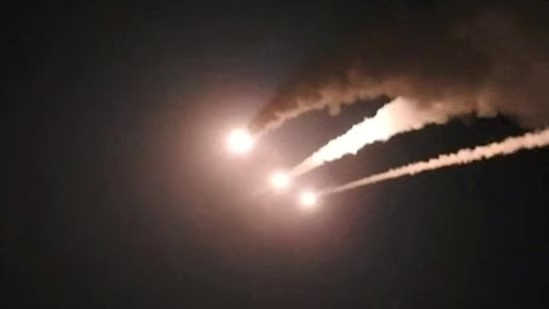
According to a US official cited in reporting, Iran fired at least four ballistic missiles along with several drones at American bases in Bahrain, Kuwait, and Jordan. Crucially, initial assessments indicated that nearly all of the incoming projectiles were successfully intercepted, and there have been no reports of US casualties or significant damage to the bases.
Allied governments reinforced that account. Jordan’s military said it intercepted and shot down five missiles aimed at Azraq, with the operation resulting only in falling shrapnel and no human injuries or material damage. In Kuwait, authorities reported intercepting hostile aerial targets in the country’s airspace, while sirens and air raid alarms sounded in both Bahrain and Kuwait as defenses were activated.
In short, while Iran portrayed the operation as a major success, the available evidence from US and allied sources suggests the attacks were largely blunted.
The Diplomatic Front
Even amid the military exchanges, diplomatic channels have stayed active. Iranian Foreign Minister Abbas Araghchi held separate phone conversations overnight with his counterparts in Saudi Arabia and Turkey, according to Iran’s IRNA news agency.
During those calls, the ministers reviewed the latest regional developments following the US attacks. Araghchi condemned the American military action as a violation of Iran’s national sovereignty and territorial integrity. He also stressed what he called Iran’s inherent right to legitimate self-defense, framing the retaliatory strikes as a justified response to aggression. Araghchi has separately warned that no US attack would be left unanswered.
These conversations highlight how Iran is working to shape regional opinion and rally support even as it trades blows with American forces.
A Brutal Situation With Room to Worsen
Analysts describe the current moment as deeply alarming. Tensions had already spiked to unprecedented levels, and the latest events followed only a brief period of relative calm before the fighting resumed.
The direct nature of the confrontation is what makes this phase especially perilous. Rather than operating through proxies or indirect pressure, Iran and the United States are now engaged with each other directly, which significantly narrows the path toward a diplomatic resolution. Iran’s insistence that water facilities and other infrastructure were struck, combined with its promise of further retaliation, suggests neither side is inclined to step back.
The involvement of multiple Gulf states adds another layer of risk. Bahrain, Jordan, and Kuwait have all now seen American facilities on their soil drawn into the conflict, raising the possibility that additional countries could be pulled in if the escalation continues.
Why This Matters
Beyond the immediate exchange of fire, the broader stakes are considerable. The Strait of Hormuz sits at the heart of this crisis, and any sustained conflict there carries implications for regional stability and global commerce that extend far beyond the battlefield.
For now, the picture is one of a brutal and fast-moving situation that carries a real risk of further escalation. With both sides signaling readiness to continue, and with US forces stationed across several Gulf nations, the coming hours and days will be critical in determining whether the conflict expands further or whether diplomatic efforts can begin to pull it back from the edge.
A Note on a Developing Story
Because this is an active and rapidly evolving conflict, details remain fluid and accounts from the different parties often diverge, particularly regarding the success of the strikes and the extent of any damage. Iranian claims of destroyed targets contrast sharply with US and allied reports of widespread interceptions and no casualties. Readers should treat early figures with caution, as assessments are still developing and the situation may change significantly in a short span of time.
Author