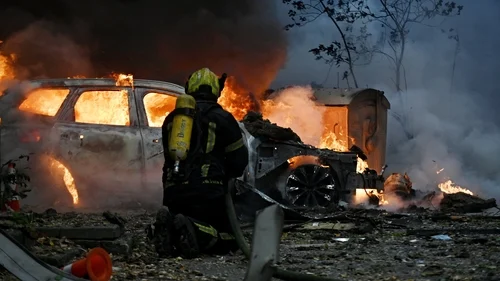
Russian Strikes on Kyiv Intensify After Deadly Drone Attack on National Academy of Sciences
Russian strikes on Kyiv resumed in the early hours of Tuesday, just hours after a drone slammed into the National Academy of Sciences in the heart of the Ukrainian capital, killing at least two people. The back-to-back attacks have heightened fears that Moscow is widening its campaign against civilian and economic targets, using a new generation of faster drones that Ukraine is struggling to stop.
Fresh Explosions Rock the Capital
Blasts echoed across Kyiv early on Tuesday morning. Mayor Vitali Klitschko reported that fragments from a missile had landed in the courtyard of one building, while a fire broke out at another location elsewhere in the city.
The latest wave of attacks comes as Russia increasingly relies on jet-powered drones, which fly higher and faster than older propeller-driven models. That shift is making it much harder for Ukrainian air defences to keep the skies over the capital safe.
A Historic Building in Flames
On Monday, a drone struck the National Academy of Sciences, located in Kyiv’s historic centre. Emergency services confirmed two deaths, with one victim’s body pulled from the debris later that evening.
Footage circulating online appeared to capture the moment of impact. A fast-moving drone could be seen diving sharply into the building before exploding, sending a plume of smoke into a clear sky. As bright orange flames spread across part of the structure, people were seen leaning out of windows, trying to escape the fire.
The academy sits in a sensitive part of the city, close to:
- The German Embassy
- A historic cathedral
- The national opera house
- Several government buildings
A Survivor’s Account
Volodymyr Horbulin, a former secretary of Ukraine’s National Security and Defence Council, was working inside the academy when it was hit. He told public broadcaster Suspilne that his assistant, who had been near the building, was killed in the attack. Horbulin himself suffered minor injuries.
Outrage From Ukrainian Officials
The academy condemned the strike in a statement, describing it as an act of Russian terror and barbarism directed at civilians who were simply going about their working day.
Foreign Minister Andrii Sybiha also reacted angrily, accusing Moscow of cynicism for targeting a scientific institution during office hours. He argued that Russia is intentionally testing how far it can go before the international community pushes back, and he called on Ukraine’s allies to supply more air defence systems.
The Jet Drone Challenge
The rise of jet-powered drones has become one of the most pressing problems for Ukraine’s military.
Zelenskyy Admits Air Defences Are Struggling
President Volodymyr Zelenskyy said Russia also struck a medical facility in Kyiv on Monday. Across the country, he said, at least nine people had been killed and more than 80 wounded in drone attacks.
In his nightly video message, Zelenskyy acknowledged that Ukraine was still finding it hard to counter the newer, high-altitude jet drones. He explained that new interceptors are being tested and are already in use by some combat units, but said further improvements are needed before they can be deployed widely and effectively. He added that developers are being pushed to work faster.
The numbers he shared highlight the scale of the problem:
- Russia launched 120 drones at Ukraine on Monday
- 90 of them were jet-powered rather than propeller-driven
- Only 57 percent of the jet drones were intercepted
That interception rate leaves a significant number of drones reaching their targets, which explains the rising toll on cities like Kyiv.
A Widening List of Targets
Officials said Monday’s attacks on Kyiv also hit a pharmaceutical company and several petrol stations. Beyond the capital, strikes damaged civilian sites, businesses and communications networks across multiple regions.
Deadly Attacks Beyond Kyiv
The violence stretched well beyond the capital:
- In Dnipro, a drone strike on a business centre killed three people and wounded 19
- In Synelnykove, southeast of Dnipro, one person died when a logistics office was hit
- In Zaporizhzhia, an attack on infrastructure left 32 people injured
Communications Networks Under Fire
Reporting from Kyiv, Al Jazeera’s Jonah Hull described a relentless series of strikes on economic targets that has continued day and night for nearly a week.
He noted that data centres and digital infrastructure are increasingly being hit. Over the weekend, Russia struck both Kyivstar, Ukraine’s largest mobile network provider, and Vodafone Ukraine, the second largest.
According to Hull, the government is preparing for a worst-case scenario in which communications across the country could be knocked out entirely. He added that the recent attacks have placed Kyiv squarely at the centre of the conflict once again.
Ukraine Hits Back
Ukraine has not remained on the defensive. It has stepped up its own long-range attacks on Russia, aiming to weaken the economic foundations of Moscow’s war effort. Its targets have included oil refineries and even online retailers, as Kyiv tries to cut into Russian revenues and erode public support for the war.
On Monday, Zelenskyy said Ukrainian forces had struck oil facilities in Russia’s Krasnodar region, along with two defence manufacturing plants.
Both Moscow and Kyiv continue to deny that they deliberately target civilians.
What This Means for Ukraine
The strike on the National Academy of Sciences has become a powerful symbol of how the war is evolving. Russia’s growing use of faster drones, combined with attacks on communications, energy and business infrastructure, suggests a strategy aimed at wearing down Ukraine’s economy and daily life.
For Ukraine, the immediate priority is closing the gap in its air defences. Until new interceptors can be produced and deployed at scale, cities like Kyiv will remain vulnerable. And with allies being urged once more to send additional support, the coming weeks may prove critical in deciding whether Ukraine can adapt quickly enough to this new phase of the war.
Author