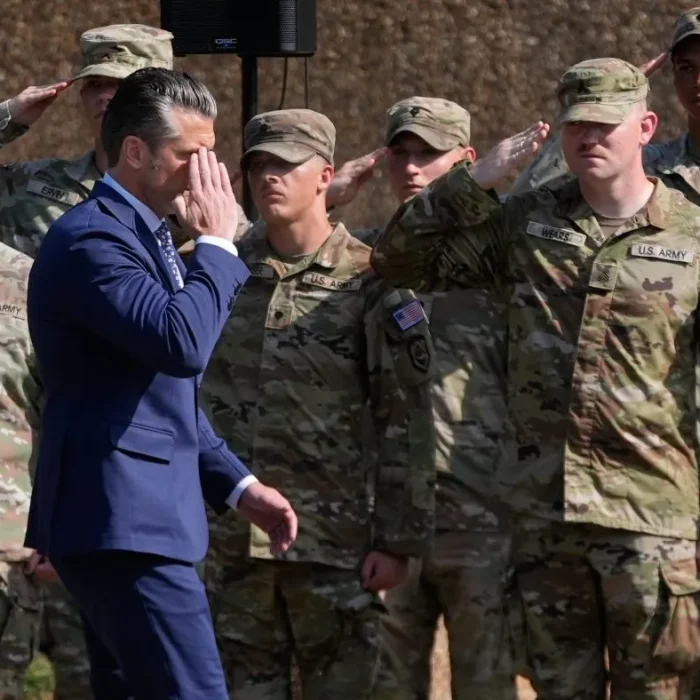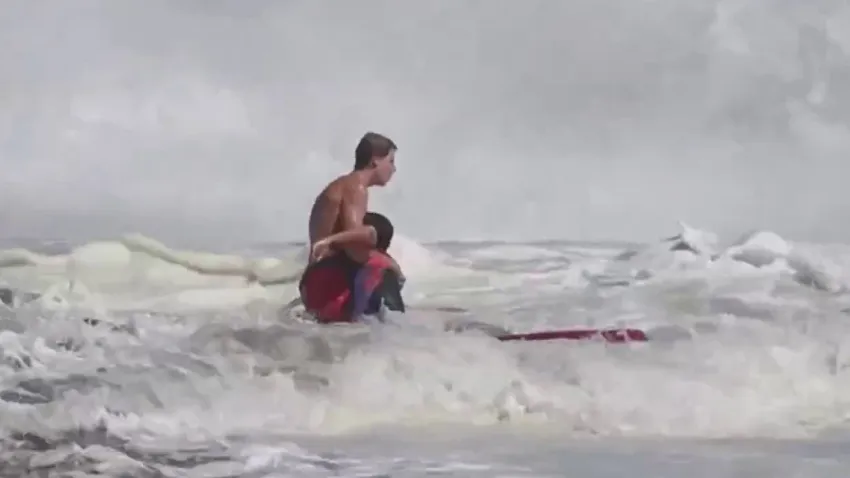
The Seabright Beach rescue that captured attention across the country last month ended where few beach stories do — in the Oval Office. President Donald Trump hosted 16-year-old lifeguard Ryder Williams and 10-year-old Nathaniel Rai to recognize the teenager who pulled the boy from the surf in Santa Cruz, California.
Video of the rescue spread rapidly online. The footage shows Nathaniel gripping Williams tightly while the young lifeguard fights the water, working to bring them both back toward the sand as waves keep arriving.
How It Happened
Williams described a sequence that unfolded in seconds. He spotted the boy lose his balance in water that reached only to the ankles — the kind of depth most people assume is harmless.
He called it in over the radio, dropped both the radio and his sunglasses at the foot of his tower, and sprinted toward the child.
Conditions made the standard approach impossible. Williams said the water was too rough for him to get a rescue tube secured around Nathaniel. He held onto the boy directly instead, absorbing wave after wave. At some point during that struggle, Nathaniel went limp in his arms.
A second lifeguard, Aaron Bohnen, entered the water and helped bring the boy to shore.
The Boy’s Memory of It
Nathaniel told The Associated Press that most of what happened is simply gone from his memory. He recalls the wave that knocked him off his feet, and then nothing until he was on the beach with lifeguards working around him.
He remembers what he said afterward, though. He told Williams he was grateful to him for saving his life.
From Viral Clip to White House Invitation
Trump noticed the footage as it circulated online and posted about it on Truth Social on July 28. He described plans to bring the young man and his family to the White House, possibly along with the boy he rescued, to present a high civilian honor. He called Williams very brave and said he deserved the recognition.
Eric Trump also weighed in publicly, describing the rescue as representing the best of the country.
The Oval Office visit followed, bringing rescuer and rescued into the same room in front of cameras once again — under considerably calmer circumstances.
Williams Keeps Deflecting the Praise
Through all of it, the teenager has resisted the hero framing. He has repeatedly described the rescue as ordinary work.
In a statement after the incident, Williams said he was grateful for the chance to return a child safely to his family. He called it his job and said he loves doing it. He also directed attention to his colleagues, thanking fellow lifeguards who carry out rescues just like his one every single day.
That last point was not modesty for its own sake. California State Parks reported that lifeguards in the Santa Cruz District completed 34 rescues over the same weekend. Powerful surf, warm temperatures and packed beaches combined to create genuinely hazardous conditions along the coast.
Why Shallow Water Deceives People
The detail that stands out in Williams’s account is where the trouble started. Nathaniel was standing in ankle-deep water when he went down.
That is not unusual. Several factors make shoreline conditions far more dangerous than they appear:
- Shore break dumps waves directly onto shallow sand with enough force to knock adults over.
- Backwash pulls hard as water retreats, dragging footing out from under swimmers.
- Rip currents can form close to shore and carry people seaward quickly.
- Children have less mass and lower center of gravity control, so a wave that staggers an adult can sweep a child away entirely.
Once a child loses footing in moving water, regaining it is far harder than most parents expect, particularly when successive waves arrive before there is any chance to stand.
The Value of Staffed Beaches
The rescue also illustrates something the 34-rescue weekend statistic makes concrete: professional lifeguards prevent a large number of drownings that never become news stories.
Most of those interventions involve no cameras and no viral clip. A guard notices a swimmer drifting, redirects a family away from a rip, or reaches someone before panic sets in. The rescue that made headlines was distinguished largely by the fact that somebody happened to be filming.
Williams appeared to understand that dynamic better than most of the people praising him. His response to national attention was to point at everyone else wearing the same uniform.
A Story With a Rare Ending
Drowning stories usually do not end this way. This one produced a boy who went home to his family, a teenager who did his job under difficult conditions, and a second lifeguard who arrived when help was needed.
The White House ceremony added recognition. The rescue itself had already supplied the outcome that actually mattered.
Author
-
Lucienne Albrecht is Luxe Chronicle’s wealth and lifestyle editor, celebrated for her elegant perspective on finance, legacy, and global luxury culture. With a flair for blending sophistication with insight, she brings a distinctly feminine voice to the world of high society and wealth.