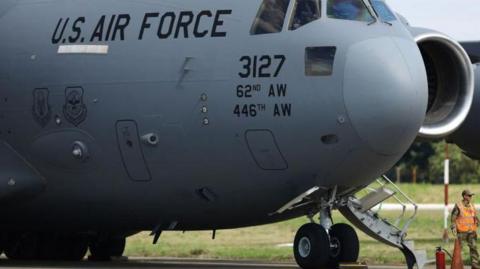
ICE third-country deportations have expanded sharply over the past month, with internal government records obtained by CBS News showing that more than 100 people were flown to eight African nations across three flights during a 10-day stretch in August. Many of those removed had never set foot in the countries where they were left.
Who Was on the Flights
The passengers were a mix of nationalities. According to the documents, they included men and women originally from Afghanistan, Cuba, Iran, Nepal, Nicaragua, Turkey and Venezuela. Others were African nationals sent to countries other than their own.
Their destinations were Burundi, Cameroon, the Central African Republic, Equatorial Guinea, Eswatini, Liberia, Rwanda and Sierra Leone.
Several details make the cases unusual. A number of the deportees had lived in the United States for many years. Some have serious medical conditions. Others had previously been granted legal protection preventing their return home because immigration judges accepted they faced persecution, torture or death there. In many instances, the only offenses on record were immigration-related.
The flights fall under a growing set of bilateral arrangements in which Washington pays or otherwise compensates foreign governments to accept people it wants to remove.
Accounts from the Liberia Flight
On Sunday, the New York Times published interviews with 10 people recently deported to Liberia. Each had spent months in ICE detention before boarding a flight lasting roughly 14 hours.
Their descriptions of the journey are severe. They said they were restrained at the wrists, ankles and waist for the duration. Requests to use the bathroom were denied, leaving people to soil themselves. When some objected to being sent to a country where they knew no one, they said officers struck them, forced them to the floor and dragged them by their restraints, leaving marks on their wrists and bruising on their necks.
Leonardo Sánchez, 49, from Cuba, had been shielded from removal to the island by an immigration judge’s order. Years of surgery and injury had left his abdomen in fragile condition. He said the waist chain pressed directly into the damaged area during the flight.
He described crying from the pain like a child and said his appeals to loosen the restraint or use the restroom went unanswered.
Carlos Téllez-Sanchez, a Venezuelan sent to Liberia, said the officers treated the group as something less than human and that there was no recourse available to them.
Several interviewees spoke only on condition of anonymity, citing fear of reprisal from either US or Liberian officials.
What Happened on Landing
Six of the deportees refused to leave the aircraft in Monrovia. Four of them spoke to the Times. They said officers hauled them out by their handcuff chains, pinned them down and pressed knees into their chests.
Sánchez said an officer knelt on his injured abdomen while others shouted warnings that he could die.
The six were then put back on the plane and flown to Equatorial Guinea, where they were removed from the aircraft. They are reportedly being held in a converted hotel said to belong to the family of President Teodoro Obiang Nguema Mbasogo. At least one person in the group requires a colostomy bag.
ICE has not publicly responded in detail to these specific allegations, which come from deportee testimony rather than independent observation.
The Money Behind the Agreements
Liberia has agreed to take in as many as 1,200 third-country deportees over the coming year. Its government says it is not being paid directly, though the United States has provided five million dollars for migration management programs tied to the arrangement.
The removals follow a surge in enforcement activity. Nearly 50,000 arrests were recorded in July, the highest single month of Trump’s second term, and more than half of those detained had no prior criminal record.
Sending People Where Americans Are Told Not to Go
One case highlights the tension in the policy. A young Afghan man, whose relatives worked alongside US forces during the two-decade American presence in Afghanistan, had been granted protection because of the risk of Taliban reprisal. He was sent instead to the Central African Republic.
The State Department advises US citizens against travelling there at all, citing armed conflict, crime, kidnapping and instability. Rwanda, another destination, carries a Level 3 advisory urging travellers to reconsider, with a blanket warning against approaching within 10 kilometres of the border with the Democratic Republic of the Congo.
Critics point to the contradiction directly: the same government warning its own citizens away from these places is delivering non-citizens there under restraint.
Equipment Purchases Draw Scrutiny
Separate procurement decisions have added to the controversy.
- ICE awarded a 16.7 million dollar no-bid contract to Compliant Technologies for 6,000 electric-shock gloves, priced at 2,495 dollars each
- The device operates as a standard glove until activated, then delivers a painful shock on skin contact
- Procurement language permits use against people who are actively or passively resisting, including during arrests, transports and protests outside facilities
- Similar devices have been deployed in jails and, reportedly, against children in Omaha public schools
- A wrongful-death suit alleges Kentucky jailers shocked Johnathon Mansfield 27 times with the device, along with 13 Taser discharges, before he went into cardiac arrest and died in October 2024
The agency is also preparing to spend between one and two million dollars on Boston Dynamics Spot robots. A Homeland Security notice describes their role as inspection, situational awareness and hazard assessment across border enforcement and policing.
A Contrast in Spending
Set against those purchases is a decision that has drawn its own criticism. Federal funding for legal representation has been eliminated for an estimated 26,000 unaccompanied immigrant children, leaving many to face immigration proceedings without a lawyer.
Supporters of the administration argue that aggressive removals are necessary to enforce existing law and deter unlawful entry, and that third-country agreements are a legitimate diplomatic tool when home countries refuse repatriation. Opponents counter that transferring people who hold judicial protection into unstable states, in restraints, sidesteps the courts entirely. That argument is now heading toward litigation, and the outcome may determine how far the practice can expand.
Author