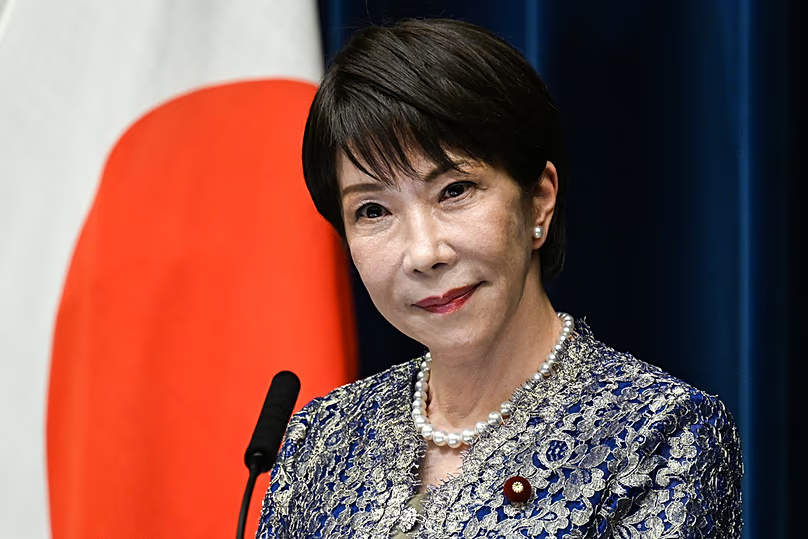
Japan permanent residency has just become much harder to obtain. On Thursday, the government rolled out tougher conditions for foreigners hoping to settle in the country for good, marking a major step in Prime Minister Sanae Takaichi’s drive to tighten immigration controls.
A Promise Delivered
Takaichi, the conservative leader who won a historic supermajority in February, made immigration reform a centerpiece of her campaign. The new residency rules are among the first clear signs that she intends to keep that pledge.
The changes will be introduced in stages. They do not, however, force anyone who already lives in Japan to leave. What they do is raise the bar for people who want to make the country their permanent home.
What Has Changed
Until now, the guidelines never set precise thresholds for income, pension contributions, or language ability. That vagueness is gone. Applicants will now need to meet several concrete standards:
- Prove an annual income above the average level
- Show they can handle casual conversations in Japanese
- Demonstrate an understanding of the country’s social rules
- Show expected pension benefits equal to someone who has paid into the system for 30 years
Alongside these conditions, the application fee jumps twenty-fold, from 10,000 yen to 200,000 yen. That is roughly 56 euros before and 1,116 euros after.
A Last-Minute Rush
The fee increase took effect immediately, and the reaction was visible. At an immigration office in central Tokyo, hundreds of people lined up in the hope of filing their paperwork before the price went up.
Among them was Yujie Chono, a 22-year-old university student born in the United States. He had waited five hours, and he spoke fluent Japanese as he explained his thinking. He said he could understand why some worry that too many newcomers might dilute Japan’s distinct culture. But he also pointed out that, with a low birth rate and a shrinking population, the country has little choice but to welcome foreigners.
His view captures the tension at the heart of this debate.
Why Immigration Has Become So Sensitive
Japan faces a rapidly ageing society and labour shortages across many industries. Even so, resistance to immigration has been growing.
Takaichi has acknowledged public unease. In a lengthy post on X, she said that as the number of foreign residents rises, some citizens feel anxious and see unfairness. She said her aim is “orderly coexistence” between Japanese citizens and foreign nationals.
Several factors have fed that mood:
- Programmes designed to bring in international workers have raised concerns among some voters
- Anti-immigration sentiment has spread widely on social media
- False claims have circulated, including that a large share of welfare payments goes to foreigners and that they make streets less safe
Politics has played a role too. Foreigners were a prominent issue in last year’s upper house election, which saw the “Japanese-first” Sanseito party surge. The party has described immigration as a “silent invasion.”
Tougher Rules Are Part of a Wider Pattern
The residency changes follow earlier moves. Last year, the ruling Liberal Democratic Party pushed for stricter regulations on business manager visas. Entrepreneurs who fail to meet the new conditions will have to leave the country.
Taken together, these steps point to a broader shift toward a more selective immigration system.
Business Leaders Urge a Different Path
Not everyone agrees with this direction. Many experts and business leaders argue that Japan must bring in more foreign workers simply to keep its economy going.
The Nikkei business daily made that case in a recent editorial. It argued that Japan should stop treating foreigners as a temporary labour supply and should encourage long-term settlement instead. Its suggestions included expanding Japanese-language education and improving how foreign residents are treated.
That perspective sits uneasily alongside the new rules, which could discourage some skilled workers from putting down roots.
What Happens Next
The immediate effect is likely to be fewer applications, since the higher fee and stricter criteria will put off some candidates. Over time, the real test will be whether the policy eases public concern without worsening labour shortages.
Key questions to watch include:
- How many applicants fall short of the income, pension, and language standards
- Whether employers report difficulty keeping foreign staff
- Whether further restrictions follow in other visa categories
The Bottom Line
Japan is trying to balance two competing realities: a population that is getting older and smaller, and a public that is increasingly wary of rapid change. Takaichi’s new residency rules lean toward control and selectivity. Whether that approach protects social harmony or leaves the country short of the people it needs will become clearer in the years ahead.
Author