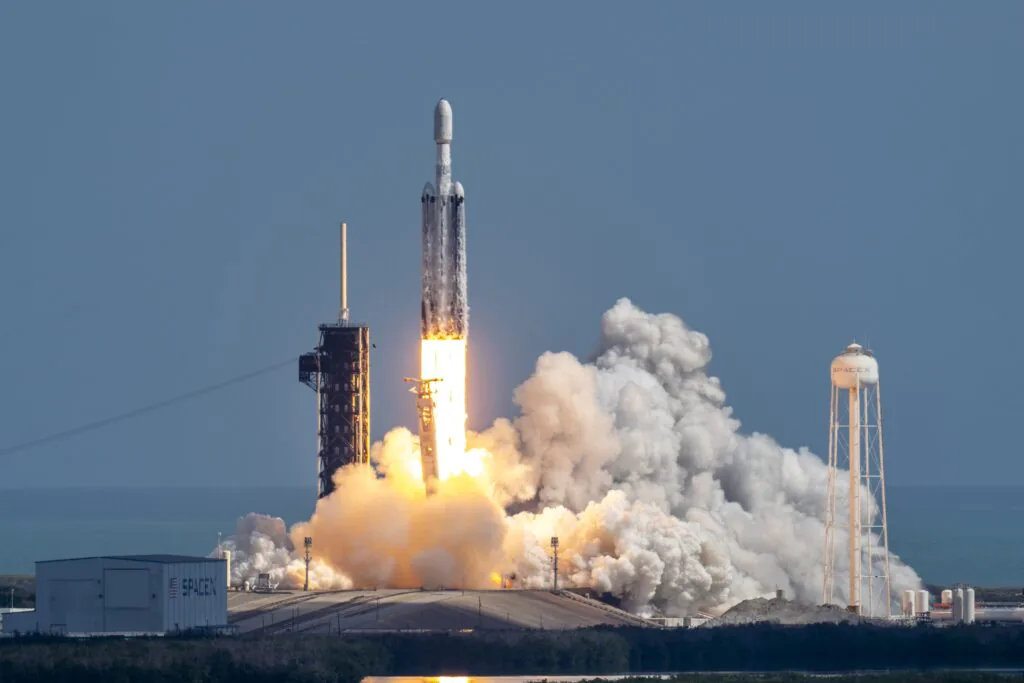
SpaceX Falcon Heavy launch made headlines once again as the powerful rocket roared off the launch pad on April 29, sending the massive ViaSat-3 F3 communications satellite into orbit. This mission marked the 12th flight of the Falcon Heavy since its debut in 2018 and added another major milestone to the rocket’s growing legacy. With its successful deployment, Viasat closes one chapter of a decade-long project while opening new possibilities for global connectivity, especially across the Asia-Pacific region.
A Powerful Liftoff From Launch Complex 39A
The mission began at 10:13 a.m. EDT (1413 UTC) when the 27 Merlin engines of the Falcon Heavy roared to life, generating around 5 million pounds of thrust. The 70-meter-tall rocket lifted away from Launch Complex 39A in Florida with the kind of fiery spectacle that SpaceX fans have come to love.
Roughly 2.5 minutes after liftoff, the two side boosters — tail numbers B1072 and B1075 — separated from the center core. Both performed a precise boost-back burn lasting over a minute to set themselves on a return path to Cape Canaveral Space Force Station.
The center core, designated B1098, continued upward for another 90 seconds before the second stage separated. From there, the upper stage began the first of three engine burns over a five-hour mission to carefully place the ViaSat-3 F3 satellite into a geosynchronous transfer orbit.
Successful Booster Landings on Earth
Less than eight minutes after launch, the two side boosters made their dramatic returns. They reignited their center engines and touched down at Landing Zone 2 and Landing Zone 40 at Cape Canaveral. This mission was particularly notable because it marked the first time a Falcon Heavy rocket used SpaceX’s newest landing pad at Space Launch Complex 40.
As is typical for most Falcon Heavy missions, SpaceX did not attempt to recover the center core. The center booster was expended to give the mission the extra performance needed to send the heavy satellite into its required orbit.
A Long, Carefully Planned Journey for the Satellite
After the booster separation phase, the Merlin Vacuum engine on the upper stage was scheduled to perform another ignition before releasing the satellite. The deployment occurred nearly five hours after liftoff, completing one of the longer Falcon Heavy missions to date.
To make this extended flight possible, the upper stage was equipped with an additional thermal protection layer. This layer ensured that the rocket-grade kerosene fuel did not freeze during the long coasting phase between engine burns. Coasting through space for several hours requires careful engineering, and SpaceX has clearly continued to refine the Falcon Heavy’s capabilities for these complex missions.
An Emotional Milestone for Viasat
The ViaSat-3 F3 satellite carries deep meaning for the team that built it. It is the second satellite in the constellation to ride aboard a Falcon Heavy rocket and the third and final member of the ViaSat-3 series. The very first satellite, ViaSat-3 Americas, launched on a Falcon Heavy back in 2023.
For the engineers and leaders behind the project, this mission marks the close of a remarkable journey that started more than a decade ago. Dave Abrahamian, Viasat’s Vice President of Satellite Systems, captured this sentiment well during a pre-launch interview, noting how much has changed since the program first began.
He pointed out that ten years ago, Viasat had only a handful of satellites in orbit. Since then, the company has launched two ViaSat-3 satellites, merged with Inmarsat, and now reaches another major milestone with the third ViaSat-3 satellite in space.
Where Will the Satellite Go Next?
After being released by the Falcon Heavy upper stage, the ViaSat-3 F3 satellite will spend the next two months in a careful orbit-raising process. Once finished, it will settle into its operational location at 155.58 degrees East along the equator, where it will begin its long-term mission.
This satellite is specifically aimed at the Asia-Pacific region, an area where demand for high-speed connectivity continues to rise sharply. The ViaSat-3 F3 alone is expected to add more than one Terabit per second (Tbps) of capacity to Viasat’s global network — an enormous boost for users in the region.
Why This Matters for Asia-Pacific Connectivity
Demand for fast, reliable, and flexible internet service has skyrocketed across Asia-Pacific in recent years. Airlines, businesses, and consumers all rely on satellite connectivity for everything from in-flight Wi-Fi to remote operations.
Many airline customers in the region have been eagerly waiting for this satellite to come online so they can offer better service to their passengers. The improved network capacity is expected to make a noticeable difference for travelers and operators alike.
Abrahamian highlighted two major strengths of the ViaSat-3 constellation: huge total capacity and the flexibility to allocate it where it’s needed most. Unlike older satellites such as ViaSat-1 or Inmarsat’s fleet, the ViaSat-3 satellites can shift capacity dynamically rather than being limited to fixed beam locations and frozen spectrum allocations.
Phased Array Technology Sets ViaSat-3 Apart
One of the biggest reasons ViaSat-3 satellites can offer such flexibility is their use of phased array antenna technology. This advanced system allows the satellite to form beams wherever they’re needed, place multiple beams in high-demand areas, and adjust spectrum allocation in real time.
This dynamic ability solves one of the biggest issues with traditional satellites — trapped capacity. With older systems, one beam could be overloaded with users while another beam in the same satellite remained nearly empty. ViaSat-3 changes this by following demand wherever it appears within the satellite’s field of view.
For users on the ground, this means faster speeds, fewer service disruptions, and a stronger overall experience.
A Strong Future for Viasat and SpaceX
The successful launch of the ViaSat-3 F3 satellite represents both the end of a decade-long project for Viasat and the start of a new era of high-capacity global connectivity. With all three ViaSat-3 satellites now in orbit or on the way to their final positions, the network is set to deliver some of the most powerful and flexible satellite communications ever made.
For SpaceX, the mission adds another big achievement to the Falcon Heavy’s resume, reinforcing the rocket’s role as a vital workhorse for heavy and high-energy missions. As more demanding missions emerge in the years ahead, Falcon Heavy is likely to remain an essential part of the global launch landscape.
Final Thoughts
The latest SpaceX Falcon Heavy launch is more than just another mission. It marks the completion of a major milestone for Viasat, the beginning of upgraded service for millions of users in the Asia-Pacific region, and another reminder of how far modern spaceflight has come. With ViaSat-3 F3 now successfully on its way to its final orbit, the world will soon see the impact of these new capabilities — from better in-flight Wi-Fi to stronger global communication networks. As space technology continues to advance, missions like this one are paving the way for a more connected future.
Author