Darkness faster than light may sound like the title of a sci-fi film, but it has just become real science. Researchers at the Technion – Israel Institute of Technology have confirmed a fascinating 50-year-old prediction: tiny dark points within light waves can actually move faster than the waves themselves. This breakthrough not only resolves a long-standing physics puzzle but could also push atomic-scale imaging far beyond its current capabilities.
Strange Dark Spots Inside Light Waves
The discovery centers on something called optical phase singularities. These are tiny vortices that form within light waves, where the wave’s amplitude drops completely to zero. In simpler terms, they are pinpoints of pure darkness embedded inside a beam of light.
Tomer Bucher, a member of the research team, describes them as “points of complete darkness embedded within the light field.” Although they sound mysterious, these singularities behave like real physical structures, and their movements have intrigued physicists for decades.
In the 1970s, well-known physicists John Nye and Michael Berry theorized that these dark points could travel faster than the light waves containing them. The idea was incredible — but for nearly fifty years, no one had been able to observe and measure this behavior directly. Until now.
A Tiny World With Huge Implications
To finally test this prediction, the Technion team didn’t experiment with beams of light traveling through vacuum. Instead, they explored optical phase singularities inside flakes of hexagonal boron nitride (hBN). This is a remarkable 2D material that’s incredibly thin and has unique optical properties.
When light enters hBN, it transforms into something called polaritons. These are hybrid particles that form when photons interact with electrons inside the material. According to Bucher, polaritons can be thought of as either extremely slow light waves or extremely fast sound waves, traveling about 100 times slower than the speed of light in a vacuum.
This slower behavior was actually a benefit for the experiment. Slower waves give scientists more time to study the rapidly evolving processes happening inside them.
Catching Light at the Edge of Time and Space
Even with the slower polariton speeds, observing what happens within a single cycle of light is no easy task. The team needed extremely advanced equipment to watch these dark singularities move and shift.
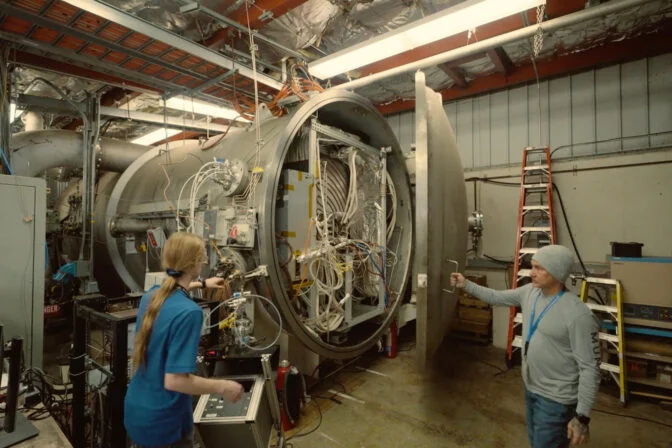
They used a modified ultrafast transmission electron microscope (UTEM), combined with a precision laser and advanced opto-mechanical tools. Using a method called free-electron Ramsey imaging, they achieved an extraordinary level of detail — 20 nanometers in space and just 3 femtoseconds in time.
For perspective, a femtosecond is one quadrillionth of a second. This means the team could observe events happening on a scale almost impossible to imagine, capturing the inner workings of light itself.
Decoding the Hidden “Singular Skeleton”
The next challenge was understanding the chaotic, swirling patterns they recorded. To make sense of the data, the team developed sophisticated computational algorithms. These tools allowed them to extract the precise amplitude and phase of the light-matter waves, revealing what Bucher calls a hidden “singular skeleton.”
They also created automated tracking systems that could follow dozens of singularities at once, mapping their precise paths through space and time across massive datasets.
What emerged from this analysis was nothing short of remarkable.
Singularities Racing Faster Than Light
When two phase singularities with opposite charges came close, they annihilated each other — much like matter and antimatter. But before vanishing, the singularities accelerated to extreme speeds, surpassing even the speed of light in a vacuum.
This might sound like it breaks the laws of physics, but it doesn’t.
Einstein’s theory of special relativity allows for this because singularities are massless and carry no energy or information. They’re more like patterns inside a wave than physical particles. Bucher describes the result as a beautiful paradox, where slower light-matter waves end up hosting features that “race” across their surface at impossible, superluminal speeds.
It’s a striking reminder of how strange and counterintuitive the world of physics can be.
A “Bad Cavity” That Led to a Breakthrough
Interestingly, this discovery happened almost by accident. The team originally set out to study a different topic — high-resolution light-matter interactions in high-quality hBN cavities. The samples for the experiment were prepared by Hanan Herzig Sheinfux of Bar-Ilan University, who had developed them while working with Frank Koppens at ICFO in Barcelona.
Ironically, the sample that turned out to be the heart of this discovery was originally considered a “bad” cavity. But while reviewing the raw data, researcher Arthur Niedermayr noticed something unusual: patterns that looked like multiple dark singularities moving around.
This discovery prompted the team to pivot completely. They reconstructed the full phase and amplitude information from their measurements, then assembled a temporally aligned movie that allowed them to watch the singularities frame by frame.
Tracking these dark points led them straight to the half-century-old predictions made by Nye and Berry.
Connecting Theory to Reality
When the researchers compared their experimental results to theoretical models — including a 1974 paper by Nye and Berry, and a follow-up study by Berry and Mark Richard Dennis in 2000 — the match was remarkable.
The new measurements aligned beautifully with the old predictions, validating decades of theoretical work and adding new layers of understanding to the science of light.
Expanding the Theory Even Further
The team didn’t stop at confirmation. They expanded the original theory to describe the full distance-velocity behavior of phase singularities. Bucher explains that this updated framework is universal, meaning it should apply not only to light but also to other types of wave systems.
That includes:
- Superfluids
- Superconductors
- Acoustic waves
- Other complex wave-based systems
In other words, this discovery could deepen our understanding of topological defects across many areas of physics, far beyond optics alone.
Real-World Applications That Could Change Imaging Forever
While the science is fascinating on its own, the potential applications are even more exciting. According to Bucher, these singularities could be used to:
- Advance super-resolution microscopy
- Encode high-density information using orbital angular momentum of light
- Improve the accuracy of atomic-scale imaging
He also points out that the analytical methods developed by the team could help reduce annoying artifacts in electron microscopy, including the so-called “bee-swarm” effect that has long troubled scientists. With these improvements, atomic-scale imaging could push into territory previously thought impossible.
What Comes Next for the Research Team
The team’s work, published in Nature, is just the beginning. Bucher and his colleagues plan to explore even more advanced topics, including:
- 3D line singularities
- Higher-order topological defects
- Optical skyrmions in real time
- Topological phases in other 2D materials
They are also developing near-field tomography techniques aimed at capturing the full 3D dynamics of complex waves. If successful, this could become a major milestone in electron microscopy and open up entirely new research areas.
A Discovery That Reshapes Our Understanding of Light
This breakthrough represents more than just a confirmation of a 50-year-old theory. It’s a reminder that even the most fundamental things — like light itself — still hold secrets we haven’t fully explored. By pushing imaging technology to its physical limits, the Technion team has revealed something extraordinary hidden within everyday light waves.
The idea that darkness can move faster than light may seem impossible, but it shows just how rich and surprising the universe of physics really is. Discoveries like this remind us that science is constantly evolving, and that even the smallest details — like tiny dark spots in a beam of light — can reshape our understanding of reality.
Final Thoughts
The confirmation that darkness can travel faster than light is a stunning blend of theory, technology, and curiosity. With ultrafast electron microscopes, sophisticated algorithms, and the unique properties of 2D materials, scientists have finally seen something physicists once only imagined.
As researchers continue exploring the strange behaviors of optical phase singularities, the impact of this discovery is likely to grow. From super-resolution imaging to advanced data encoding and even deeper insights into the nature of waves, this study marks the beginning of a new chapter in physics — one where darkness, surprisingly, plays a leading role.
Author