US Troop Withdrawal from Germany: Pentagon Pulls 5,000 Soldiers as Trump-Merz Tensions Boil Over
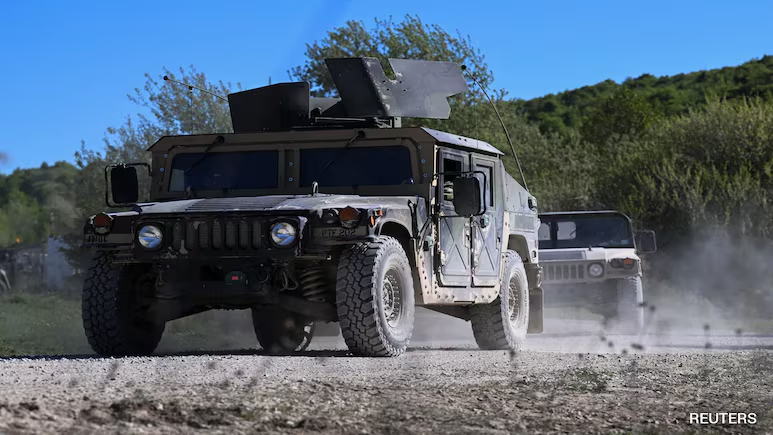
The US troop withdrawal from Germany is officially underway. The Pentagon has confirmed that roughly 5,000 American service members will be pulled out of the country in the coming months, marking one of the most significant shifts in transatlantic military posture in recent years. The decision lands at a moment of rising friction between President Donald Trump and German Chancellor Friedrich Merz, with the two leaders openly clashing over how to handle the unfolding conflict involving Iran.
Pentagon Confirms the Drawdown
Speaking to Fox News Digital, chief Pentagon spokesman Sean Parnell verified the order, stating that the Secretary of War has formally directed the redeployment. According to Parnell, the move follows an in-depth assessment of America’s defense footprint across Europe and reflects current operational realities on the ground.
The withdrawal is expected to roll out gradually, with completion projected within the next six to twelve months. Officials describe it as a strategic recalibration rather than an abrupt pullback, though the timing has raised eyebrows among defense analysts and European partners alike.
Why Germany Matters to the US Military
Germany has long been the backbone of American military operations across Europe. Around 38,000 US troops are currently based in the country, with US European Command headquartered at Ramstein Air Base. For decades, Ramstein and other American installations have functioned as essential logistics centers and command posts, supporting missions stretching from Eastern Europe to the Middle East.
Pulling 5,000 personnel out of this network is no small adjustment. While the remaining force still represents a substantial presence, the symbolic weight of reducing troop numbers in such a strategically vital ally cannot be ignored.
A Familiar Push from Trump
This is not the first time President Trump has moved to scale back US troops in Germany. Back in 2020, during his first term, he ordered the removal of approximately 12,000 American soldiers from the country. That plan, however, ran into stiff bipartisan opposition in Congress and was never fully executed before the Biden administration took office and shelved the effort.
The current decision suggests Trump is once again willing to challenge long-standing assumptions about America’s military commitments in Europe, particularly when relations with allied governments turn rocky.
The Trump-Merz Feud Heats Up
Tensions between Washington and Berlin have escalated sharply in recent weeks. Speaking earlier this week in Marsberg, Chancellor Merz openly criticized the American handling of the Iran situation. He suggested that the United States was being “humiliated” by Iranian leadership and voiced his hope that the conflict would come to a swift end.
Trump did not take the comments lightly. The president has since fired back through several Truth Social posts, accusing Merz of misunderstanding the gravity of Iran’s nuclear ambitions.
In one particularly pointed message, Trump claimed that Merz appeared comfortable with the idea of Iran possessing a nuclear weapon, calling the chancellor unqualified to comment on the matter. He warned that an Iran armed with such weapons would effectively hold the entire world hostage and argued that previous US presidents and other world leaders should have acted long ago to prevent that outcome.
Trump also took aim at Germany’s broader trajectory, suggesting the country is struggling both economically and otherwise, and tying that decline to what he sees as flawed leadership.
Not the First Disagreement Between the Two Leaders
The Iran dispute is only the latest chapter in a broader pattern of disagreement between the two leaders. Trump and Merz have previously locked horns over several issues, including:
- Trade tariffs affecting European exports to the US
- Defense spending commitments within NATO
- The pace at which Germany is rebuilding its military capabilities
Each of these disputes has chipped away at the once-solid working relationship between Washington and Berlin, and the troop withdrawal announcement now adds a concrete policy consequence to the ongoing rhetorical battle.
What This Means for NATO
The US troop withdrawal from Germany inevitably raises questions about the future of NATO cohesion. European allies have been watching American moves carefully, particularly as Trump continues to pressure member states to take on a larger share of their own defense costs.
For Germany, the announcement may serve as a wake-up call. The country has already begun rolling out new measures to strengthen its military, including incentives aimed at boosting recruitment. With the threat from Russia still looming on Europe’s eastern flank, Berlin faces growing pressure to accelerate its defense modernization.
For NATO as a whole, the move reinforces a question that has hung over the alliance for years: how reliable is American military support when political relationships sour?
A Decision With Long-Term Consequences
While the Pentagon frames the redeployment as a routine review of force posture, the political backdrop tells a different story. The US troop withdrawal from Germany arrives at a moment when transatlantic trust is being tested, alliance dynamics are shifting, and personal feuds between leaders are spilling into major policy decisions.
Whether this drawdown becomes a one-time adjustment or the beginning of a larger reduction in America’s European footprint will depend heavily on how relations between Trump and Merz evolve in the months ahead. For now, both governments appear locked in a standoff with global security implications that extend far beyond the 5,000 troops packing their bags.
Author