NASA Lithium-Fed Nuclear Thruster Roars to Life in Historic Propulsion Test
The NASA lithium-fed nuclear thruster has officially powered up, marking a milestone that could reshape the future of space travel. In a first-of-its-kind ground test, NASA engineers ignited a prototype of their next-generation electromagnetic thruster, hitting power levels never before achieved in any electric propulsion test in the United States. If everything continues to go according to plan, this advanced technology could one day carry astronauts to Mars.
The achievement is more than just a technical demonstration. It represents a major leap forward in the long-running effort to develop propulsion systems powerful enough to support deep-space human exploration.
A Record-Setting Performance
NASA fired up its prototype thruster inside a vacuum chamber, reaching power levels as high as 120 kilowatts. That figure shatters previous benchmarks for electric propulsion testing in the country. To put it in perspective, this thruster operates at over 25 times the power of the electric thrusters currently aboard the Psyche mission, NASA’s spacecraft launched in 2023 to study a metal-rich asteroid.
James Polk, senior research scientist at NASA’s Jet Propulsion Laboratory, called the moment a major payoff after years of focused engineering work. He emphasized that the test not only proved the thruster works but also confirmed that the team could hit their target power levels. With that foundation in place, scientists can now turn their attention to scaling the system up for far more ambitious missions.
How Electric Propulsion Works
Electric propulsion systems differ fundamentally from traditional chemical rockets. Instead of relying on combustion, they use magnetic fields and electric currents to accelerate propellant to extraordinarily high speeds. This approach is dramatically more efficient, requiring up to 90 percent less propellant compared to conventional rockets.
The trade-off has historically been thrust. Most current electric thrusters rely on solar power and produce only a low, continuous push that builds up over time. While effective for long unmanned missions, this method isn’t ideal for transporting humans across vast interplanetary distances quickly.
That’s where NASA’s new lithium-fed magnetoplasmadynamic (MPD) thruster changes the equation.
What Makes the Lithium-Fed MPD Thruster Different
Unlike traditional electric thrusters, the MPD thruster runs on lithium metal vapor. It uses powerful electric currents that interact with a magnetic field to electromagnetically accelerate lithium plasma. This unique design allows the system to operate at significantly higher power levels while still maintaining the fuel efficiency that makes electric propulsion so attractive.
The benefits of this approach include:
- Higher thrust output than current electric propulsion systems
- More efficient use of propellant compared to chemical rockets
- Suitability for long-duration deep-space missions
- Potential to dramatically reduce launch mass
- Compatibility with future nuclear power systems
When paired with a nuclear power source, the MPD thruster could enable spacecraft to carry larger payloads, reduce travel time, and support the kind of crewed missions that would have once seemed impossible.
Inside the Test Chamber
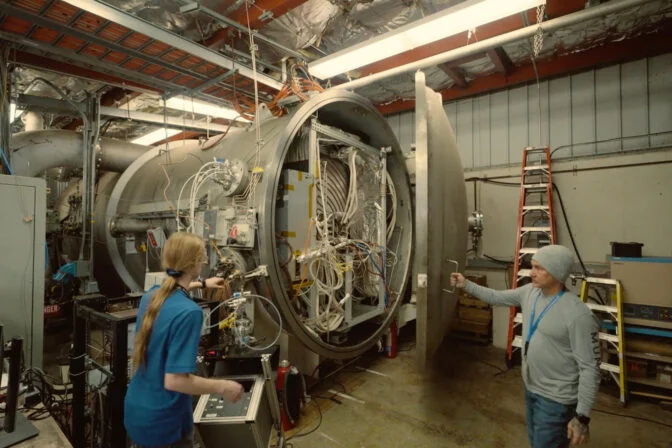
To put the thruster through its paces, engineers placed it inside a 26-foot-long water-cooled vacuum chamber at JPL’s Electric Propulsion Lab. The setup mimics conditions in space, allowing scientists to safely test extreme power levels without risking damage to the surrounding environment.
During five ignitions, the thruster reached temperatures of more than 5,000 degrees Fahrenheit. The visual display alone was striking: the thruster’s nozzle-shaped outer electrode released a glowing red plume, while the tungsten electrode at its core burned with a brilliant white light. It was the kind of scene that fuses science with sheer spectacle, hinting at what future spacecraft engines may look like.
A Mars Mission in Sight
NASA’s JPL has been developing the MPD thruster for the past two and a half years in collaboration with Princeton University and NASA’s Glenn Research Center. The work is funded by NASA’s Space Nuclear Propulsion project, which aims to support a future megawatt-class nuclear electric propulsion system capable of carrying humans to Mars.
NASA Administrator Jared Isaacman emphasized that despite the wide variety of programs the agency manages, the goal of reaching Mars remains a top priority. He described the test as a tangible sign of progress toward landing an American astronaut on the Red Planet.
This isn’t just talk. With each successful demonstration, the technology moves closer to becoming a key part of America’s long-term space strategy.
What’s Next for the Thruster Program
The recent test is only the beginning. NASA engineers will use data gathered from this initial demonstration to plan a new round of more advanced experiments. The team is aiming to push the thruster’s power output to between 500 kilowatts and 1 megawatt per unit in the coming years.
Reaching those numbers will be essential because launching a crewed spacecraft to Mars is expected to require between 2 and 4 megawatts of total propulsion power. That means multiple MPD thrusters working in unison for extremely long durations — likely more than 23,000 hours of continuous operation.
This brings up some major engineering challenges, including:
- Sustaining performance at extreme temperatures
- Ensuring component durability over thousands of hours
- Managing power distribution from a nuclear source
- Building reliable integration between thrusters and spacecraft systems
Each of these obstacles will require precise design and rigorous testing before any crewed mission can be greenlit.
Why This Matters for the Future of Space Exploration
The successful firing of the NASA lithium-fed nuclear thruster reflects a broader shift in how space agencies are thinking about long-distance travel. Traditional rockets, while powerful, are limited by the sheer amount of fuel they need to carry. Nuclear-powered electric propulsion offers a far more sustainable solution for missions that span months or years.
Beyond Mars, this technology could open the door to faster missions to the outer planets, more ambitious robotic exploration, and potentially even deep-space cargo transport. It represents a fundamental rethinking of how humans move through space, replacing brute-force combustion with finely tuned electromagnetic acceleration.
As Isaacman put it, NASA is committed to continuing strategic investments that fuel the next great leap in human exploration. With the lithium-fed thruster now proving it can deliver, that leap may be closer than ever before.
Author