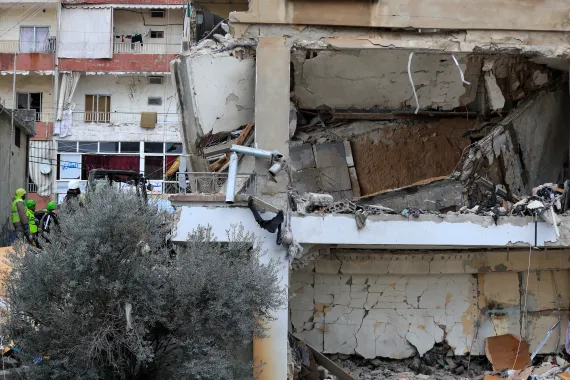
Israeli Airstrikes Southern Lebanon Leave 7 Dead as Catholic Convent Demolished
The latest wave of Israeli airstrikes southern Lebanon has once again shattered hopes that the fragile ceasefire between Israel and Hezbollah might bring lasting calm to the region. On Saturday, at least seven people were killed and several others wounded as Israeli forces struck multiple villages, while the Israeli military reportedly bulldozed parts of a Catholic convent in a border community. The strikes and demolitions come despite a ceasefire that has technically been in place since April 17, highlighting just how brittle the current truce truly is.
A New Round of Evacuation Warnings
Earlier in the day, the Israeli military issued fresh evacuation warnings to residents of nine southern Lebanese villages, signaling that more military operations were imminent. The directive added to a growing climate of fear in the region, where civilians have spent months caught between Israeli forces and Hezbollah fighters. While the ceasefire remains officially in effect, the steady stream of attacks from both sides has continued to take a heavy human toll.
A Catholic Convent in Yaroun Comes Under the Bulldozer
One of the most disturbing developments unfolded in the border village of Yaroun, where Israeli bulldozers tore through portions of a Catholic convent that had been completely empty due to the ongoing fighting.
Gladys Sabbagh, the superior general of the Basilian Salvatorian Sisters, told The Associated Press that she was informed the convent had been destroyed using heavy machinery. According to her, the small compound included a school that had been closed since the 2006 Israel-Hezbollah war, along with a medical clinic that had recently been relocated to the nearby village of Rmeich.
The convent had been home to just two nuns, both of whom had left earlier because of the war. With Yaroun’s residents now displaced, even basic confirmation of the site’s condition has been difficult to obtain.
Conflicting Accounts From the Israeli Army and the Church
The Israeli military offered its own version of events, claiming that during operations targeting Hezbollah infrastructure in Yaroun, a building with no visible religious markings was unintentionally damaged. It added that once soldiers learned the structure was linked to a church, they took steps to prevent any further damage.
The military also alleged that Hezbollah had previously used the compound to fire rockets toward Israel and emphasized that it does not deliberately target religious sites.
The Catholic Church in Lebanon firmly rejected this explanation. Reverend Abdo Abou Kassm, director of the Catholic Center for Information, stated that the church strongly opposes any actions targeting houses of worship. He stressed that churches are intended to be places of peace, love, and education — not military outposts.
A Pattern of Religious Site Damage
This incident comes on the heels of another deeply troubling event just days earlier. Images had surfaced showing an Israeli soldier striking a fallen statue of Jesus on the cross with an axe in the southern Lebanese village of Debel. Those images sparked widespread outrage in Lebanon and across the international Christian community, fueling concerns that religious heritage is being increasingly drawn into the conflict.
Civilian Toll Across Southern Lebanon
Beyond Yaroun, Saturday’s airstrikes claimed lives in several other communities. Lebanon’s state-run National News Agency reported the following:
- A strike on a car in Kfar Dajal killed two people
- An attack on a home in Lwaizeh left three people dead
- Two more were killed when a strike hit the village of Shoukin
Lieutenant Colonel Ella Waweya, the Israeli military’s Arabic-language spokesperson, said on X that the Israeli air force conducted approximately 50 airstrikes over the previous 24 hours, targeting what she described as Hezbollah infrastructure and personnel.
Hezbollah did not stay silent. The group claimed responsibility for a drone attack on Israeli troops who had gathered inside a house in the coastal village of Bayed.
Demolition Campaign Reshapes the Border Region
The Israeli military has been steadily flattening neighborhoods across towns and villages near the Lebanese-Israeli border in recent weeks. Officials say these structures were used as outposts by the Iran-backed Hezbollah, but the scale of the demolitions has raised concerns about the long-term displacement of civilian populations.
A new video released by the Israeli military on Friday showed soldiers holding an Israeli flag while walking through the wreckage of a soccer stadium in the Lebanese town of Bint Jbeil. According to the military, the stadium was destroyed after being discovered to be rigged with explosives.
How the Latest War Began
The current chapter of the conflict between Israel and Hezbollah erupted on March 2, when Hezbollah fired rockets into northern Israel. The escalation came just two days after the United States and Israel launched their joint military campaign against Iran, Hezbollah’s main backer.
Since then, Israel has carried out hundreds of airstrikes and launched a ground invasion of southern Lebanon, capturing dozens of villages along the border. The intensity of operations has reshaped vast stretches of southern Lebanon, leaving entire communities in ruins.
A Fragile Diplomatic Effort
In a rare diplomatic development, Lebanon and Israel held their first direct talks in more than three decades during this period of conflict. The two nations have technically been in a state of war since Israel’s founding in 1948, and any direct dialogue between them carries enormous symbolic weight.
A ten-day ceasefire was declared in Washington and went into effect on April 17. It has since been extended by three additional weeks. While the truce has reduced the scale of fighting, it has clearly not stopped it altogether, as Saturday’s deadly strikes underscore.
A Heavy Human Cost
The toll of the war has been staggering. According to Lebanon’s Health Ministry, 2,659 people have been killed and 8,183 wounded since the conflict began two months ago. These numbers represent not just statistics but families, communities, and entire villages forever changed by the fighting.
What Lies Ahead
The Israeli airstrikes southern Lebanon and the destruction of religious and civilian infrastructure raise difficult questions about how long the current ceasefire can hold. Each new strike, each demolition, and each civilian casualty risks unraveling whatever progress diplomats have managed to achieve.
For Lebanese communities living near the border, the reality remains brutal. Homes have been destroyed, religious sites damaged, and lives uprooted. Whether the next round of negotiations can deliver a more durable peace — or whether the conflict will deepen further — depends largely on choices being made far from the villages now bearing the brunt of the violence.
For now, southern Lebanon remains a region caught between fragile diplomacy and unrelenting conflict, with the international community watching anxiously to see what comes next.
Author