Stardust in Antarctic ice may not sound like a window into deep space — but it turns out the frozen layers at the bottom of the world hold a remarkable record of our Solar System’s path through the galaxy. By studying ancient snow and ice, scientists have traced our cosmic neighborhood’s history over the past 80,000 years, uncovering a subtle clue about how the Solar System has moved through the space around it.
Space Is Dustier Than You Think
When most people picture outer space, they imagine stars, planets, and moons. But a huge portion of space is actually filled with sprawling clouds of gas, plasma, and stardust — known as interstellar clouds.
In just the local region of our galaxy, there’s a complex of roughly 15 individual interstellar clouds. Right now, the Solar System is passing through one of them, fittingly called the Local Interstellar Cloud. These clouds aren’t random; their origins and histories are thought to be closely tied to the birth and death of stars.
And remarkably, their fingerprints can be found right here on Earth — locked inside Antarctic ice.
Looking Down to Study the Sky
Astronomy almost always points outward. Telescopes gather light from distant stars and galaxies, letting us infer how stars live and die, how elements form, and how the universe evolves.
This research flips that approach on its head.
Instead of observing light traveling toward us, scientists study the physical debris of exploding stars that has landed on Earth. Stars act as cosmic furnaces, forging elements in their cores — everything from carbon and oxygen to calcium and iron. That includes rare isotopes, or variant forms of elements, such as iron-60.
When massive stars die in supernova explosions, these elements are flung out into space, where they become interstellar dust. Tiny grains of that dust drift through the galaxy, and every so often, some of them settle onto Earth’s surface. Embedded in those grains is radioactive iron-60 — a clear chemical signature of a stellar explosion.
By hunting for iron-60 atoms in Earth’s geological archives, researchers can study events like supernovae long after their light has faded from the sky.
Why Antarctica Is the Perfect Archive
This is where Antarctica becomes invaluable. Its snow piles up slowly and stays largely undisturbed, building a layered record that stretches back tens of thousands of years.
Each layer is essentially a snapshot, capturing the material that was floating through our cosmic neighborhood at that moment in time. Read in sequence, those layers become a timeline of the Solar System’s surroundings.
A Surprising Find in the Snow
The investigation began with an unexpected result. When researchers analyzed 500 kilograms of recent Antarctic snow, they found the rare radioactive iron-60 isotope — even though there had been no recent near-Earth supernova to explain it.
So where did it come from? A few possibilities emerged:
- The interstellar clouds themselves. Perhaps the stardust sits waiting in the clouds, and Earth picks it up as the Solar System passes through. If true, denser clouds would deliver more iron-60. This was the team’s educated guess back in 2019.
- An ancient echo. Millions of years ago, Earth received large showers of iron-60 from massive supernovae. The iron-60 in recent snow might simply be the lingering tail of that signal — a rain that had slowed to a drizzle.
To tell these explanations apart, the researchers needed to look further back in time.
Counting Atoms in 80,000-Year-Old Ice
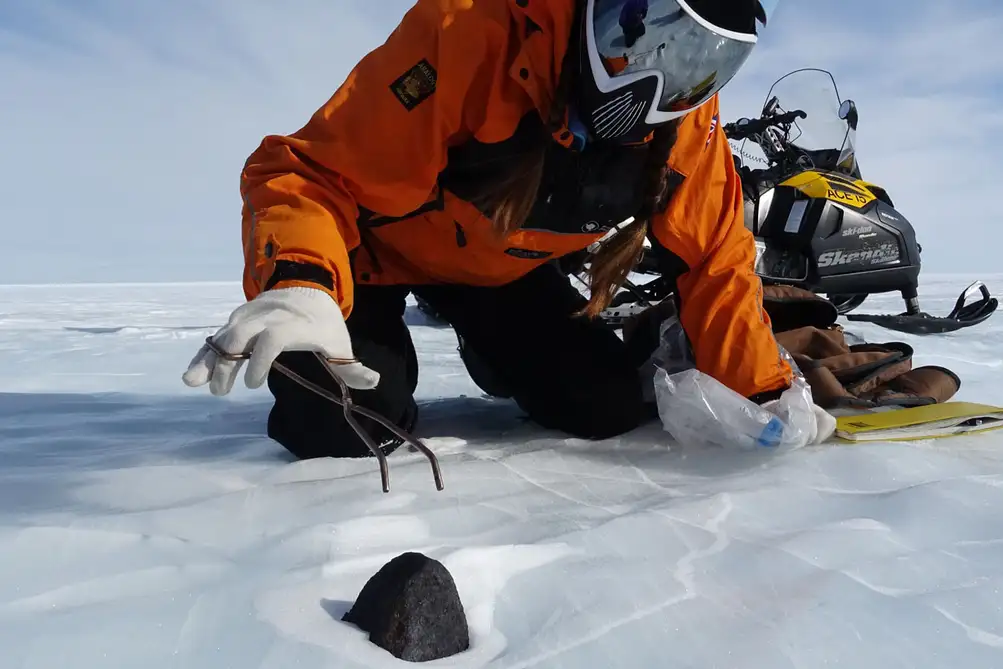
The team analyzed a 300-kilogram section of Antarctic ice dating from 40,000 to 80,000 years ago. The process is painstaking. The ice has to be melted and chemically treated to isolate minuscule traces of iron — including the iron-60 carried by stardust.
Then, using accelerator mass spectrometry — an extraordinarily sensitive atom-counting technique — at the Heavy-Ion Accelerator Facility at Australian National University, the researchers counted individual iron-60 atoms one by one.
Based on earlier measurements from surface snow and thousand-year-old ocean sediments, they expected to find a steady, predictable level of iron-60.
Instead, they found less. Not zero — but noticeably lower than anticipated.
What the Lower Levels Mean
That shortfall is significant. It suggests that less interstellar dust was reaching Earth during that 40,000-to-80,000-year window.
Crucially, this is a fairly rapid change on astrophysical timescales. It doesn’t match the very long timescales associated with the iron-60 that rained down millions of years ago. That mismatch pushed the team to look for a smaller, more local source for the isotope.
A Story That Mostly Fits
Astronomers have been studying the clouds surrounding the Solar System too. Last year, a study reconstructing the history of these clouds concluded they most likely originated in a stellar explosion. The same research found that the Solar System has been traveling through the Local Interstellar Cloud since sometime between 40,000 and 124,000 years ago.
If that’s accurate, the amount of iron-60 collected on Earth should have shifted somewhere within that same window — between 40,000 and 124,000 years ago.
And that’s exactly what the Antarctic ice revealed.
Still, the story isn’t a perfect match. If these clouds came directly from an exploding star, scientists would expect to find far more iron-60 than actually shows up in the ice. That gap remains an open question.
The Bottom Line
The discovery of stardust in Antarctic ice has given researchers a tangible record of the Solar System’s movement through its galactic surroundings — written not in starlight, but in frozen layers of snow. The findings line up well with the idea that our Solar System entered the Local Interstellar Cloud tens of thousands of years ago, even if the details don’t fit flawlessly.
The next step is to dig deeper, both literally and figuratively. By analyzing even older ice, scientists hope to untangle the full history of these local interstellar clouds — and finally understand where they came from. For now, one thing is clear: some of the best clues about the cosmos aren’t found by looking up, but by looking down.
Author