Italy’s Leaders Visit Modena Attack Victims as “Psychiatric Distress” Emerges as a Likely Factor
In the aftermath of a violent Modena car-ramming attack, Italy’s most senior leaders have moved quickly to stand with the victims. Prime Minister Giorgia Meloni and President Sergio Mattarella visited those injured in the car-ramming and stabbing attacks that unfolded on the main shopping street of the northern city of Modena.
The visits came as investigators began to outline what may have driven the assault — and as a shaken community searched for both answers and reassurance.
What Happened in Modena
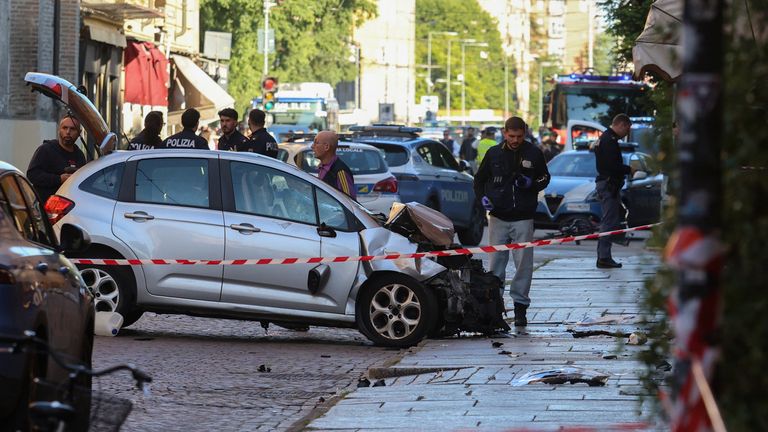
The attack took place at around 4:30 p.m. local time (14:30 GMT) on Saturday, in the heart of one of Modena’s busiest areas.
According to authorities, a 31-year-old man identified as Salim El Koudri drove at high speed through the city centre, striking more than a dozen people in his path. The violence did not end there — the attacker also stabbed a pedestrian before a group of passers-by managed to stop him.
The toll was severe. The ANSA state news agency reported that eight people were taken to hospital in serious condition.
Severe Injuries Among the Victims
A statement released Sunday by the city prosecutor’s office revealed the devastating impact on some of those caught in the attack.
Two women, aged 55 and 69, had their legs amputated as a result of their injuries. One of them remained in a life-threatening condition. Prosecutors described the attack as having been carried out “in an indiscriminate, random and deliberate manner” — a phrase that captures both the apparent lack of a specific target and the seriousness with which authorities are treating the case.
Italy’s Leaders Show Their Support
On Sunday, Meloni and Mattarella visited two hospitals where the injured were being treated. Neither leader released formal statements following the visits, allowing the focus to remain on the victims and their recovery.
Meloni had spoken out the previous day, calling the attack “extremely serious.” She also paid tribute to those who stepped in during the crisis, thanking the residents who “courageously intervened to stop the perpetrator,” as well as the police for their response.
“Psychiatric Distress” at the Center of the Investigation
As the investigation continues, officials have offered an early indication of what may lie behind the attack.
Speaking to journalists on Sunday, Interior Minister Matteo Piantedosi said that while inquiries into the circumstances were still ongoing, the incident appeared connected “to a situation of psychiatric distress.” He also stressed that, from a counterterrorism standpoint, “nothing escaped us” — signaling that authorities did not view the attack as terrorism.
Further details emerged from Italian broadcaster RaiNews, which reported that the suspect had shown symptoms of schizoid disorders. According to that report, El Koudri had been treated between 2022 and 2024 at a mental health centre located in the same province where the attack took place.
A Political Debate Over the Attacker’s Background
The attack also drew political commentary, particularly regarding El Koudri’s origins.
ANSA reported that El Koudri was born in the northern province of Bergamo to a family originally from Morocco. Far-right Deputy Minister Matteo Salvini — whose anti-immigrant League party is part of the governing coalition — commented on those origins, emphasizing that the attacker was an Italian national “of second generation.”
A Community That Stepped Up
Amid the violence, one detail offered a measure of hope: ordinary citizens were the ones who stopped the attacker.
State media reported that two of the four people who quickly moved to block the attacker from fleeing the scene were Egyptian nationals. Their actions were singled out for praise.
Modena’s Mayor Massimo Mezzetti described those who intervened as a powerful symbol of community strength. He said they represented “a community that knows, even in such a dramatic moment, how to react, unite and intervene,” adding that the entire Modena community should follow their example.
The Bottom Line
The Modena car-ramming attack left a city stunned and several victims with life-altering injuries, including two women who lost their legs. As investigators point toward psychiatric distress rather than terrorism, the focus now turns to the recovery of the injured and the deeper questions the case raises about mental health care and public safety.
Yet alongside the horror, Modena’s response offered something reassuring — the sight of bystanders, including members of the immigrant community, risking their own safety to protect others. In a moment of chaos, it was ordinary courage that brought the attack to an end.
Author