US Ebola Outbreak Response Crumbles as Experts Sound the Alarm Over Funding Cuts
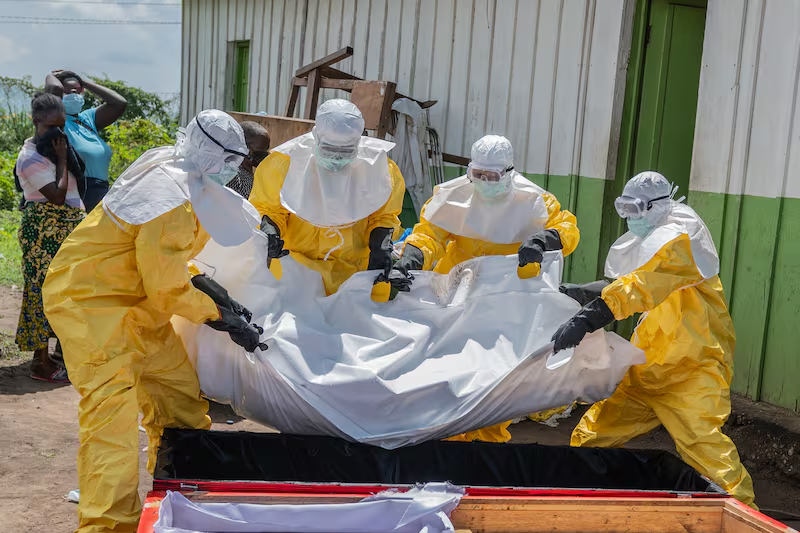
The US Ebola outbreak response has come under fierce criticism from global health experts as a deadly viral surge sweeps through parts of central Africa. A rare and dangerous strain of Ebola has emerged, infecting hundreds of people and claiming lives across multiple countries, yet the United States, once a leader in international health emergencies, appears strikingly absent from the effort to contain it.
The timing could hardly be worse. After more than a year of sweeping cuts to American foreign aid programs and federal health agencies, the country that once led the fight against deadly outbreaks now finds itself sidelined, leaving experts deeply worried about the consequences.
A Dangerous Strain Resurfaces
The current outbreak involves the Bundibugyo strain of the Ebola virus, an uncommon variant that has only triggered two known outbreaks in recent decades. There is no approved vaccine and no cure currently available for this specific form of the disease. Scientists and public health officials across the world are now scrambling to track where the virus is spreading and figure out how to stop it before the situation spirals further out of control.
Since April, the Democratic Republic of the Congo has reported four hundred eighty-two suspected cases along with roughly one hundred sixteen deaths. Uganda has confirmed two cases and one fatality, while signs suggest the virus may have already crossed into South Sudan. According to Kristian Andersen, a professor of immunology and microbiology at Scripps Research, the outbreak likely went undetected for several months before being identified.
A Public Health Emergency Declared
The seriousness of the situation prompted Tedros Adhanom Ghebreyesus, Director General of the World Health Organization, to declare the outbreak a Public Health Emergency of International Concern. Notably, he made the declaration before even assembling the committee usually responsible for such decisions, underscoring just how urgent the matter has become. Officials warn the outbreak could persist for months.
US Funding Pulls Back at the Worst Possible Moment
According to Matthew Kavanagh, director of the Center for Global Health Policy and Politics at Georgetown University, the Democratic Republic of the Congo has one of the most fragile health systems in the world and was the second largest recipient of USAID assistance. The sudden withdrawal of US funding, delivered with virtually no warning, has thrown basic operations into chaos.
The numbers tell a stark story. American foreign assistance to the DRC dropped from one point four billion dollars in 2024 to four hundred thirty-one million dollars in 2025, with only twenty-one million dollars committed so far this year. Aid to Uganda has followed a similar downward path, falling from six hundred seventy-four million dollars to three hundred seventy-seven million dollars in 2025, and now sitting at a negative balance in the current year.
Andersen described global health investments as remarkably cost-effective relative to the returns. Preventing and containing outbreaks early is dramatically cheaper than responding to a full-blown crisis. By cutting off prevention efforts, the United States is essentially guaranteeing that more expensive emergency responses will become routine.
The WHO Loses American Support
Adding fuel to the fire, the United States announced its departure from the World Health Organization along with the end of one hundred thirty million dollars in annual funding. That move resulted in two thousand three hundred seventy-one job cuts at the organization, according to Kavanagh. He described the decision as a self-inflicted wound brought on by the current administration, calling the consequences entirely predictable when public health surveillance and capacity are stripped away.
Andersen put it more bluntly. The United States is not merely stepping back from the table. It is, in his words, completely overturning it.
Key American Agencies Left Without Leaders
The pain extends to domestic agencies as well. Layoffs, resignations, and high-profile departures have left critical positions vacant. The Centers for Disease Control and Prevention currently has no director. There is no US Surgeon General. The Food and Drug Administration has no commissioner. Ebola response teams were suspended under the second Trump administration, and medical supplies and health centers have been significantly reduced.
A Closed Lab That Should Be Open
One of the most striking examples of lost capacity involves a world-class Ebola research laboratory in Frederick, Maryland, operated by the National Institutes of Health. Under normal circumstances, this facility would be heavily involved right now. Researchers there could be investigating monoclonal antibody treatments, testing vaccine candidates, and conducting deep genetic sequencing of virus samples.
Instead, the lab sits closed. Its staff was laid off abruptly last year, and the facility’s website remains down. When asked about the situation, CDC incident manager Satish Pillai declined to address the closure directly, only confirming that the United States maintains some testing capacity through its broader laboratory network.
Boots on the Ground Pulled Away
The damage extends to people working directly in affected regions. Currently, only twenty-five to thirty staff members remain at the US country office in the DRC. One additional person is being sent, with other experts available only remotely.
Before the cuts, hundreds of health workers were actively monitoring for viral spillover events in both the DRC and Uganda. Beyond Ebola, thousands more were working on HIV, tuberculosis, malaria, and maternal and child health initiatives. These frontline workers were often the first to spot signs of new outbreaks because patients rarely arrive at clinics knowing they have Ebola. They typically show up with fever or other vague symptoms, and trained community workers are the ones who connect the dots.
Travel Bans Instead of Real Action
Rather than restoring health infrastructure, the United States has opted for travel bans targeting noncitizens recently in the affected region. Kavanagh dismissed the strategy as little more than public health theater, arguing it punishes affected countries without actually preventing transmission. The Africa CDC has echoed those concerns, urging nations to avoid fear-driven travel restrictions and instead focus on supporting outbreak control at its source.
An Outbreak That Did Not Have to Spread
Kavanagh did not mince words about the current situation. He described it as an out-of-control epidemic that has already crossed international borders, with potentially devastating consequences for the region. Health leaders in the DRC count among the world’s most experienced Ebola responders, but they are now battling a crisis without the global support system that once stood behind them.
Andersen praised African scientists who have already sequenced the virus and produced remarkable early research, but stressed that walking away from international cooperation makes no sense. Outbreaks have economic, geopolitical, and human consequences that reach far beyond any single country.
The Moral Question at the Center
Beyond the politics and the budget figures sits a deeper question. Allowing people to die from a disease that can be stopped is, as Kavanagh put it, simply immoral. Ebola is a virus that humanity knows how to contain. The tools exist. The expertise exists. What is missing now is the commitment to use them. The world is not facing an unsolvable mystery. It is facing a choice, and so far, the United States appears to be choosing not to act.
Author