Oil Prices Jump After US Attacks on Iran: Markets React to Fresh Escalation
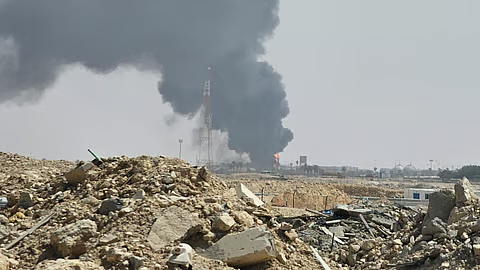
Oil prices jumped sharply once again after the United States launched a fresh round of attacks on Iran, rattling global energy markets that had only just begun to settle. The latest strike hit a military installation in Bandar Abbas, a port city that holds major strategic value along Iran’s southern coast.
The renewed military action sent traders scrambling and pushed crude prices higher within hours, reigniting fears about supply disruptions in one of the world’s most important shipping corridors.
What Happened in the Latest US Strike
According to US Central Command (Centcom), American forces did more than just hit a ground target. They also intercepted and destroyed four Iranian drones that were described as a danger to operations around the Strait of Hormuz.
Centcom framed the action as a defensive measure rather than an act of provocation, saying its goal was to safeguard US personnel from ongoing threats in the region. This marks the second time in just three days that Washington has struck Iranian targets, suggesting tensions are far from cooling despite earlier diplomatic gestures.
Earlier in the week, Centcom confirmed it had carried out separate strikes on southern Iran. Those operations reportedly focused on Iranian missile installations and vessels that were allegedly attempting to plant mines in the strait. The military said the purpose was to keep its troops out of harm’s way.
How Oil Prices Responded
The market reaction was immediate and significant. Here is how the major benchmarks moved:
- Brent crude, the global oil benchmark, climbed about 3.75% to reach $97.83 a barrel.
- US-traded crude rose roughly 4%, settling around $92.22 a barrel.
These gains reflect just how sensitive the energy market remains to any signs of renewed conflict. To put the swings in perspective, before the war began, Brent crude was trading closer to $70 a barrel. At the height of earlier tensions, it briefly spiked to around $120.
The volatility has been dramatic, and these latest strikes show that any optimism in the market can evaporate quickly when fresh hostilities break out.
Why the Strait of Hormuz Matters So Much
To understand why a single military strike can move global oil prices, you have to understand the importance of the Strait of Hormuz.
This narrow waterway is one of the most critical chokepoints in the global energy trade. Roughly one-fifth of the world’s oil and liquefied natural gas (LNG) supplies typically pass through it. When the strait is threatened or partially closed, the ripple effects are felt by consumers and businesses around the world through higher fuel and energy costs.
The current crisis has effectively choked off this vital route. Shortly after the US and Israel launched airstrikes on Iran on 28 February, Tehran responded by threatening to target ships using the passage. That single threat was enough to send energy prices into a tailspin and create lasting uncertainty in the market.
A Fragile Ceasefire Under Strain
What makes the latest attacks especially alarming is the timing. They come despite a supposed ceasefire between Tehran and Washington, with both governments engaged in talks aimed at ending a conflict that has now dragged on for roughly three months.
Iran wasted no time condemning the new strikes, calling them “a grave violation of the ceasefire.” Iranian officials warned that the country would not allow any hostile act to go unanswered, raising the possibility of further retaliation and deeper escalation.
The conflict has not stayed neatly contained, either. Kuwait’s military announced on Thursday that it was actively intercepting hostile missile and drone threats, though it declined to share additional details. This suggests the instability is spilling beyond Iran’s borders and could draw in neighboring states.
Hopes for a Deal Had Briefly Calmed Markets
Just days before the latest strikes, the mood in the oil market had been noticeably more upbeat. Prices had been falling steadily earlier in the week, driven by growing optimism that a diplomatic breakthrough was near and that the Strait of Hormuz might soon reopen to normal traffic.
That hope helped ease some of the pressure on global energy costs. But the renewed US action has reversed much of that progress, reminding investors and policymakers alike just how fragile the situation truly is.
What This Means for the Global Economy
The latest escalation carries consequences far beyond the battlefield. Rising oil prices tend to feed directly into inflation, raising costs for transportation, manufacturing, and everyday goods. For households already feeling the squeeze, more expensive energy is rarely welcome news.
Here are the key takeaways from the current situation:
- Energy markets remain extremely sensitive to any military activity near the Strait of Hormuz.
- The ceasefire between the US and Iran appears shaky at best, with both sides trading accusations.
- Continued disruption to the strait could keep oil prices elevated and fuel broader inflationary pressure.
- Regional spillover, as seen with Kuwait’s interceptions, raises the risk of a wider conflict.
Looking Ahead
For now, the world is watching closely to see whether diplomacy can regain momentum or whether the cycle of strikes and counterstrikes will continue. The reopening of the Strait of Hormuz remains the single biggest factor that could bring stability back to global energy prices.
Until a durable agreement is reached, oil markets are likely to stay on edge, reacting sharply to every new development. The recent jump in oil prices after the US attacks on Iran is a clear signal that the conflict’s economic shockwaves are far from over, and that the path to lasting peace remains uncertain.
Author