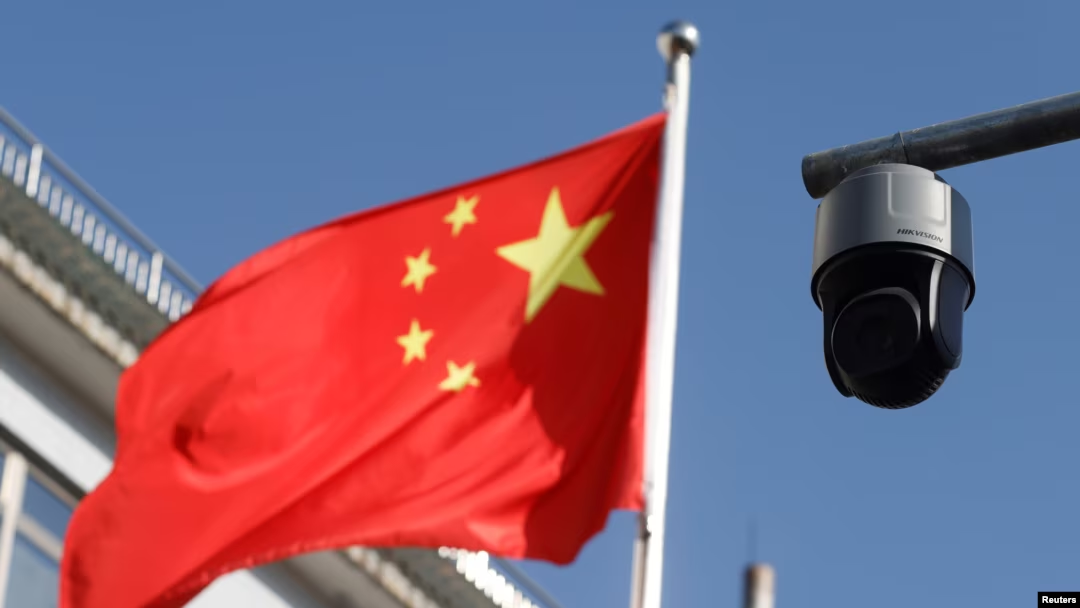
China’s State Surveillance Model Abroad Faces a Pacific Test
In a remote Pacific village ringed by banana trees, an unusual scene unfolded that revealed how China’s state surveillance model abroad is being quietly exported far beyond its borders. When Chinese police arrived at Fighter One, a quiet community in the Solomon Islands, they came not with weapons but with a proposal: a system they claimed would keep residents safe.
What followed offers a revealing case study in how Beijing is attempting to spread its approach to security and control around the world, and the resistance that approach can provoke.
The Proposal That Raised Eyebrows
The Chinese officers gathered villagers on a grassy patch and laid out their plan. They suggested that residents fill out cards listing the names, addresses, and dates of birth of every household member. More strikingly, they recommended collecting fingerprints and palm prints.
Such biometric collection was both highly unusual and legally questionable in a country that lacks any laws governing personal data collection. The request alarmed local politicians and observers in neighboring countries, who feared it could hand the government powerful tools to stifle freedoms.
A Different Kind of Security Pitch
Under Chinese leader Xi Jinping, Beijing has worked to export its ideas about security to nations across the globe, including the Solomon Islands, a Pacific country located some 3,000 miles away.
The contrast with the Western approach is stark. Where Washington offers treaties committing American troops to defend allies against external threats, Beijing offers something entirely different: equipment and tactics that help governments maintain order at home.
This pitch has found a receptive audience among authoritarian and fragile democratic states in Africa, Southeast Asia, and Central Asia. For these governments, domestic threats to regime security often rank as an equal or even greater priority than building up a conventional army.
Reviving a Mao-Era System
When the Chinese police visited Fighter One, they were responding to a genuine local request. The community wanted help keeping rowdy young men and boys from coming to the village at night, where they would get intoxicated on betel nut and a potent moonshine called kwaso.
The solution the police proposed, however, was anything but ordinary. They introduced an obscure Mao-era community surveillance system known as the Fengqiao Experience.
Named after a town in eastern China, the system originally encouraged neighbors to spy and inform on one another to root out political enemies. Under Xi, it has been revived as part of a broader effort to eliminate any challenges to the Chinese Communist Party.
How Fengqiao Works in China
To understand why the proposal alarmed observers, it helps to see how the system operates within China itself. There, the Fengqiao approach has taken on a deeply intrusive character.
The system manifests in numerous ways:
- Police monitor individual households in sprawling apartment complexes, in one case assigning each unit a color code indicating whether occupants posed a security risk.
- Officers have visited the homes of minority groups like Tibetans and Uyghurs to promote party policies.
- Government workers have delivered “anti-cult” lectures at churches.
- Companies are required to register their employees in police databases.
This heavy-handed style of state control is precisely what worried critics when it appeared poised to take root in the Solomon Islands.
A Model Police State
China has positioned itself as a policing model for other nations to emulate, frequently pointing to its low rates of violent crime as proof of success. Yet the vast security apparatus that keeps citizens safe is also routinely used to crush political dissent.
From birth, each Chinese citizen is assigned a household registration card that restricts where they can live. Their movement is tracked by an expanding network of surveillance cameras, many equipped with artificial intelligence capable of recognizing not just faces but even the way a person walks.
In once-restive regions like Xinjiang, millions of Uyghurs have been subjected to biometric data harvesting that included DNA samples, iris scans, and voice pattern collection. In the party’s eyes, all of this is necessary, since it views its legitimacy as inseparable from its ability to preserve social order.
Spreading the Model Worldwide
China’s efforts extend well beyond the Solomon Islands. Like-minded governments have eagerly embraced Beijing’s assistance as a means of entrenching their own power.
When Vietnam’s leader visited Beijing this year, the two governments pledged to cooperate closely on safeguarding “political security,” with Xi emphasizing their shared interest in defending Communist Party rule. With Cambodia, China pledged to jointly resist “external infiltration” and prevent “color revolutions,” a coded reference to pro-democracy movements that Beijing views as Western-backed plots.
The scale of China’s training programs is remarkable. According to a study by the Carnegie Endowment for International Peace, China has held nearly 900 training sessions since 2000, covering counterterrorism, riot control, and border control, for at least 138 countries.
As political scientist Sheena Chestnut Greitens, a co-author of the Carnegie report, put it, China is attempting to rewrite the standards of what global security means and which countries are best at providing it.
A Troubling Track Record
China’s policing exports have produced concerning outcomes in several countries. Beijing has embedded officers in police forces in the Central African Republic and the Pacific nations of Vanuatu and Kiribati. It supplied thousands of surveillance cameras to Ecuador in 2011, enabling that country’s intelligence agency to better monitor political opponents.
Perhaps most disturbingly, China trained a unit of South African police in 2016 that was later deployed to intimidate and assassinate political rivals of then-President Jacob Zuma, according to the Africa Center for Strategic Studies. Greitens noted that exporting police training also serves a public relations purpose, allowing China to portray its system as a public safety success rather than a human rights failure.
A Pacific Laboratory
China’s foothold in the Solomon Islands grew dramatically in 2019, when the country severed decades of diplomatic ties with Taiwan to recognize Beijing instead. Known locally as “the switch,” this move opened the floodgates to Chinese financial support, trade, and investment, while alarming Australia, the United States, and other Western allies.
The switch also inflamed longstanding tensions between the more developed island of Guadalcanal, home to the capital Honiara, and the poorer island of Malaita, which had maintained closer ties to Taiwan. Those tensions exploded into deadly riots in 2021 that targeted Honiara’s century-old Chinese community.
In the aftermath, then-Prime Minister Manasseh Sogavare signed a security pact with Beijing in 2022, justifying it as a way to combat “hard internal threats” while dismissing traditional partner Australia as “inadequate.” Leaked excerpts of the never-publicly-released pact show it allows the Solomon Islands to request Chinese police, armed police, and military personnel to restore order and protect Chinese interests.
Policing Alongside Business Interests
China’s policing presence has gone hand in hand with the expansion of its mining and other businesses, reflecting Beijing’s need to protect its overseas interests. Beijing embedded its first batch of police in the Royal Solomon Islands Police Force in 2022 and donated $1.5 million worth of riot gear, including bulletproof vests, shields, and helmets.
Critics see this as part of a troubling pattern. Peter Kenilorea Jr., a longtime opposition politician now serving in the new prime minister’s cabinet, argued that the power imbalance has allowed Chinese firms in mining and timber to raze forests and pollute rivers while using illegal ports to evade fees, all with little consequence. The Chinese, he said, “come and they do their own thing. It’s like open season.”
Propaganda Versus Reality
The China Police Liaison Team operates out of Rove Police Headquarters in Honiara, with roughly ten members rotating in and out over months-long stints. They have been celebrated in Chinese state propaganda as evidence of Beijing’s benevolence toward its neighbors.
A national police university published an article in 2024 describing the officers as enduring hardship, suffering infections and insect-infested rooms, so that poor villagers could benefit from the wisdom of the Fengqiao Experience. Meanwhile, the Solomon Islands government website filled with images of Chinese police donating equipment, serving tea to students, and putting on drone shows and kung fu demonstrations.
Yet questions linger about sustainability. Virginia Comolli, head of the Pacific Program at the Global Initiative against Transnational Organized Crime, found cases where donated Chinese police vehicles sat idle because there wasn’t enough money for fuel or spare parts to repair them. As she put it, the central question is always whether any of this is sustainable.
Divided Opinions on the Ground
Among residents, views are genuinely mixed. Some are willing to give China a chance, reasoning that anything is better than the status quo in a country the United Nations has named one of the world’s 44 least developed nations.
Jacqueline Maeli, a 43-year-old resident whose hilltop community was visited by the Chinese police team, captured this pragmatic outlook. Wearing a secondhand T-shirt reading “China Fantastic,” she said she was agnostic about which flag the police flew, declaring she would support whichever government helped make the country work better.
The Backlash Builds
When news emerged that the Chinese police had proposed collecting fingerprints and other data at Fighter One, concerns quickly mounted. Celsus Talifilu, now special secretary to the new prime minister, argued in a blog post that the police had no authority to collect personal information, register biometric data, or conduct neighborhood surveillance.
He warned that the Fengqiao model’s emphasis on monitoring and coercion threatened both social harmony and local customs, such as relying on village chiefs to resolve disputes. As he put it, “This is against our norms. People will not take lightly to being spied on by their neighbors.”
The criticism extended beyond the islands. An Australian newspaper ran an editorial condemning the program, while security analysts at the Australian Strategic Policy Institute warned that the Solomon Islands risked becoming a proving ground for authoritarian practices disguised as community service.
China Pushes Back
Beijing’s propaganda machine responded forcefully. The Global Times dismissed Western reactions as the discomfort of former colonial powers whose grip on the Pacific was slipping. It also insisted that China was not imposing the Fengqiao model but merely offering it for consideration.
The Solomon Islands police, for their part, issued a statement asserting that the pilot program was locally led rather than introduced at China’s behest. They denied it was about surveillance or coercion and promised that no data would be transferred to any foreign authority. Neither the Solomon Islands police nor the Chinese Embassy responded to requests for interviews.
An Uncertain Future
Following the uproar, the Fengqiao pilot program at Fighter One was suspended, and no biometric data was ever shared. The noisy youth, notably, remain a problem, leaving the original concern unresolved.
Some residents would still welcome a Chinese police role. Pedical Togamae, a 42-year-old emergency room doctor in Fighter One, noted that local police are so understaffed they often fail to show up. If giving his fingerprints would help end the nightly disturbances, he said he would gladly comply, explaining simply that the community just wants peace.
The recent election of Matthew Wale, a prime minister historically skeptical of Beijing, now raises fresh questions about China’s foothold in the country.
What the Solomon Islands Reveals
The story of China’s state surveillance model abroad in the Solomon Islands illustrates both the ambition and the limits of Beijing’s approach. The effort goes beyond technology and tactics; it represents an attempt to spread an ideology centered on state control.
Yet the backlash at Fighter One demonstrates that such ideas do not always travel as smoothly as the party might hope. As the Solomon Islands navigates its relationship with Beijing under new leadership, it stands as an early and revealing test of whether China’s vision of security can take root in places with their own traditions, values, and growing wariness of foreign influence.
For now, the experiment remains unresolved, a small Pacific nation caught between the promise of help and the fear of control, watched closely by a world increasingly attentive to how China exports not just goods, but governance itself.
Author