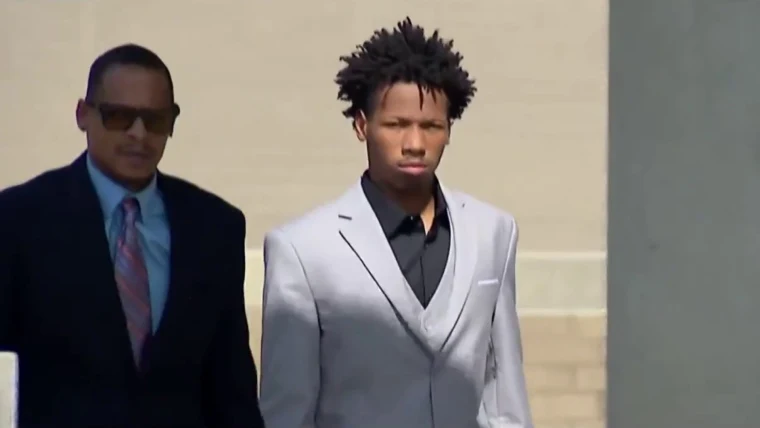
Karmelo Anthony Trial Ends With 35-Year Sentence in Teen’s Death
The Karmelo Anthony trial reached its conclusion on Tuesday afternoon when jurors found him guilty of murder and handed down a 35-year sentence for the fatal stabbing of 17-year-old Austin Metcalf at a Frisco track meet last year. The verdict closed a case that had gripped national attention and stirred intense emotion both inside and outside the courtroom.
Anthony, who was also 17 at the time of the killing, had maintained that he acted in self-defense. The jury, however, rejected that argument after weighing the evidence.
How the Verdict Came Together
Deliberations began Tuesday morning, following closing arguments from prosecutors and Anthony’s defense team. His attorneys had argued throughout the trial that he stabbed Metcalf to protect himself.
State district Judge John Roach Jr. gave jurors an additional option, instructing them that they could consider a lesser charge of manslaughter rather than murder. In the end, they settled on the more serious charge and the lengthy sentence that followed.
From the moment it began, the case attracted widespread coverage and became a magnet for misinformation and racially charged commentary on social media. Anthony is Black, and Metcalf was white, a detail that fueled much of the online discourse surrounding the trial.
Family Members Confront Grief in Court
After the jury left the courtroom, members of Austin Metcalf’s family delivered victim impact statements, offering those closest to him a chance to describe how his death had reshaped their lives.
His mother, Meghan Metcalf, spoke of a home once filled with laughter that had fallen silent since losing her son. She recalled embracing him on the morning of the track meet, never imagining it would be the last time she saw him alive. She said Anthony should consider himself fortunate to have received 35 years, since she felt she had been condemned to a lifetime without her child. For much of her statement, Anthony kept his head down and did not appear to look in her direction.
Austin’s father, Jeff Metcalf, spoke next as childhood photographs of his twin sons played on a screen, images of birthday parties, fishing trips, and football games. His words were raw and forceful. He described grief not as sadness but as rage, trauma, and the inability to escape memories that replay endlessly. At one point he struck the witness stand with such force that people in the courtroom flinched.
He also revealed that both his and Meghan’s homes had been targeted by fake 911 calls designed to provoke a heavy police response, and he criticized how the public conversation had wrongly fixated on race. The experience, he said, opened his eyes to how cruel people can be. When he asked Anthony to look at him and received no response, his anger boiled over before he apologized to the judge.
The final family member to speak was Austin’s twin brother, Hunter Metcalf. He began by asking Anthony for a small measure of respect by meeting his gaze, while acknowledging that Anthony might not be able to. Hunter described the anguish of losing his twin and explained that his faith had given him some comfort. Still, he said he could not understand why Anthony had taken so much from his family.
A Tense Scene Outside the Courthouse
Emotions ran high beyond the courtroom walls as well. After the sentencing, Anthony’s family was escorted to a waiting vehicle while supporters called out words of encouragement. As the car pulled away, a family member made a heart gesture toward the gathered crowd.
The atmosphere outside the Collin County courthouse remained charged. Supporters on both sides lingered after the verdict, and sheriff’s deputies intervened to calm several tense confrontations. Two people were taken away in handcuffs as tempers flared. One of them was identified as Sholdon Daniels, a Dallas-area attorney and former Republican congressional candidate who had run for the U.S. House seat held by Representative Jasmine Crockett.
Reactions to the Sentence
Among Anthony’s supporters was Justice Graham, who described feeling heartbroken by the 35-year sentence. She expressed her belief that Anthony had not intended to kill Metcalf and that he had shown genuine remorse, calling the punishment too harsh. Hearing the sentence, she said, broke her heart because it could just as easily have been someone close to her.
Graham also argued that race had played a major role in shaping public reaction to the case and the demonstrations that surrounded it. She pointed to rhetoric from counter-protesters as evidence of how deeply the issue had divided people, suggesting the case had become a lens through which different sides aired their views on race.
As Anthony’s family departed, the crowd gradually thinned. Deputies remained on site, however, as small groups continued to gather outside the courthouse.
A Case That Resonated Far Beyond Frisco
The conclusion of the Karmelo Anthony trial brings a measure of legal finality to a tragedy that touched two families and captured a divided national audience. For the Metcalf family, the 35-year sentence offers a verdict but not relief, as their statements made clear that no outcome could restore what they lost. For Anthony’s supporters, the punishment felt disproportionate to a young man they believe acted out of fear.
What remains is a story that became about far more than a single act of violence, one that exposed how quickly grief, division, and questions of race can converge in the public eye. The courtroom proceedings have ended, but the pain and disagreement they revealed are unlikely to fade quickly.
Author