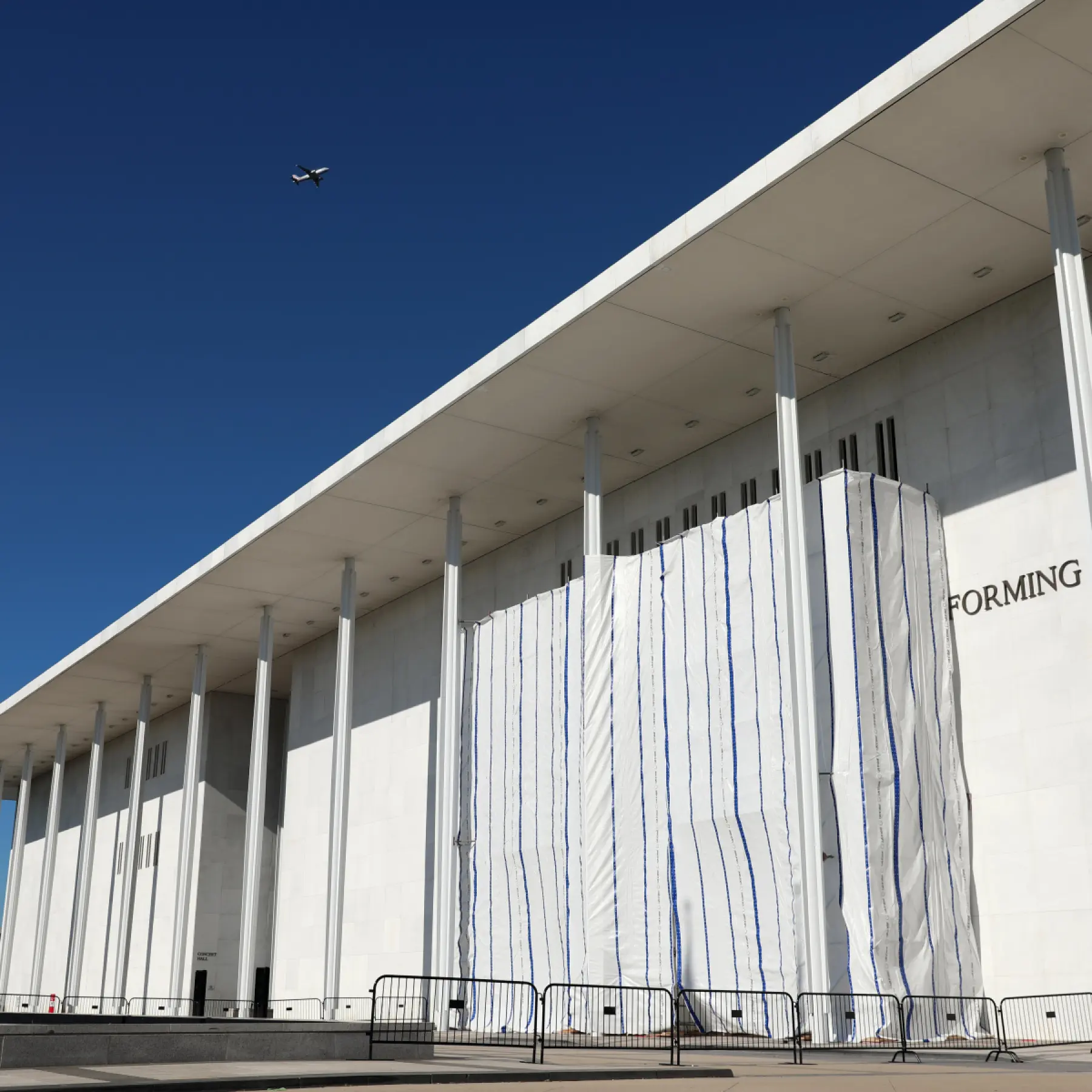
Days after the Kennedy Center Trump name was removed under a federal court order, a large striped tarp still draped the front of the famed Washington, D.C. arts venue on Sunday, leaving curious visitors frustrated and asking a simple question: what exactly is behind the cover?
The lettering bearing President Donald Trump’s name came down on Saturday, fulfilling a judge’s order. Yet rather than revealing the building’s restored original facade, the center kept much of its exterior hidden behind scaffolding and tarpaulin, prompting suspicion among onlookers who had hoped to witness the moment for themselves.
Confusion and Frustration on the Plaza
For many who made the trip, the lingering tarp felt like an anticlimax, if not something more deliberate.
Stephen Caken, a New York resident in Washington for an internship, said he couldn’t understand why the covering remained in place a full day after the name had reportedly been taken down. To him, it looked like an attempt to draw attention away from the entire episode.
Others saw deeper symbolism in the saga. John Mathew Smith, who traveled from Maryland, accused the president of trying to weaken the nation’s cultural symbols, suggesting the move was part of a broader pattern of reshaping American institutions to his liking.
Tim Terpstra, who lives nearby, had already visited once that weekend and returned hoping the tarp would finally be gone. He said he simply wanted reassurance that the name was truly down and that no trace of it remained.
The Kennedy Center did not immediately explain why the covering stayed up, and earlier court filings cited weather-related delays during the removal work.
How the Removal Unfolded
The takedown followed a tense legal and logistical buildup. After an appeals court declined to pause a ruling by U.S. District Judge Christopher Cooper, the center was left with no choice but to comply. Cooper had found that the venue acted unlawfully when it added Trump’s name, concluding that the institution could not be renamed without approval from Congress.
Crews began erecting scaffolding on Friday as crowds gathered to watch. Some protesters chanted “Take it down,” while others cheered the workers on, at one point calling them heroes. According to video shot through a small gap in the scaffolding, the bronze letters began coming off around 3 a.m. Saturday, several hours after the original deadline had passed.
In a court filing, the center’s executive director and chief operating officer, Matt Floca, confirmed that all physical signage renaming the building after Trump had been removed from the facade and grounds. The institution also stripped the name from its website, official letterhead, and even staff email signatures.
A Symbolic Battle Over a Beloved Venue
The fight struck a nerve in Washington, a heavily Democratic city where the Kennedy Center has long stood as a cultural cornerstone. Naming the building, originally dedicated to assassinated President John F. Kennedy, after a sitting president felt to many residents like an affront to a cherished landmark.
The legal saga traces back to December, when Trump’s handpicked board of trustees added his name to the building. The decision triggered a backlash, with numerous artists withdrawing from scheduled performances in protest.
Ohio Democratic Representative Joyce Beatty, an ex-officio member of the board, quickly filed a legal challenge against the renaming. After the name finally came down, she celebrated online by posting a video of herself performing the “YMCA” dance that Trump himself had popularized at rallies.
A Legal Fight Far From Over
Although the name is gone for now, the dispute is not finished. The Kennedy Center’s appeal is expected to unfold over the coming weeks.
Trump, who personally led the rebranding effort, has not hidden his displeasure. He named himself chair of the board in early 2025 and later announced plans to close the center for a two-year renovation he described as a complete rebuilding. Judge Cooper blocked that closure as well, finding the board had failed to properly weigh alternatives.
Throughout his second term, Trump has used the venue to spotlight work aligned with his cultural tastes. He hosted the Kennedy Center Honors, the center premiered First Lady Melania Trump’s documentary, and it recently hosted the finals of his national civics contest for high school students.
Part of a Broader Effort to Reshape Washington
The Kennedy Center clash is just one piece of Trump’s wider campaign to remake the capital in his own image. Among his other projects, he has paved over the White House Rose Garden to create a patio reminiscent of Mar-a-Lago, demolished the East Wing to make way for a large ballroom, and altered the color of the Lincoln Memorial Reflecting Pool.
He has also floated ambitious plans to build a golf course, erect what would be the world’s tallest arch on a traffic circle near Arlington National Cemetery, and install a sculpture garden along the Potomac River.
Some of his initiatives lean more ideological than aesthetic. White House officials have launched a sweeping review of the Smithsonian Institution to bring it in line with the president’s views on American history. The administration has also reinstalled a contested Confederate monument and edited the memorial of founding father George Mason to remove language noting that he owned slaves despite championing individual rights.
What Comes Next
For now, the tarp remains a fitting symbol of an unresolved standoff: the name is officially gone, but the full picture stays hidden from public view. Visitors continue to gather, hoping to glimpse the Kennedy Center’s restored identity, while the broader legal and cultural battle over Washington’s landmarks shows no sign of slowing down.
Until the covering finally comes off, the question lingering on the plaza is the same one many Americans are asking about the capital itself: what will it look like when the wraps come off?
Author