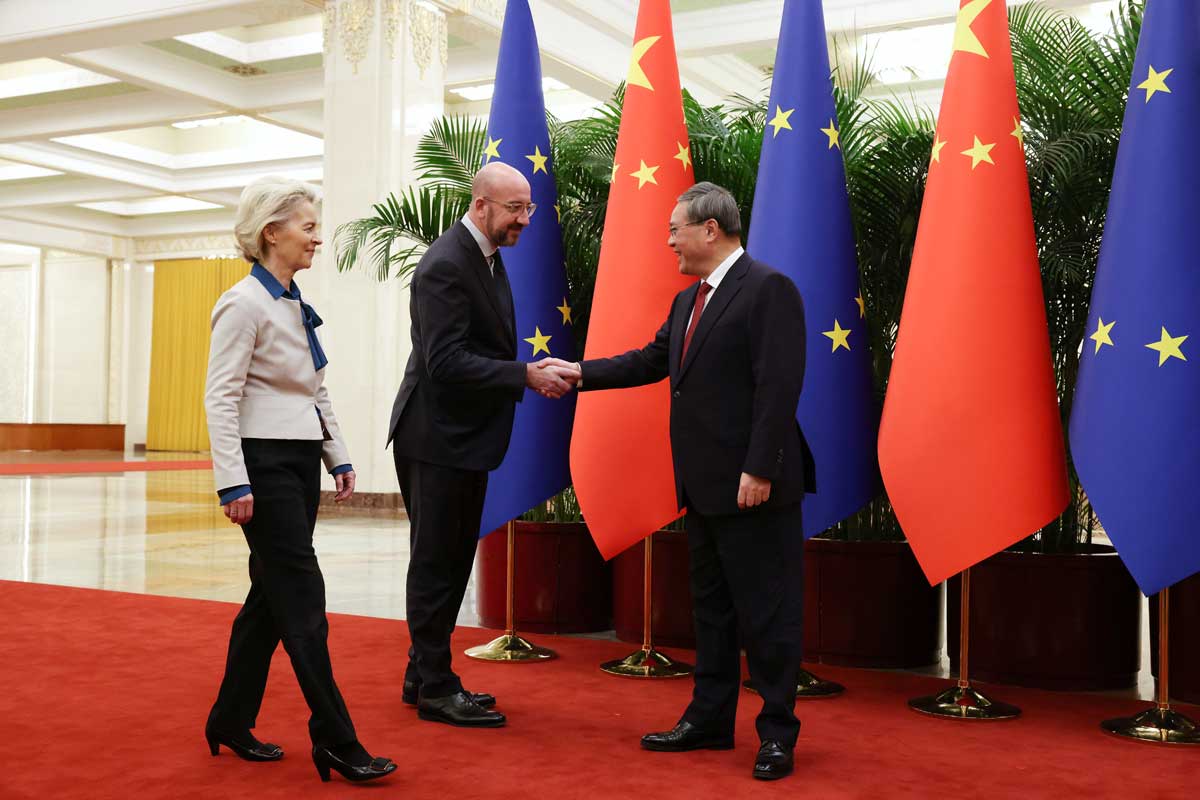
The EU China trade imbalance has reached a tipping point, pushing European leaders to confront one of their most difficult economic dilemmas: how to push back against China’s growing trade dominance without igniting a full-blown trade war. With the bloc’s deficit now exceeding 1 billion euros a day, the pressure to act has never been greater, but neither has the risk of getting it wrong.
A Growing Sense of Urgency
This week, the Group of Seven industrial nations pledged an ambitious goal to diversify away from China, adding fresh momentum to the European Union’s own efforts to counter the world’s largest export engine.
Across all 27 EU capitals, there is now unanimous agreement that China’s trade policies pose a serious economic threat if left unchecked. At a meeting in Brussels, the bloc’s leaders gathered to weigh how to handle upcoming trade talks with Beijing and to explore possible responses, including potentially powerful new trade tools.
Europe’s anxieties run deep and span multiple fronts:
- A trade deficit with China exceeding 1 billion euros per day, partly driven by state-subsidized products
- Beijing’s tight grip on critical minerals and semiconductor chips
- Mounting fears that European industries simply cannot withstand the pressure much longer
Voices Calling for Action
Frustration within the EU’s leadership is becoming increasingly vocal.
The bloc’s chief trade negotiator, Maros Sefcovic, recently described Europe’s trade relationship with China as fundamentally unsustainable, arguing that meaningful diversification requires a dedicated instrument. French President Emmanuel Macron went further, warning that the EU could adopt strong measures, including possible tariffs, if Beijing fails to address the imbalance.
Yet beneath the tough rhetoric lies a sobering reality. Several member states have privately acknowledged that diversifying supply chains away from China will take years, and that the bloc must remain realistic about what’s achievable in the short term.
The Diversification Dilemma
While the goal is clear, the path forward is anything but simple.
Recent developments highlight just how dependent Europe remains. The EU reportedly sought to temporarily lift sanctions on a Chinese chipmaker after the auto industry warned of looming shortages. Meanwhile, Spain has been strengthening its role as a European hub for Chinese automotive imports and production, making any confrontation with Beijing potentially costly.
These tensions reveal the core challenge: Europe wants to reduce its reliance on China, but doing so too quickly could damage its own industries.
How Far Europe Has Come
The current discussions mark a significant evolution in Europe’s stance.
The shift began in 2019, when the EU started taking a harder line by labeling China both an economic competitor and a systemic rival. That change was fueled largely by frustration over unequal market access and increasingly lopsided trade.
For years, however, business continued largely as usual. European industrial giants, especially in Germany, resisted restrictions as long as China remained a profitable export market. In 2024, then-Chancellor Olaf Scholz strongly opposed tariffs on Chinese electric vehicles, fearing retaliation.
The Pain Hits German Industry
That reluctance is now being tested as the economic damage spreads, particularly across German industry.
German carmakers have been hit especially hard. According to the German Economic Institute, shipments to China fell by a third in 2025, leaving them more than 50 percent below their 2022 peak of roughly 30 billion euros.
The warning signs are everywhere:
- BMW recently slashed its profitability forecast, blaming weak demand and fierce competition in China.
- Machinery producers and the pharmaceutical sector are facing growing pressure.
- The EU’s overall trade deficit with China widened for a second straight year in 2025, reaching 360 billion euros, and continued growing into early 2026.
There’s also rising concern that higher U.S. tariffs are redirecting more Chinese goods toward European markets, intensifying the strain.
The Subsidy Problem
A central grievance driving Europe’s frustration is China’s massive system of state subsidies.
Beijing has reportedly provided up to eight times more government support to its domestic companies than firms in OECD nations received between 2005 and 2024. This support has helped China capture market share across numerous sectors, including solar, shipbuilding, steel, telecom equipment, wind turbines, aerospace, and automobiles.
A recent OECD report found that nearly 60 percent of global market share gains by Chinese companies can be attributed to subsidies. China’s newest five-year economic plan, issued in March, signals no slowdown, with officials aiming to modernize traditional industries while advancing frontier technologies like robotics, biomedicine, and nuclear fusion.
Europe’s Hidden Leverage
Despite the challenges, the EU isn’t without bargaining power.
China’s economy remains heavily dependent on exports, largely because its domestic demand stays weak. The EU was China’s second-largest export market last year, serving as an important buffer against a cooling Chinese economy.
With the United States erecting more trade barriers, Europe’s wealthy market of 450 million consumers becomes increasingly valuable, giving the bloc meaningful leverage in any negotiation.
China’s Rare-Earth Trump Card
That leverage, however, is counterbalanced by a powerful weapon in Beijing’s arsenal: its dominance over rare-earth processing.
This control gives China enormous influence in any trade conflict. Bloomberg Economics estimates that a year-long cutoff of rare earths and permanent magnets from China could put roughly 4.4 trillion dollars in global GDP at risk.
China has already demonstrated this power. In 2025, it imposed export controls on rare-earth elements, sparking global panic over shortages and potential manufacturing shutdowns.
What the EU Is Considering
In response, the bloc is weighing a range of measures, including:
- Making existing defensive trade tools more agile and responsive
- Expanding the staff of the European Commission’s trade department
- Adopting entirely new trade instruments
But a major obstacle persists. Companies dependent on Chinese raw materials have been slow to adapt. According to BME, an association of German supply-chain managers, the vast majority have shifted less than 10 percent of their purchasing away from China over the past three years, with little change expected soon.
The vulnerability was on full display when European carmakers lobbied to suspend sanctions on a major Chinese semiconductor supplier, warning they would run out of stock within weeks without an exemption.
A Catch-22 for Brussels
European officials understand they’re caught in a bind. China has already cautioned that it will fight any EU efforts to protect its industries or expand its policy toolkit.
Still, a growing consensus is emerging: acting now will likely be less costly in the long run than maintaining the status quo. Officials increasingly agree that the bloc cannot allow itself to be paralyzed by the fear of retaliation, and that the public must be prepared for greater trade friction ahead.
Germany in the Spotlight
No country’s position is watched more closely than Germany’s.
Long benefiting from close ties with China, Berlin has traditionally favored keeping trade as free as possible. But that stance appears to be shifting after years of sluggish growth and as competition bites deeper into key sectors.
Chancellor Friedrich Merz recently told lawmakers that the EU cannot stand by while others bend shared rules, emphasizing that Europe must protect its economy against unfair trade practices. His comments align him more closely with member states pushing for a tougher approach.
Yet doubts linger about how far Berlin will actually go. When Economy Minister Katherina Reiche visited China in May, she stressed that any policy must ensure German companies can continue exporting.
As Cora Jungbluth of Bertelsmann Stiftung put it, Germany now views the relationship more critically, yet remains bound by deep interdependencies, making it a particularly delicate balancing act.
The Bottom Line
The widening EU China trade imbalance has forced Europe to confront a defining economic challenge of the decade. The bloc must find a way to defend its industries and reduce dependence on China without triggering a destructive trade war or crippling retaliation.
With China’s rare-earth leverage looming large and European companies slow to diversify, the road ahead is fraught with risk. Yet there’s a clear and growing recognition in Brussels that inaction is no longer an option. How successfully Europe navigates this tightrope, balancing firmness with pragmatism, may well shape the continent’s economic future for years to come.
Author