The Andy Burnham Makerfield election could quietly reshape the future of British politics, as a cluster of post-industrial towns in northwest England prepares to make a decision with national consequences. On Thursday, voters in Makerfield will choose whether to send Andy Burnham, the popular mayor of Greater Manchester, back to Parliament, a move that could ultimately put him on a path to 10 Downing Street.
A Local Vote With National Stakes
At first glance, this looks like an ordinary local by-election. In reality, it may help determine who leads the country.
Burnham, widely known as the “King of the North,” has made his intentions clear. If he wins, he says he will challenge Prime Minister Keir Starmer for leadership of the ruling Labour Party. And thanks to the quirks of the British political system, no public general election would be needed for him to take the top job.
That puts Makerfield, a collection of former mining towns, in the unexpected position of helping shape Britain’s future.
A Prime Minister Under Pressure
The backdrop to this contest is a deeply unpopular government.
Just two years after a landslide victory, Keir Starmer has become the least popular British leader on record. His struggles stem from several sources:
- A perceived lack of personality and vision
- A series of damaging policy U-turns
- Multiple scandals, including appointing a friend of Jeffrey Epstein as ambassador to Washington
Adding to his woes, his own defense secretary recently resigned over the government’s alleged unwillingness to invest enough in the military. For many voters, the overriding sense is that life has only gotten harder since Starmer took office.
The Rise of Britain’s Most Popular Politician
Standing in stark contrast is Andy Burnham himself.
His reputation for empathy and his ability to connect with ordinary people have made him the most popular politician in Britain, a notable achievement in a country grappling with stagnant wages, political turbulence, and rising racial tension.
The mood on the ground reflects a hunger for change. Peter Thompson, a 78-year-old vinyl store owner in Ashton-in-Makerfield, captured the frustration bluntly, describing the country as an “absolute mess” where “everything is just about broken.”
Interestingly, even some skeptics aren’t entirely unhappy with the attention. Thompson, who isn’t a Burnham supporter and suspects the mayor is using Makerfield as a stepping stone to power, still finds the political spectacle “quite nice,” noting that “everyone gets their 15 minutes of fame.”
A Path to Power
If the polls are accurate, Burnham is on track to win.
A recent survey by the pollster Convergent placed him at 49 percent, well ahead of his main challenger, Reform UK, at 37 percent. Reform is led by Nigel Farage, a prominent ally of Donald Trump.
Should Burnham secure victory, the sequence of events could unfold quickly:
- He wins the Makerfield seat and returns to Parliament.
- He triggers a leadership contest against Starmer.
- If successful, he becomes prime minister, without a national vote.
It’s a remarkable scenario that leaves this tight-knit community of red-brick terraces and former mining heritage holding extraordinary influence.
Inside Makerfield
The constituency itself tells a familiar story of regional Britain.
Home to around 100,000 people, roughly the size of Green Bay, Wisconsin, Makerfield is made up of several post-industrial towns, none of which are actually named “Makerfield.” Its mines and mills have long given way to retail and service jobs, with many local shops now converted into vape stores or left vacant entirely.
Yet the area retains its character. This is heartland rugby league territory, a sport closely tied to the working-class English north. Patches of green countryside, nature reserves, and parks weave between the terraced streets, where nature has reclaimed much of the old industrial landscape.
Burnham, 56, grew up in this region and supports Everton, the Liverpool-based soccer club. At his campaign launch in May, he called the election a “clarion call for change” for a place he says he loves deeply.
A National Message in a Local Race
Although technically a local election, Burnham’s pitch has been unmistakably national in scope.
He has demanded sweeping change across the economy, education, housing, transport, and social care, arguing that achieving any of it requires a fundamental change to politics itself.
His policy promises include:
- Easing taxes on small businesses
- Increasing defense spending
- Maintaining the current government’s pledge not to raise income tax
Critics argue this is an unrealistic offer in a cash-strapped nation. Burnham, however, points to Greater Manchester becoming Britain’s fastest-growing economic area under his leadership as evidence that his approach works.
The Battle of Vibes
Much of this contest comes down to perception and personality.
According to Oxford politics professor Ben Ansell, Burnham’s greatest strength is that “he really looks like he is listening to people and feeling their pain.” While words alone won’t fix the economy, Ansell suggested it’s preferable to have a leader offering positivity rather than one trapped in a “doomerish spiral.”
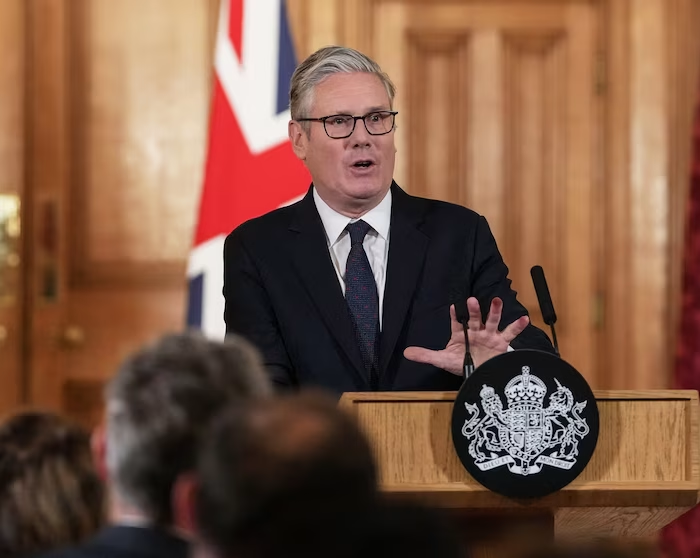
At the opposite end of that spectrum sits Starmer, often described as awkward and uninspiring. His defense is that he prioritizes substance over style. He has vowed to fight any leadership challenge, whether from Burnham or former health secretary Wes Streeting, insisting his refusal to step down reflects “a very deep sense of duty” rather than stubbornness.
From Insider to Man of the People
Burnham’s political journey is itself a study in reinvention.
He followed a well-trodden path from Cambridge University to government adviser, later serving in the cabinets of Tony Blair and Gordon Brown. But as mayor of Greater Manchester since 2017, he has cultivated a far earthier image, trading sharp suits for a more relatable look of black jackets, t-shirts, and jeans.
His Manchester base only adds to his appeal, a city celebrated globally as the home of Oasis, Manchester United, and the cultural energy of 1990s Britpop and rave culture.
The Far-Right Challenge
Standing in Burnham’s way is Reform’s candidate, Robert Kenyon, a plumber-turned-local councilor.
A victory for Kenyon would hand Farage a significant opportunity to further destabilize Labour ahead of the next general election, likely in 2029. Kenyon’s platform leans heavily on hardline positions, including:
- Building a new local hospital and adding more police
- Rapid, mass deportation of illegal immigrants
- Scrapping net-zero climate policies
However, his campaign has been overshadowed by controversy. British media unearthed old, now-deleted social media posts in which he declared himself sexist and made derogatory claims about women. Neither Kenyon nor Reform disputes the posts. Kenyon called them “crass” and admitted to making mistakes, while his party noted they predated his political career.
The Bigger Picture
Both campaigns declined interview requests, choosing instead to focus on British media in the final stretch of the race.
What makes this contest so significant is that Makerfield represents a type of battleground growing ever more important in modern Britain, a place where economic decline, political disillusionment, and the rise of populism collide.
The Bottom Line
The Andy Burnham Makerfield election is far more than a routine local vote. It has become a potential launchpad for one of Britain’s most popular politicians to seize the highest office in the land, all while testing the strength of a rising far-right movement.
If Burnham wins and follows through on his promise to challenge Starmer, an unassuming cluster of northern towns could end up rewriting the story of British leadership. For now, all eyes are on Makerfield, where the choices of 100,000 voters may echo far beyond their close-knit community.
Author