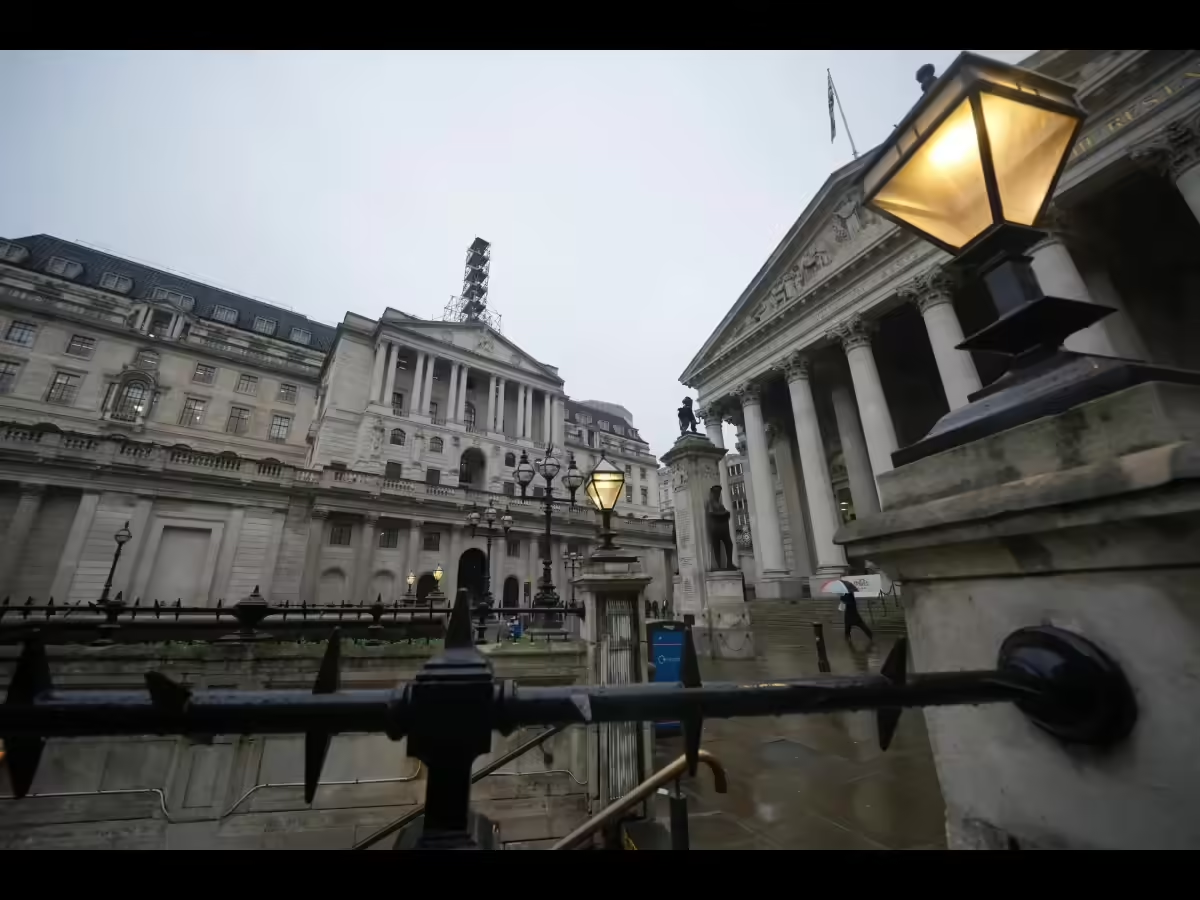
The Bank of England interest rates remained unchanged at 3.75% this Thursday, as policymakers continue to walk a delicate line between stubbornly high inflation and a sluggish economy. The decision, widely expected by economists, comes against a turbulent global backdrop shaped by the Iran war and its ripple effects on energy prices worldwide.
A Cautious Hold
The choice to keep rates steady reflected the central bank’s careful balancing act.
The hold aligned perfectly with the expectations of economists polled by Reuters. Within the Monetary Policy Committee, seven of the nine members backed the decision to maintain the current rate, signaling broad but not unanimous agreement.
Behind that consensus, however, lay a notable split in opinion.
The Dissenting Voices
Not everyone on the committee favored standing pat.
Two members broke from the majority, both pushing for tighter policy. BoE chief economist Huw Pill and external committee member Megan Greene each voted to raise the base rate by 25 basis points, which would have lifted it to 4%.
Their dissent underscores the genuine uncertainty within the bank about how aggressively to respond to persistent inflationary pressures.
The Iran War’s Inflationary Shadow
A central factor weighing on the decision was the fallout from the Iran war.
Higher energy costs stemming from the conflict have driven inflation higher across economies around the globe. As a net energy importer, the U.K. is especially exposed to these kinds of price shocks, making the situation particularly precarious.
The bank acknowledged this vulnerability directly. While prices have eased somewhat since the initial spike, it noted that the war “makes it hard to predict what is going to happen with them,” highlighting the deep uncertainty clouding the outlook.
A Mixed Inflation Picture
The U.K.’s current inflation data presents a complicated story.
Inflation held at a cooler-than-expected 2.8% in May, with the increases largely driven by rising transportation fuel costs. Yet beneath the surface, troubling signs persist:
- The economy shrank by 0.1% in April, according to recent data
- The cooler inflation reading was partly attributed to a change in the U.K.’s regulated energy price cap
- That relief is expected to be temporary
Crucially, the price cap is set to rise by 13% later this summer, when energy costs are projected to hit a two-year high.
Why Inflation May Rise Again
Despite the recent easing, the bank is bracing for inflation to tick back upward.
The expectation is that rising energy prices will carry knock-on effects throughout the broader economy. As the BoE explained, the ultimate impact will depend heavily on how long energy prices remain elevated.
The bank was candid about the limits of its own power, acknowledging that monetary policy cannot influence global energy prices. Instead, it framed its role as ensuring that higher inflation does not become entrenched or cause lasting damage, stressing that it is monitoring the situation very closely.
Markets Still Bet on a Hike
Even with peace prospects emerging, market sentiment leans toward tightening.
Despite the breakthrough in negotiations between Washington and Tehran, markets are still betting that the Bank of England will raise rates before the end of the year, according to LSEG figures. This reflects lingering doubts about whether the inflation threat has truly passed.
Adding context, the Strait of Hormuz, a critical Middle Eastern oil shipping route, had been effectively closed due to the conflict, keeping oil prices elevated throughout the crisis.
A Fragile Step Toward Peace
There are, however, signs of de-escalation on the geopolitical front.
U.S. President Donald Trump and Iranian President Masoud Pezeshkian electronically signed a 14-point Memorandum of Understanding aimed at laying the groundwork for a durable peace settlement to the four-month war. While promising, the agreement’s long-term impact on energy markets remains uncertain.
How Other Central Banks Are Responding
The BoE’s decision unfolds within a broader global context of central banks grappling with inflation.
Several major institutions have already made their moves:
- The Federal Reserve held U.S. rates steady at 3.5%–3.75%, though Kevin Warsh’s hawkish debut as Fed chair unnerved investors and sent markets swooning.
- The European Central Bank became the first major central bank to raise rates in response to the energy crisis triggered by the Iran war.
- The Bank of Japan followed suit, lifting its policy rate to a 31-year high of 1%.
Against this backdrop, the BoE’s decision to hold appears comparatively restrained.
Diverging Expert Views
Economists offered varying interpretations of the road ahead.
Luke Bartholomew, deputy chief economist at Aberdeen, suggested the BoE may be able to avoid the kind of aggressive tightening already underway at the ECB and hinted at by the Fed. He added that if energy prices continue to moderate, the conversation could even shift back toward rate cuts, though likely not until next year.
George Brown, senior economist at Schroders, struck a more cautious note. He warned the bank cannot afford complacency, describing it as “playing for time rather than going on the attack.” Still, he argued the bar for hikes remains high, citing a softer labour market and weak growth as factors that should help limit second-round inflation effects.
An Economy at a Crossroads
The overall picture is one of genuine uncertainty.
Suren Thiru, chief economist at the Institute of Chartered Accountants in England and Wales, captured the moment by describing U.K. monetary policy as standing “at a crossroads.” He noted that the U.S.-Iran peace framework has boosted hopes that inflation could cool without further tightening.
Yet he cautioned that this optimism is fragile. Renewed hostilities, he warned, could quickly tilt the balance back toward rate hikes, reversing the cautious calm.
The Bottom Line
The decision to hold Bank of England interest rates at 3.75% reflects an institution caught between competing pressures, persistent inflation on one side and a weakening economy on the other. With the Iran war injecting volatility into energy markets and a fragile peace deal still taking shape, the path forward remains far from clear.
For now, the BoE appears content to wait and watch, buying time while it assesses how energy prices and global tensions evolve. Whether that patience gives way to rate cuts or rate hikes will depend largely on forces beyond the bank’s control, leaving the U.K. economy balanced precariously at a genuine crossroads.
Author