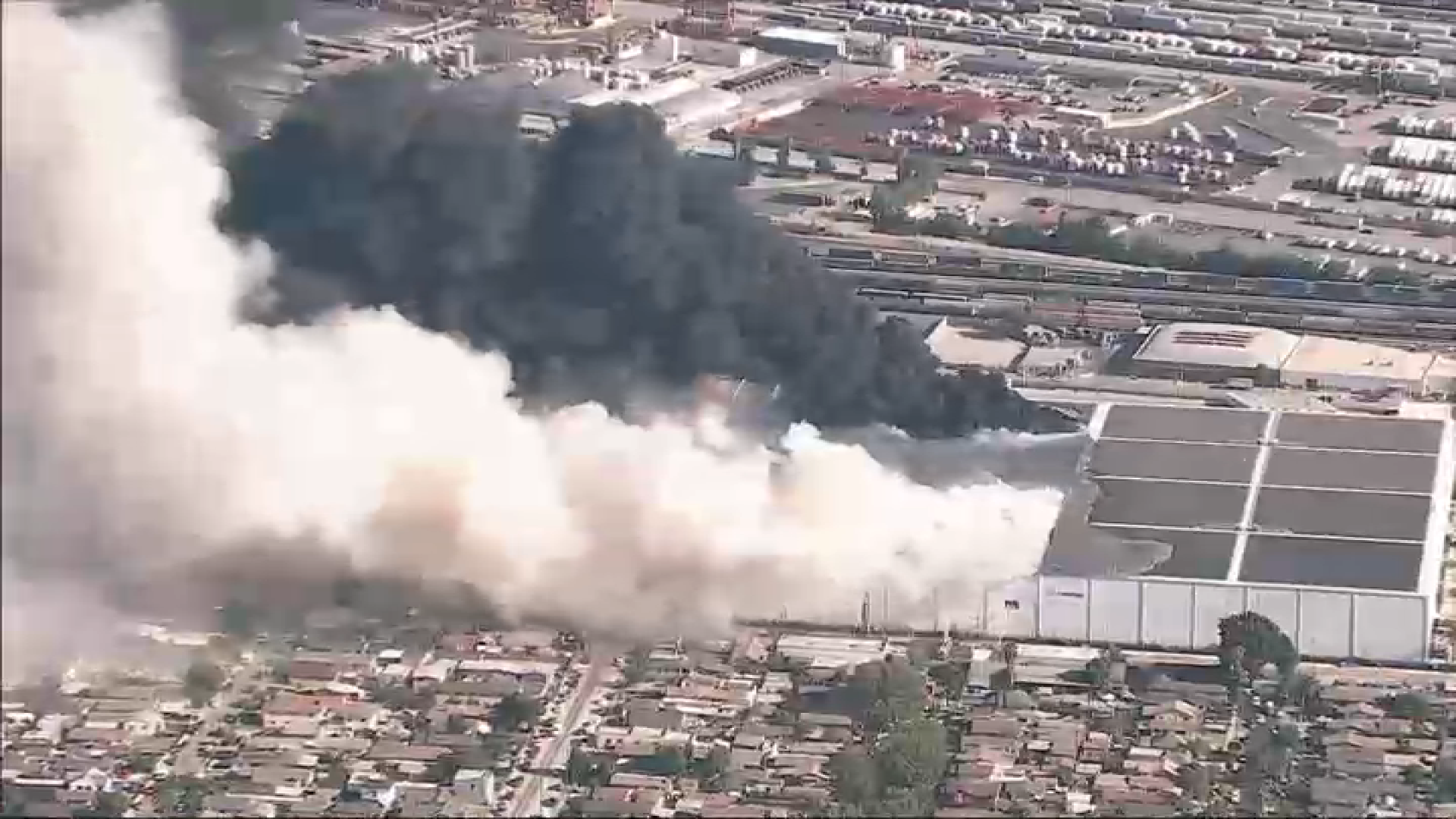
The Boyle Heights warehouse fire has pushed California to the point of formal action. Governor Gavin Newsom declared a State of Emergency on Saturday night as thick black smoke kept pouring from a Lineage Logistics cold storage facility on the 1400 block of South Los Palos Street. Days after it first ignited, the blaze refuses to fully surrender, and officials are now bracing for a long road to containment and cleanup.
A Fire That Won’t Stay Out
The trouble began shortly before 2:30 p.m. on Wednesday inside a freezer area of the cold storage building. The fire was first reported at the roughly 500,000-square-foot Lineage facility, which is used to store frozen foods. Crews initially managed to knock it down, only to watch it roar back to life and reignite later in the week. CBS News
Part of what makes this fire so difficult is the building itself. Fire officials described the structure as essentially a giant cooler, built with corrugated steel walls packed with dense foam insulation and reinforced interior steel panels. That design traps heat and keeps firefighters from easily reaching the hot spots burning deep inside. CBS News
There’s another complicating factor. The facility relied on ammonia in its refrigeration system to keep frozen food at extremely low temperatures, and that ammonia may have fueled the blaze during its first day. The presence of the chemical has raised serious questions about air quality and possible health risks for nearby residents. CBS News
Why the State Stepped In
Newsom’s declaration unlocks additional state funding for firefighting, public health services, and disaster recovery as Los Angeles continues to wrestle with the emergency. In his statement, the governor said California was mobilizing to back up Los Angeles while local officials remained in charge of the response. He emphasized that the state stood ready to protect public health, support emergency operations, and assist affected residents both during the crisis and throughout recovery.
Interestingly, local officials had not formally requested extra state resources when the declaration came down. According to Caroline Thomas Jacobs, director of the California Governor’s Office of Emergency Services, Newsom acted preemptively so the region would have help available the moment it was needed.
Jacobs noted that Cal OES has been working shoulder to shoulder with the City and County of Los Angeles and regional partners. The emergency status, she explained, streamlines coordination and lets the state tap into additional capabilities as the situation demands, all while keeping the focus on protecting communities and supporting the locally led effort.
Resources Headed to Los Angeles
The declaration opens the door to a substantial pool of state assets. Among the resources now available to the region are:
- 5.5 million N95 respirator masks ready for distribution to impacted communities
- Commercial-grade air purifiers for deployment at evacuation centers, community facilities, and other public spaces
- Bottled water and additional emergency supplies through the state’s logistics network
- Enhanced air quality monitoring and technical support
Beyond equipment, specialized personnel are on standby. Cal OES Fire and Rescue Branch leaders with technical expertise are available to advise Los Angeles fire officials on how best to handle the warehouse blaze. The state offered similar guidance during a chemical tank failure in Garden Grove, drawing on lessons that could prove useful here.
A Local Emergency, Too
The state was not acting alone. By Saturday night, both Mayor Karen Bass and Governor Newsom had issued emergency declarations, citing the scale and complexity of the incident. Earlier in the day, Bass said the Emergency Operations Center had been activated and that the city asked Newsom to waive regulations that might slow down response and recovery work. CBS News
Bass framed the joint effort around a single goal: preventing a larger disaster. The priority, she said, was not only extinguishing the flames but safely removing the toxic materials and disposing of them properly to avert an environmental catastrophe.
The Looming Biohazard Problem
One of the most pressing concerns has nothing to do with flames directly. Because the fire is burning inside a frozen food storage facility, officials worry that more than 85 million pounds of decaying food could create a biohazard. The site reportedly holds frozen bread and meat products, and further decay could produce hazardous conditions. NBC Los AngelesNBC Los Angeles
That reality means the cleanup ahead will be enormous. Crews will eventually need to haul away and dispose of thousands of tons of spoiled food, a logistics-heavy operation requiring careful coordination and transport to area landfills once the fire is finally out.
Air Quality Remains a Concern
The smoke has spread well beyond the immediate neighborhood. South Coast Air Quality Management District officials extended a special Particle Pollution Advisory through midday Sunday as the fire continued to affect air quality east of downtown Los Angeles and across parts of the San Gabriel Valley. ABC7
Monitoring equipment has been picking up troubling readings. Sensors have detected elevated levels of fine particulate matter, or PM2.5, since Friday night, with conditions ranging from “Unhealthy for Sensitive Groups” to “Very Unhealthy” across central Los Angeles County, the San Gabriel Valley, the eastern San Fernando Valley, and the northwest San Bernardino Valley. ABC7
Officials stressed that the advisory is not a shelter-in-place order. Still, health guidance is clear: anyone who sees or smells smoke should stay indoors with doors and windows shut and rely on air conditioning or air purifiers rather than systems that pull in outside air.
To support monitoring, the California Air Resources Board is coordinating with local and regional partners to keep accurate air quality information flowing, and state agencies say they are ready to deploy more resources if asked.
What Comes Next
For now, firefighters continue battling flare-ups while watching the unpredictable conditions inside the warehouse. No injuries have been reported, and the cause of the fire remains under investigation. Notably, this isn’t the first time this property has burned, as a fire broke out on the roof of the same facility back in 2024. CBS News
With state and local declarations now in place, Los Angeles has the backing it needs to tackle both the immediate firefight and the massive recovery that will follow. The coming days will test how quickly crews can contain the blaze and begin clearing the hazardous aftermath left behind.
Author