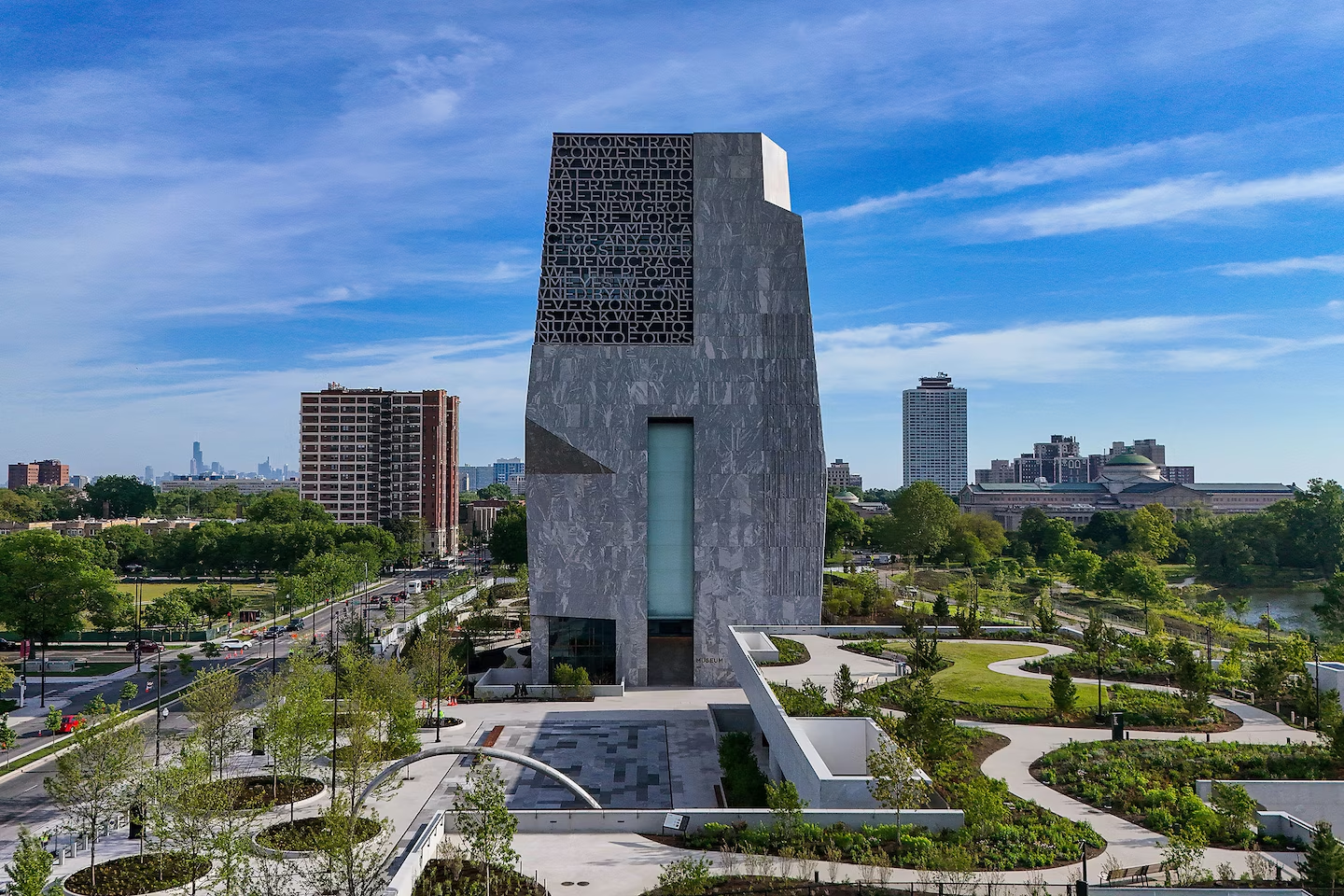
The Obama Presidential Center has officially opened, but its debut has sparked a heated debate over what the $1 billion project actually is. While many members of the public assume it functions as a traditional presidential library, critics argue it operates as something quite different — the headquarters of Barack Obama’s private foundation and a platform for promoting his worldview to future generations.
The center opened to considerable fanfare last week in a park near the shore of Lake Michigan. Yet beneath the celebration lies a contentious question that has divided Chicagoans, historians, and political observers alike: Did the public sign up for a library, or for something else entirely?
Not a Typical Presidential Library
One of the most striking differences sets the Obama Center apart from its predecessors. Every other modern presidential library houses the former president’s official papers for public viewing. The Obama Presidential Center, however, contains no such archive. Instead, Obama’s presidential records are being stored elsewhere, with the possibility that digital versions may eventually be accessible at the site.
At its core, the center serves two main purposes: it operates as a museum dedicated to Obama’s presidency and as the headquarters of the Obama Foundation, his private nonprofit organization.
The sprawling 19.3-acre campus is built for far more than quiet reflection. Its features include:
- A “Democracy in Action Lab” and various leadership programs.
- Conference facilities and foundation offices.
- A major athletic complex designed for youth sports and community programs.
These elements aren’t typically found at a presidential library, reinforcing the perception that the center is meant to be active and forward-looking rather than purely commemorative.
A “Living Institution”
The foundation itself has been open about its vision. Signs around the campus perimeter read “Bring Change Home” and “A Home For Action,” language that mirrors how the Obama Foundation describes the project in its annual reports.
Rather than calling it a traditional library, the foundation has referred to it as a “campus” and a “living institution.” Its 2024 annual report describes the goal as creating something that will inspire, empower, and connect the next generation of leaders.
Obama echoed this sentiment during the opening ceremony, insisting the center was not designed to be a lifeless mausoleum. He highlighted foundation leaders from around the world, including a Polish human-rights lawyer involved in dozens of lawsuits touching on refugees, climate policy, and anti-discrimination litigation. Obama said the center is devoted to amplifying such stories and providing the tools needed to expand their impact.
Perhaps most tellingly, he added that while the institution is non-partisan, it is not value-neutral, stating plainly that it has a point of view.
Critics See an Activism Center
For skeptics, those remarks confirmed long-held concerns. Presidential historian Tevi Troy, a former George W. Bush administration aide, noted that most presidential libraries serve as monuments to a presidency that already belongs to the past. In his view, Obama appears to want something different — a center that continues to promote his ideas and political views into the future.
Troy pointed to Obama’s background as a community organizer and activist, suggesting it was unsurprising that he would steer the project in this direction. Critics say the opening ceremony only reinforced the impression that the center is designed not merely to preserve a legacy, but to actively carry a vision forward.
The Fight Over Public Land
The debate carries extra weight because of where the center sits. It occupies roughly 19 acres of Jackson Park, often described as Chicago’s equivalent of Central Park, under a controversial 99-year agreement that city leaders approved for a one-time payment of just $10.
Opponents argue that transferring public parkland to a private foundation violated the public trust doctrine, a legal principle meant to preserve public assets for public benefit. Although legal challenges ultimately failed in court, critics emphasize that the central arguments were never fully tested on their merits.
Richard Epstein, a New York University law professor and a leading authority on the public trust doctrine who represented the Protect Our Parks group, said their defeat did not come from being told they were wrong. Instead, he explained, they were told they had no right to bring the complaint at all. He described the experience as an epic frustration, arguing that the public trust doctrine is meant to restrain the legislature rather than be set aside by it.
Financial Concerns and Unanswered Questions
Epstein’s worries extend beyond land use. He noted that courts never fully examined whether the foundation had adequate financial safeguards before taking control of the site. This includes a long-promised $470 million reserve fund intended to protect taxpayers from future liabilities. A Fox News Digital investigation reportedly found that only $1 million has actually been deposited into that fund.
The financial questions have grown louder following reports that minority-owned and local subcontractors who worked on the center say they were owed millions of dollars. Critics also highlight that the public contribution went beyond the land itself, pointing to hundreds of millions of taxpayer dollars spent on surrounding road, utility, and transportation improvements. Supporters counter that these upgrades modernized the entire area.
A “Bait and Switch”?
Some political figures have framed the project in even sharper terms. Bob Grogan, chairman of the Illinois Republican Party, claimed the project was initially promoted as a presidential library to win public support and secure the land, only to evolve into something else entirely.
Grogan bluntly described it as a Democratic headquarters on the South Side rather than a library, calling the shift a classic example of Chicago-style bait-and-switch. He argued that the foundation would naturally use the campus as its home base for meetings and planning rather than renting space elsewhere.
Adding context to the distinction, the National Archives and Records Administration confirmed that the Obama Center operates entirely under the Obama Foundation and sits outside the federal presidential library system. This means the foundation, not the federal government, controls how the center is run, what exhibits are displayed, and how Obama’s legacy is presented. The campus does, however, include a branch of the Chicago Public Library.
A More Measured View
Not everyone sees the project as purely problematic. Troy acknowledged that presidential libraries have evolved over time and that making records available digitally could benefit historians, potentially sparing researchers from cross-country travel to review documents.
He also recognized that presidents have traditionally enjoyed broad discretion over the non-archival portions of their libraries, since they raise the money themselves. As Troy put it, it isn’t the direction he would choose, but Obama raises the funds and gets to do what he wants.
Still, Troy cautioned against drifting too far from the core purpose of these institutions, which he described as memorials to a presidency and repositories for presidential documents.
The Bigger Picture
The opening of the Obama Presidential Center has reignited a fundamental debate about what such institutions should be. Supporters see a bold, modern reimagining of how a former president can continue contributing to public life. Critics see a private foundation operating on public land while sidestepping the traditional library model.
As the dust settles, several questions remain worth watching:
- Whether the promised $470 million reserve fund will be adequately funded.
- How disputes with subcontractors are ultimately resolved.
- Whether the foundation’s stewardship of public parkland holds up over the 99-year agreement.
Ultimately, the controversy surrounding the Obama Presidential Center reflects a deeper tension between honoring the past and shaping the future. Whether one views it as a visionary living institution or a departure from tradition, the project has clearly become more than just a building — it’s a symbol of competing ideas about legacy, public trust, and the role of former presidents in American life.
Author