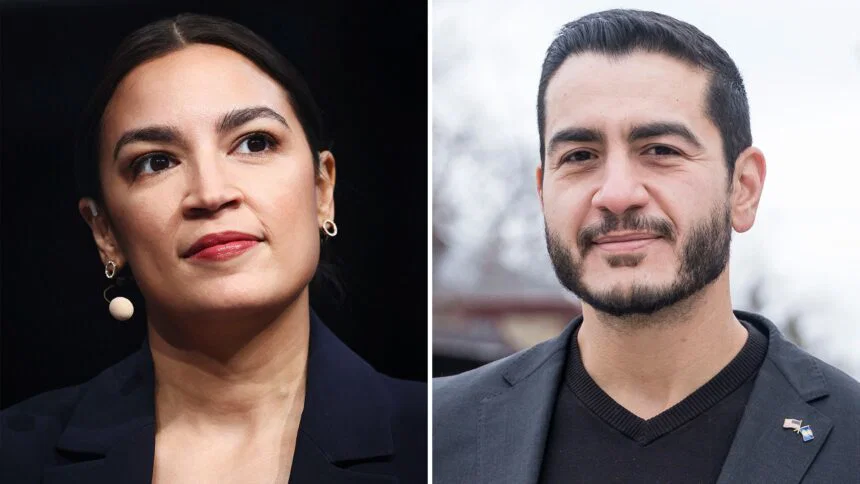
AOC endorses El-Sayed, and with that single move, one of the most closely watched Democratic Senate primaries in the country has become the latest battleground in the party’s ongoing tug-of-war between its progressive wing and its establishment. Rep. Alexandria Ocasio-Cortez threw her considerable political weight behind Abdul El-Sayed on Thursday, setting up a direct clash with the party leadership as Democrats fight to reclaim the Senate this November.
A Consequential First Endorsement
For Ocasio-Cortez, the New York firebrand widely known by her initials, this wasn’t just any endorsement. It marked the first time this cycle that she has weighed in on a contested Democratic Senate primary, making it one of her most significant moves of the midterm season.
She had notably stayed on the sidelines in competitive primaries in states like Maine, Texas, and Iowa. That restraint makes her decision to jump into the Michigan race all the more meaningful, signaling that she views this particular contest as worth the political capital.
Explaining her reasoning, Ocasio-Cortez framed the stakes in stark terms. She argued that despite the ideological rifts within the party, Democrats across the spectrum recognize this moment as existential, and that many are willing to set aside their differences to give the party the best shot at victory. In her view, El-Sayed represents that best chance right now.
Who Is Abdul El-Sayed?
El-Sayed is no stranger to the progressive spotlight. An epidemiologist, academic, and former public health official who recently served as a top health director in Wayne County, he has built his campaign around a bold progressive platform. If elected, he would make history as the nation’s first Muslim senator.
His agenda leans firmly to the left, and several positions define his candidacy:
- Strong support for Medicare-for-all as a centerpiece of his platform
- A call to abolish ICE
- Sharp criticism of Israel’s military campaign in Gaza, which he has characterized as genocide
- A pledge to reject PAC donations entirely
El-Sayed also served as a prominent surrogate for Bernie Sanders during the 2020 presidential campaign, and Sanders has long counted himself among his backers. That progressive pedigree has made El-Sayed a favorite of the party’s activist base.
The Establishment’s Concerns
Not everyone in the Democratic Party is thrilled about El-Sayed’s momentum. Senate Minority Leader Chuck Schumer and much of the party establishment have tacitly lined up behind a different candidate: centrist Rep. Haley Stevens.
The worry among establishment figures is rooted in electability. They fear that nominating El-Sayed could put a Democrat-controlled seat at risk by pushing the party too far left in a state that President Donald Trump carried in 2024. Stevens, by contrast, is seen by her allies as better positioned to win over the swing voters who often decide statewide races in Michigan.
That anxiety has translated into significant financial support. Stevens has benefited from millions of dollars in super PAC spending, including substantial contributions from Israel-aligned groups. El-Sayed’s refusal to accept PAC money stands in sharp contrast, a distinction his campaign has leaned into as a point of pride.
A Three-Way Contest
While the race is often framed as a duel between the progressive and establishment lanes, there’s a third major contender worth noting. State Sen. Mallory McMorrow, who has been building a growing national profile, is running as a progressive positioned somewhere between El-Sayed and Stevens.
McMorrow has pitched herself as a candidate capable of drawing support from both wings of the party. Like El-Sayed, she has described Israel’s actions in Gaza as genocide and said she believes war crimes were committed, though she has emphasized that reaching a solution matters more than debating definitions.
All three candidates are vying to succeed retiring Democratic Sen. Gary Peters, with the primary set for August 4.
Momentum on the Left
Ocasio-Cortez’s endorsement doesn’t arrive in a vacuum. It follows a string of striking primary victories by far-left and socialist-aligned candidates in recent contests, including high-profile showdowns in New York City and Colorado. Those wins have energized the progressive movement and emboldened it in its broader struggle against the center-left establishment.
The polling reflects that energy. Multiple recent surveys show El-Sayed leading the Democratic field. One poll placed him at 42 percent, well ahead of Stevens at 33 percent and McMorrow trailing in single digits. That represents a dramatic reversal from late 2025, when Stevens held the lead and El-Sayed sat far behind. His steady climb has only deepened establishment unease.
What the Endorsement Means
Political observers see real significance in the timing and target of Ocasio-Cortez’s support. Beyond the ideological alignment, she praised El-Sayed’s strengths in digital communication, describing it as a core competency in modern campaigning.
One pollster suggested the Michigan race could serve as a proof of concept for the progressive movement. If El-Sayed can win both the primary and the general election in such a fiercely contested swing state, it would challenge the long-held assumption that a more moderate candidate is automatically more electable, at least in the current political era.
Still, some analysts caution against reading too much into progressive wins elsewhere. Michigan, they note, is a pragmatic, closely divided state whose electorate differs meaningfully from places like New York City, where socialist-aligned candidates have thrived.
The Personal and Political Stakes
This isn’t the first time Ocasio-Cortez has backed El-Sayed. She also supported his unsuccessful 2018 bid for Michigan governor, giving their alliance a history that predates this Senate contest.
El-Sayed expressed deep gratitude for the endorsement, crediting Ocasio-Cortez with changing the trajectory of American politics and inspiring a generation to believe government can work for ordinary people. He also took a pointed swipe at Schumer, suggesting the longtime Democratic leader simply doesn’t want to see him inside the Senate.
Looking Toward November
Whoever emerges from the August primary will face former Rep. Mike Rogers, who is cruising toward the Republican nomination. Rogers is making his second consecutive Senate run after narrowly losing to now-Sen. Elissa Slotkin in 2024. Leading nonpartisan handicappers rate the Michigan Senate race as a toss-up, underscoring just how much is riding on the Democratic primary outcome.
Republicans, for their part, wasted no time responding. The Michigan GOP dismissed the endorsement as the least surprising political news of the week, framing the general election as a choice between what it called the far-left agenda of Ocasio-Cortez and El-Sayed and the commonsense values of Michigan’s working families.
With more than a month remaining before the primary and a sizable bloc of undecided voters still in play, the race remains fluid. What’s clear is that Michigan has become a defining test of where the Democratic Party is headed, and Ocasio-Cortez has just made sure the whole country is watching.
Author