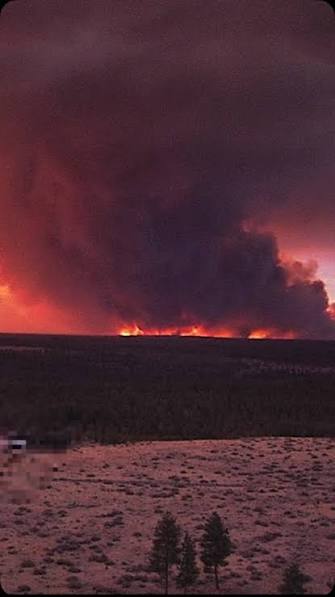
The Akawa Butte burn area remains off limits even as evacuation notices around Sisters begin to lift — and fire officials want residents to understand that those two facts are not in conflict. Containment lines holding at more than 80 percent means the fire is unlikely to spread. It does not mean the ground beneath the burn is safe to walk on.
That distinction is the entire message crews and the Deschutes County Sheriff’s Office are trying to get across right now.
Containment Is Not the Same as Safe
There is a persistent misunderstanding about what containment percentages actually describe.
Containment measures how much of a fire’s perimeter has been secured with control lines that crews expect to hold. A fire at 80 percent containment still has active interior burning. More importantly, the terrain inside that perimeter has been fundamentally altered in ways that make it hazardous to anyone unfamiliar with post-fire conditions.
Evacuation notices lift when it is safe for people to return to their homes. That is a separate judgment from whether it is safe to enter the burned landscape itself.
The Hazards Waiting in the Burn Scar
Officials have identified several specific dangers, each of which has caused serious injuries and deaths at fire sites elsewhere.
Fire-Weakened Trees
Often called hazard trees or, in firefighting slang, widowmakers, these are the single most lethal threat in a burn area.
A tree can appear entirely intact while its interior has been hollowed out by fire or its root system consumed underground. There is frequently no visible warning before it comes down. Wind is not required — these trees fall on still days, and they fall without sound until the moment they hit.
Overhead limbs present the same problem in miniature. Branches killed by heat remain suspended in the canopy until something dislodges them.
Unstable Soil and Hidden Voids
Fire burns downward as well as outward. When it consumes root systems and buried organic material, it leaves cavities beneath a surface that still looks solid.
Ash pits are the classic version of this hazard: a depression filled with fine white ash that can conceal embers hot enough to cause severe burns hours or even days after the surface appears cool. Step into one and your foot goes through before you register anything is wrong.
Slope stability is a related concern. With vegetation gone and soil structure compromised, hillsides that held firm for decades can give way — and the same conditions create serious debris flow and flash flood risk when rain eventually arrives.
Lingering Hot Spots
Deep-seated heat can persist in stumps, root channels and duff layers long after visible flames are gone. Under the right wind conditions, those pockets can throw embers and start new fires.
For anyone walking through, they are simply an unmarked burn risk — there is no reliable way to identify them from the surface.
Active Heavy Equipment
This is the hazard people tend to overlook entirely.
Burn areas during and after suppression are working job sites. Dozers, engines, water tenders, chippers and logging equipment operate on narrow roads with limited sight lines and heavy dust. Operators are not expecting civilian traffic, and in many cases cannot see or hear an approaching vehicle or person in time.
Why the Closures Stay in Place
Every person who enters a closed burn area creates a chain of consequences that extends well beyond their own risk.
- Rescues divert resources. Crews still working the incident have to stop and respond.
- Rescuers face the same hazards, often under time pressure that increases exposure.
- Assessment work gets delayed when teams must account for unauthorized people in the area.
- Recovery is set back, since damaged soil and seedling regrowth are easily destroyed by foot and vehicle traffic.
Closures are not bureaucratic caution. They reflect a judgment that the ground has not yet been evaluated tree by tree and slope by slope.
What Returning Residents Should Do
For those coming home as notices lift, a measured approach matters.
- Stay on established roads and out of closed zones, regardless of how accessible they appear.
- Inspect your property from a distance first, watching for leaning trees near structures and driveways.
- Treat all downed lines as energized, and report them rather than moving them.
- Watch for wildlife displaced by the fire and moving through unfamiliar territory.
- Check for smoldering material around outbuildings, woodpiles and fence lines.
- Document damage thoroughly before beginning any cleanup, for insurance purposes.
- Wear an N95 or better during cleanup, since disturbed ash carries fine particulates and potentially hazardous residue from burned structures.
Air Quality Still Deserves Attention
Even with flames largely subdued, smoke and ash remain a factor. Ash disturbed by wind or activity puts fine particles back into the air, and interior burning within the perimeter continues to generate smoke.
Residents with asthma, COPD or cardiac conditions — along with children and older adults — should limit outdoor exertion until conditions clearly improve, and check current air quality readings rather than relying on how the air looks.
The Longer Timeline
Burn scars remain hazardous for far longer than most people expect. Hazard trees continue falling for years as decay progresses. Soil instability persists through multiple wet seasons. Some of the most dangerous post-fire events — debris flows in particular — occur months after the last ember dies, when heavy rain hits ground that can no longer absorb it.
Land managers will reopen sections of the Akawa Butte area progressively, as crews complete hazard assessments and mitigation work. That sequencing is deliberate.
The Bottom Line
The fire near Sisters is largely contained, and residents are returning. That is genuine progress.
But officials are asking for patience on one specific point: stay out of the burn area until it is formally declared safe. The dangers there are not the dramatic, visible kind that prompt evacuations. They are quiet — a tree that falls without warning, a patch of ground that isn’t ground, a hot spot buried under cold-looking ash.
Those are precisely the hazards that catch people who assume the danger ended when the flames did.
Author
-
Lucienne Albrecht is Luxe Chronicle’s wealth and lifestyle editor, celebrated for her elegant perspective on finance, legacy, and global luxury culture. With a flair for blending sophistication with insight, she brings a distinctly feminine voice to the world of high society and wealth.