The funeral of Ayatollah Khamenei has drawn an ocean of mourners to the streets of Tehran, marking the start of one of the largest and most emotionally charged farewells the country has ever witnessed. On Saturday, the Iranian capital transformed into a sprawling stage of grief and defiance as the weeklong mourning period officially began — a period designed not only to honor the fallen leader but to project the endurance of the Islamic Republic itself.
A City Draped in Black
From the pre-dawn darkness, crowds clad entirely in black began filling the streets around Tehran’s Grand Mosalla, an enormous mosque and prayer complex at the heart of the capital. Their early arrival followed direct appeals from Iran’s leadership, who urged citizens to show up in overwhelming numbers.
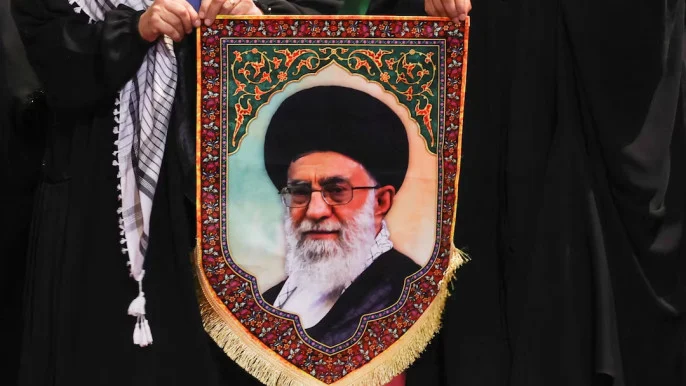
As the sun climbed higher, so did the crowd. By mid-morning, tens of thousands packed the vast courtyard, gathering beneath a towering banner bearing the image of the late leader. Many wailed openly, beat their chests in rhythmic mourning songs, and waved the national flag.
At the center of it all rested the coffin of the 86-year-old Ayatollah. Wrapped in the Iranian flag and crowned with his signature black turban, his body lay enclosed in a glass case. Beside him stood four more coffins — those of family members who were killed alongside him during the opening strikes of the war with the United States and Israel four months earlier.
A Surge of Nationalism
What set this gathering apart from traditional Iranian ceremonies was the striking presence of national symbolism. Mourners who traveled from every corner of the country embraced flag-waving on a scale rarely seen before, choosing the national banner over the religious flags that typically dominate such events.
This shift reflects a broader wave of nationalist feeling that has swept through Iran since the war began. The mood was not purely one of sorrow — it carried an unmistakable edge of anger and resolve. In various clips circulating from the scene, some mourners could be heard chanting cries for revenge, vowing to strike back against those responsible for the leader’s death.
The atmosphere was intense in every sense. With temperatures climbing to around 93 degrees, water was misted from rooftops in an effort to cool the packed crowds. Roads surrounding the site were sealed off to vehicles, leaving many to travel the final stretch on foot while loudspeakers filled the air with religious music and giant portraits lined the streets.
An Even Bigger Farewell Ahead
Saturday’s turnout, as staggering as it was, may only be a prelude. Organizers expect the crowds to swell dramatically on Monday, when the casket will be carried in a procession through Tehran’s streets.
According to those planning the event, somewhere between 15 and 20 million people could converge on the capital alone — a figure that would place this among the largest funerals ever held for any world leader. Tehran’s mayor echoed that projection, suggesting the turnout could reach as high as 20 million.
The scale of the ceremony had been delayed for months because of the conflict, pushing the elaborate proceedings well beyond their usual timeframe.
Questions of Succession
The late Ayatollah has been succeeded by his 56-year-old son, Mojtaba Khamenei. Yet his absence from the public eye has fueled speculation and uncertainty.
According to an Iranian official and a Middle Eastern diplomat, the younger Khamenei has not been seen since the war erupted and is not expected to appear at the funeral events. Multiple sources indicated that he was injured in the same attack that claimed his father’s life, though the severity of those injuries remains unknown.
Behind Closed Doors
Before the public ceremonies began, more private proceedings took place on Friday. The late leader’s body was visited by senior Iranian officials, top military commanders, and a roster of foreign dignitaries paying their respects.
Among those present was the influential Parliament Speaker, who also serves as Iran’s lead negotiator in talks with Washington. Days earlier, he had called on Iranians to attend by the millions, describing the occasion as an unparalleled farewell that would prove the nation would not stay silent in the face of what he framed as oppression.
International representation was notable as well. Visitors reportedly included a former Russian president along with delegations from China, Turkey, Saudi Arabia, India, and Afghanistan.
Security on High Alert
As the ceremonies open to the general public, safety has become a pressing concern. Iran has painful experience with attacks on such gatherings. A previous assault claimed by the Islamic State struck a large memorial in 2024, killing dozens of people in the central city of Kerman.
With millions expected to flood public spaces, authorities face the enormous challenge of protecting crowds of unprecedented size against potential threats.
A Farewell That Crosses Borders
The mourning will not remain confined to Tehran. The ceremonies are set to continue in Qom, the center of Iranian religious scholarship, before moving across the border into Iraq, home to some of Shia Islam’s holiest sites.
Holding events in Iraq carries strategic weight, allowing Iran’s Revolutionary Guard Corps — the country’s dominant military, political, and economic power — to display its regional influence. Notably, Iran-aligned militias in Iraq have reportedly launched hundreds of attacks against U.S. facilities there since the war began.
The Final Resting Place
The lengthy sequence of tributes will culminate later in the week. Following the events in Qom and Iraq, the Ayatollah is scheduled to be laid to rest on Thursday in his hometown of Mashhad — a city that houses the most revered Shia shrine in all of Iran.
As Iran navigates this moment of grief, defiance, and transition, the massive funeral stands as both a mourning ritual and a powerful statement — a display meant to signal that, even after the loss of its long-standing leader, the Islamic Republic intends to endure.
Author