The debate over Strait of Hormuz fees has taken a fresh turn, as Iran’s top envoy to China revealed that vessels passing through the vital waterway will soon face new charges, though not everyone will be treated equally. In a move likely to stir controversy with Washington, Tehran has indicated that nations it considers friendly, chief among them China, could receive special treatment. The announcement highlights the ongoing geopolitical tug-of-war surrounding one of the world’s most strategically important shipping routes.
A Promise of Preferential Treatment
Speaking at a prominent international forum in Beijing, Iran’s ambassador to China laid out Tehran’s evolving approach to the strait. According to his remarks, ships travelling through the passage would indeed be subject to new fees.
However, he was quick to clarify that certain countries would benefit from favourable arrangements. He specifically named China, along with other nations Tehran regards as allies, as recipients of what he described as special considerations when it came to determining the nature and level of these charges.
This distinction between friendly and other nations suggests Iran intends to use control over the strait as both an economic tool and a diplomatic lever, rewarding partners while potentially pressuring rivals.
The Backdrop of a Fragile Agreement
The announcement comes against the backdrop of a delicate arrangement reached earlier between Iran and the United States. That initial deal, signed the previous month, was designed to halt hostilities between the two nations.
Under its terms, commercial vessels were granted free passage through the waterway for a period of 60 days. Yet significant uncertainty lingers over what rules will govern the strait once that window closes.
Negotiations toward a lasting settlement remain ongoing, but the two sides appear far from aligned. Washington has taken a firm stance, insisting that any final agreement must prohibit Iran from imposing tolls or fees on ships using the strait. Tehran, clearly, has other ideas.
Fees Versus Tolls: A Careful Distinction
One of the more intriguing aspects of the ambassador’s comments was his deliberate choice of language. While confirming that charges would be introduced, he firmly rejected the notion that these amounted to tolls.
He argued that because the strait forms part of Iran’s territorial waters, the country was fully entitled to collect what he termed service fees. In his view, this framing distinguishes the charges from the kind of tolls Washington has explicitly ruled out.
According to his explanation, these fees would serve several practical purposes, including:
- Guaranteeing the safety and security of passage through the strait.
- Overseeing and supervising the movement of vessels.
- Addressing the environmental consequences created by the enormous volume of ships.
By linking the charges to security and environmental management, Iran appears to be building a justification that positions the fees as responsible governance rather than opportunistic taxation.
Partnering with Oman
Iran is not approaching this challenge alone. The ambassador emphasised that Tehran was working closely with neighbouring Oman to develop new arrangements for managing the strait.
This cooperation makes geographic sense, as both nations sit on opposite sides of the narrow waterway. To formalise their collaboration, the two countries have reportedly established a joint committee tasked with determining how this strategically vital passage will be governed going forward.
Such a partnership could lend additional legitimacy to Iran’s plans, presenting the new framework as a shared regional initiative rather than a unilateral decision imposed by Tehran alone.
A Waterway of Immense Global Importance
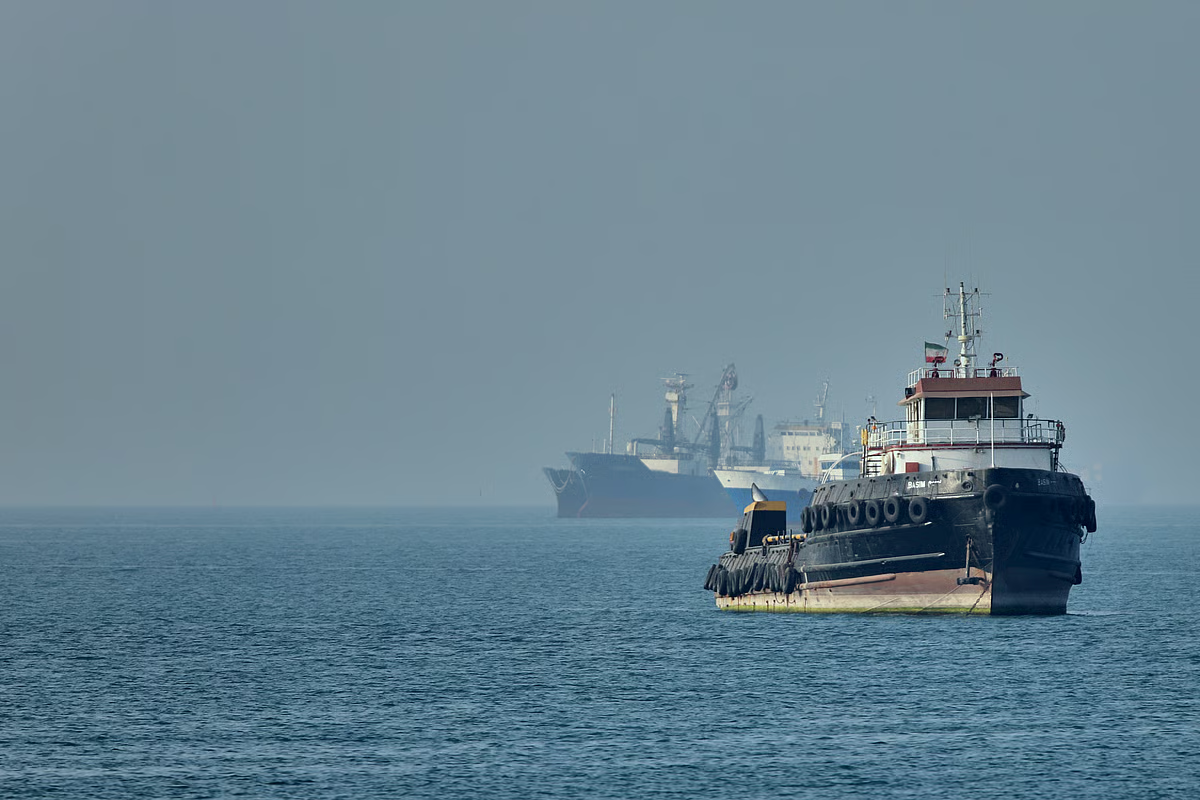
To appreciate why these developments matter so much, one must understand the sheer significance of the Strait of Hormuz to the global economy. During peacetime, this single passage handles an astonishing share of the world’s energy trade.
Roughly one-fifth of all crude oil and liquefied natural gas shipped worldwide passes through the strait. Any disruption to this flow sends ripples across international markets, affecting energy prices and economic stability far beyond the region.
That vulnerability was starkly demonstrated during the recent conflict. When Iran effectively closed the strait during the war launched by the United States and Israel in late February, energy prices surged dramatically, underscoring just how much the world depends on the uninterrupted movement of ships through these waters.
The Shadow of Recent Conflict
The current disputes cannot be separated from the four-month war that reshaped tensions in the region. The ambassador himself stressed that the strait had transformed into a security issue in the wake of that conflict.
The war left lasting marks on the strategic landscape. In response to Iran’s actions, the United States imposed a naval blockade on Iran’s southern ports in April, aiming to choke off Iranian oil exports. This tit-for-tat escalation heightened the stakes surrounding control of the waterway.
Now, as the two sides attempt to negotiate a permanent settlement, the question of who controls passage through the strait, and on what terms, has become a central point of contention.
Balancing Power and Diplomacy
Iran’s approach reflects a careful balancing act between asserting sovereignty and navigating international pressure. By insisting on its right to charge service fees while offering concessions to allies, Tehran seeks to strengthen its strategic partnerships while pushing back against American demands.
The offer of preferential treatment to China is particularly telling. As one of the world’s largest energy importers and a key economic partner for Iran, China represents both a valuable ally and a counterweight to Western influence. Extending favourable terms to Beijing reinforces this important relationship.
At the same time, this strategy risks further inflaming tensions with Washington, which remains determined to prevent Iran from monetising or weaponising access to the strait.
An Uncertain Road Ahead
As negotiations continue, the future of the Strait of Hormuz remains deeply uncertain. The competing visions held by Iran and the United States suggest that reaching a mutually acceptable agreement will be no easy task.
For now, Iran appears intent on establishing a framework that asserts its authority over the waterway while cultivating goodwill among friendly nations. Whether this approach will succeed in the face of American opposition remains to be seen.
What is clear, however, is that the strait will continue to serve as a focal point for regional and global tensions. With so much of the world’s energy supply flowing through this narrow channel, the decisions made in the coming months could carry consequences reaching well beyond the Middle East.
Ultimately, the situation serves as a powerful reminder of how a single stretch of water can hold enormous sway over international relations, energy markets, and the delicate balance of power in one of the world’s most volatile regions.
Author