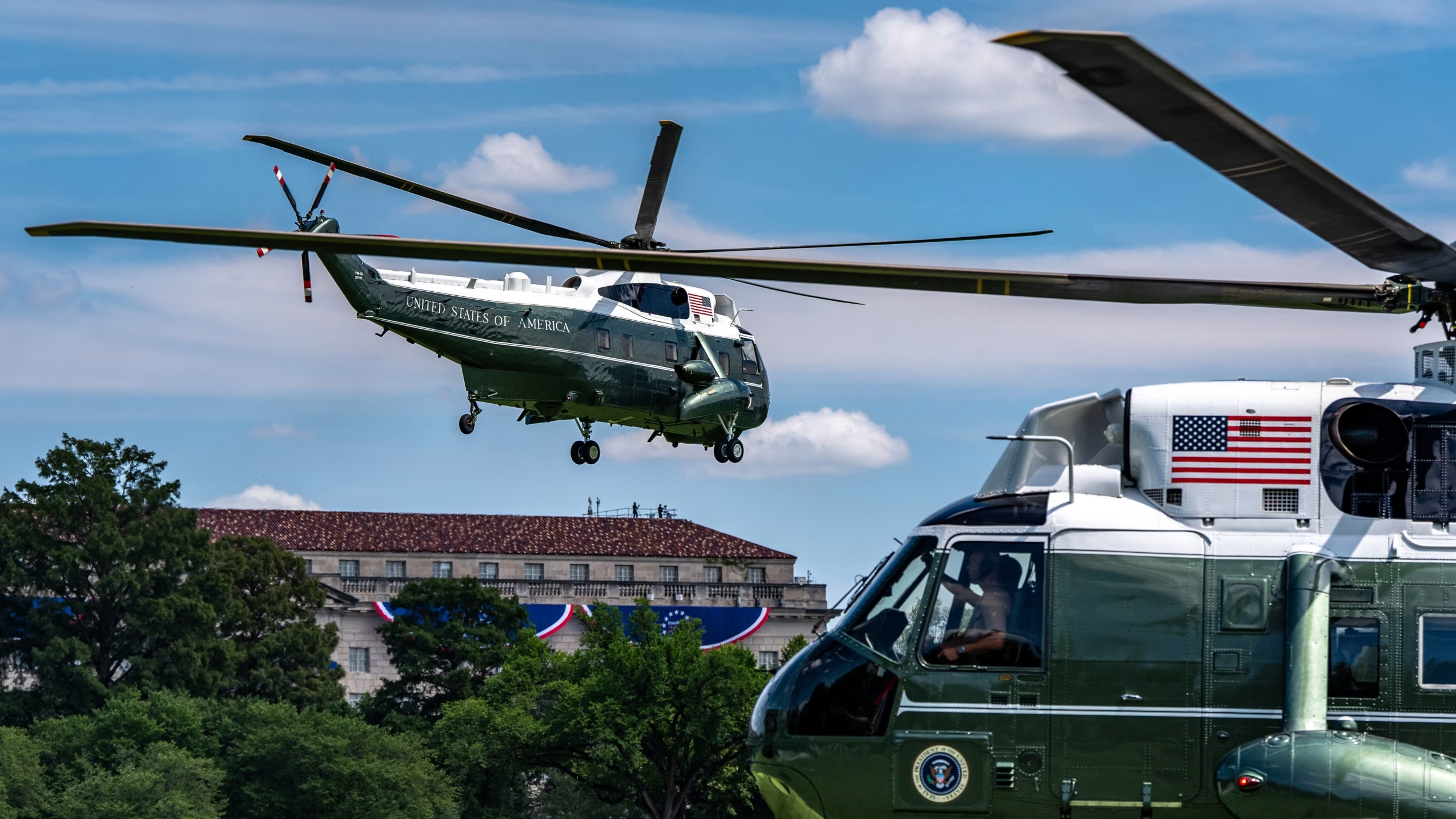
Marine One is now at the center of a federal aviation safety investigation after the presidential helicopter came closer than permitted to a commercial airliner over Washington, D.C. The incident happened Tuesday while the president was aboard, and both the National Transportation Safety Board and the Federal Aviation Administration are examining what occurred.
The story was first reported by The Wall Street Journal, which said the helicopter flew too near a commercial jet departing from Ronald Reagan Washington National Airport.
What Investigators Have Confirmed
The NTSB verified to Axios that it is looking into a reported loss of separation event involving the two aircraft. That phrase carries specific meaning in aviation. It describes a situation where the minimum required distance between aircraft, whether measured laterally or vertically, was not maintained.
An FAA spokesperson said the agency is reviewing the event and offered an early assessment. Based on the preliminary safety review, the separation loss was momentary, and the two aircraft continued moving apart afterward rather than converging further.
The spokesperson also emphasized that this was not a case of aircraft operating without oversight. The controller handling the airspace was in communication with both the commercial pilot and the Marine One pilot throughout the episode. The president, he said, was never in danger.
The White House Response
Kush Desai, a White House spokesperson, echoed that framing while acknowledging the incident occurred. He said the president was at no point in harm’s way during the brief loss of separation, and that the administration continues coordinating with military aviation personnel, the FAA and other security staff to maintain presidential safety.
The statement is notable for what it does not do. It does not dispute that the aircraft came too close. It reframes the event as brief, controlled and non-threatening rather than denying it happened.
Why This Airspace Is Uniquely Difficult
Washington’s airspace is among the most complicated in the country, and the reasons are structural rather than incidental.
Reagan National sits directly on the Potomac River, minutes from downtown, with approach and departure paths threading between restricted zones over federal buildings and monuments. Layered on top of that commercial traffic is a steady volume of military and government helicopter movement, including presidential transport, that operates on its own routes at low altitude.
The result is an environment with very little geometric slack. Aircraft are separated by relatively narrow margins by design, because the surrounding restricted airspace does not permit wide dispersal. When something drifts even slightly from plan, the buffer disappears quickly.
Regulators have been working to address safety in increasingly congested national airspace generally, and the capital region represents the sharpest version of that challenge.
The Shadow of January 2025
This investigation does not occur in a vacuum. It follows the fatal midair collision near Reagan National in January 2025, an event that fundamentally changed how the airport’s airspace is managed.
In response to that crash, the FAA imposed permanent restrictions and prohibited mixed helicopter and jet traffic in the area. The core principle behind those rules was straightforward: reduce the number of situations in which rotary-wing and fixed-wing aircraft occupy overlapping space at the same time.
That history is precisely why a loss of separation involving a helicopter and an airliner near this specific airport draws immediate federal scrutiny. Under ordinary circumstances, a momentary separation issue might generate a routine review. Here, it touches directly on rules written in response to lives lost.
What Investigators Will Actually Examine
The public statements so far describe what happened. The investigation will focus on why.
Several questions typically drive an inquiry of this type. Whether the helicopter deviated from its assigned route or altitude, and if so, what caused the deviation. Whether the departing aircraft followed its expected profile. Whether controller instructions were timely, clear and correctly executed by both crews. And whether any automated warning systems activated aboard either aircraft.
Investigators will also examine how presidential movements are coordinated with civilian traffic in practice, not just in policy. Marine One operations involve security considerations that can constrain how much advance routing information is shared and how much flexibility controllers have. Understanding whether those constraints contributed to the event is likely to be a central line of inquiry.
The Broader Question
Loss of separation events are not rare in absolute terms. The aviation system logs them regularly, and the vast majority resolve exactly as this one apparently did, with aircraft moving apart and no one aware anything unusual occurred.
What makes this case significant is location and context. It happened in the airspace that has received the most intensive safety attention in the country over the past eighteen months, and it involved the aircraft carrying the president.
The findings will matter beyond this single flight. If the review identifies a procedural gap in how presidential helicopter movements integrate with commercial traffic around Reagan National, the remedy would likely apply broadly rather than to one route or one crew.
For now, the confirmed facts are limited. Two aircraft came closer than rules allow. A controller was talking to both. They separated on their own. Two federal agencies want to know how it happened.
Author
-
Lucienne Albrecht is Luxe Chronicle’s wealth and lifestyle editor, celebrated for her elegant perspective on finance, legacy, and global luxury culture. With a flair for blending sophistication with insight, she brings a distinctly feminine voice to the world of high society and wealth.