Ten years ago, an international tribunal ruled that China’s sweeping claims across the South China Sea had no basis in law.
China ignored it then. It is ignoring it now.
On Sunday, fourteen countries marked the anniversary with a joint statement reaffirming that the ruling stands — and Beijing responded by calling it “a piece of waste paper.”
The Statement
Japan, the Philippines and the United States led a coalition of fourteen nations declaring that China’s maritime claims lack legal foundation.
“We reaffirm that the award rendered 10 years ago by the Arbitral Tribunal is a significant milestone and is final, legally binding and definitive between China and the Philippines,” the statement said.
The full list of signatories:
- Australia
- Britain
- Canada
- Estonia
- Germany
- Italy
- Japan
- Latvia
- Lithuania
- New Zealand
- Philippines
- Romania
- Slovenia
- United States
The geographic spread is notable. This is not merely a regional grievance. European nations with no territorial stake in the waterway signed on — a reflection of how much global trade depends on it.
What the 2016 Ruling Actually Said
The Philippines brought its case to the Permanent Court of Arbitration and won.
The tribunal found that China’s expansive assertion of sovereignty over the South China Sea had no basis under international law.
It was, on paper, a decisive legal victory.
Beijing has rejected it continuously ever since.
China’s Response
The Chinese foreign ministry did not soften its position for the anniversary.
“The so-called award is nothing but a piece of waste paper that is illegal, null and void, and has no binding force,” the ministry said.
It reiterated China’s sovereignty claims and blamed tensions in the region on intensified military deployments by outside powers — the United States chief among them.
Beijing called on other nations to respect its territorial and maritime rights and to stop actions it says undermine regional stability.
The Diplomatic Escalation
China went further than a written rebuttal.
In a separate statement late Sunday, the foreign ministry confirmed it had summoned the chief minister of Japan’s embassy in Beijing.
The protest concerned remarks by Japan’s foreign minister marking the ruling’s anniversary, as well as the joint statement itself.
Beijing pledged to respond “firmly and forcefully” to what it characterized as Japanese provocations. It also raised complaints over other issues, including Taiwan.
That combination — South China Sea, Taiwan, Japan — is not accidental. Beijing increasingly treats these as a single front.
What Is Actually Happening at Sea
Beneath the legal argument sits a physical one.
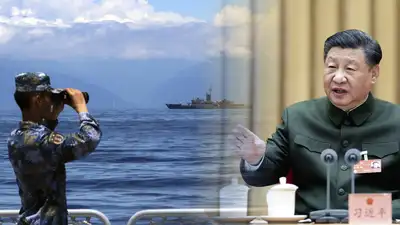
The Philippines and China have been locked in repeated maritime confrontations in recent years.
Manila accuses Beijing of conducting “dangerous manoeuvres” inside its exclusive economic zone — the waters where, under international law, the Philippines holds sovereign rights over resources.
Filipino fishermen have reported being driven away from waters they have worked for generations.
Why a Binding Ruling Isn’t Binding
This is the uncomfortable lesson of the past decade.
International law produced a clear verdict. That verdict has no enforcement mechanism.
There is no body that can compel China to withdraw its vessels, dismantle its installations, or respect Philippine fishing grounds. The tribunal could rule. It could not act.
What remains is exactly what happened Sunday: statements, anniversaries, diplomatic protests, and a coalition of nations repeating that the law says what it says.
Beijing’s counter-strategy is equally clear. Reject the ruling’s legitimacy entirely, reframe the dispute as external interference by the United States, and continue operating in the waters regardless.
Why the World Cares
The South China Sea is not a peripheral concern.
An enormous share of global trade transits these waters. The fisheries feed millions across Southeast Asia. The seabed holds significant energy reserves.
More fundamentally, the dispute has become a test case for whether international maritime law functions at all when a major power simply declines to accept it.
Fourteen countries said Sunday that it does.
China said it is waste paper.
Ten years on, the ruling stands unchallenged in law and unenforced in practice — and neither side shows any sign of moving.
Author