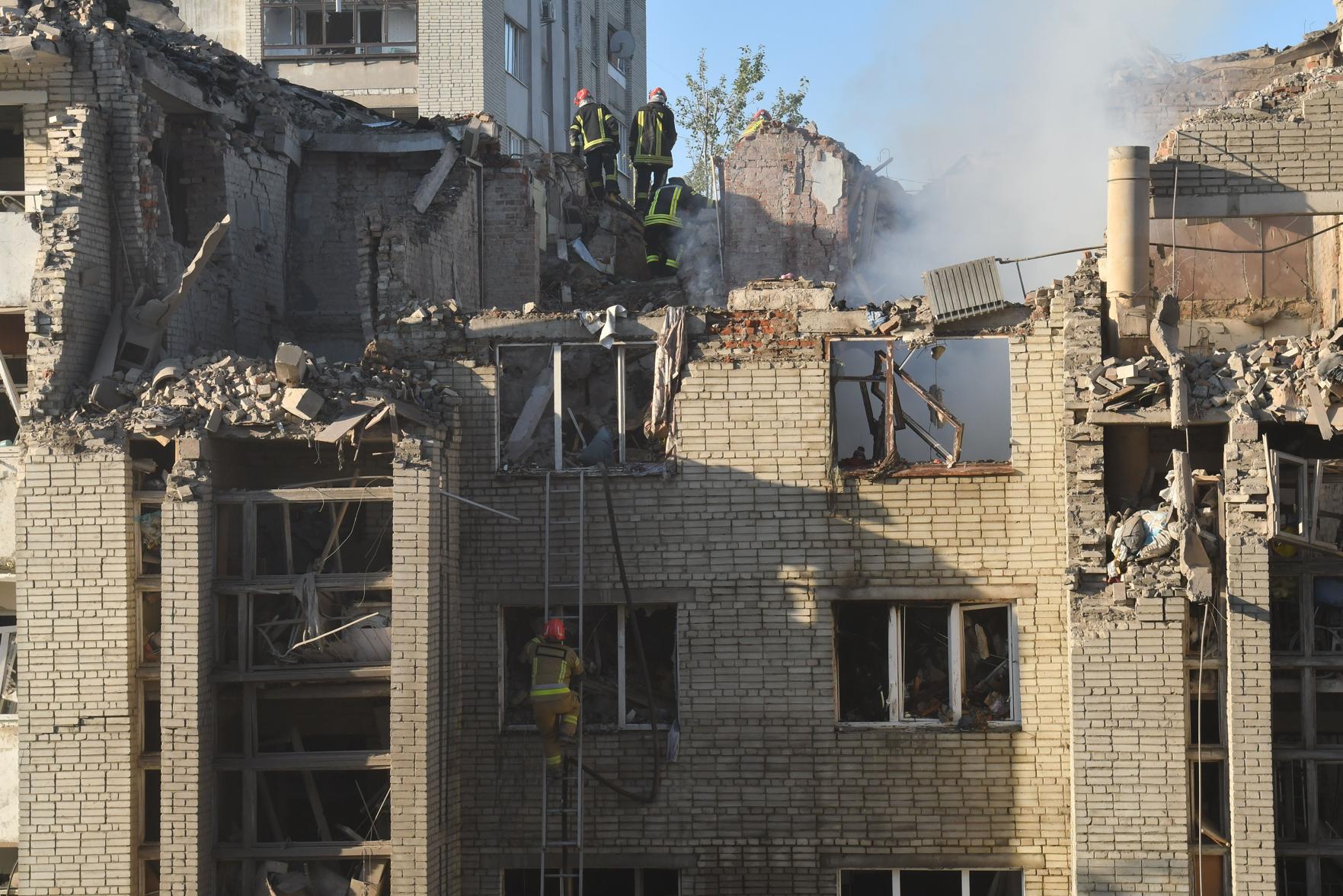
Russian strikes on Kyiv early Saturday killed at least nine people and wounded twenty-eight more, according to Ukraine’s State Emergency Service, in an attack that hit residential neighbourhoods across multiple districts of the capital.
Mayor Vitali Klitschko confirmed the city had come under ballistic missile attack. AFP reported hearing more than ten explosions as the strikes unfolded.
Fires broke out across several parts of Kyiv, and power was cut in some areas.
Where the Missiles Landed
The heaviest toll came in Darnytskyi district, where emergency services reported at least seven people killed and fourteen injured, two of them children.
In Solomyanskyi district, two people died and eight were wounded, including two children, when a five-storey residential building was partially destroyed.
Klitschko reported that a residential block in Shevchenkivskyi had also been partly demolished, with people trapped inside the wreckage.
One missile came down close to the Lithuanian embassy. Lithuania’s foreign ministry said windows were shattered and debris scattered across the compound, though no casualties among staff were reported.
A Pattern That Is Intensifying
Moscow has stepped up ballistic missile attacks on the capital in recent weeks, a shift that carries specific tactical significance.
Ballistic missiles descend at extremely high speed on a steep trajectory, leaving defenders a window measured in seconds rather than minutes. Only a narrow set of systems can engage them reliably, and the Patriot is the principal one available to Ukraine.
That is why Zelensky has framed interceptors as the single most urgent requirement facing his country.
The Poland Incident
Saturday’s strikes follow closely on another troubling development. Two days earlier, a suspected Russian cruise missile came down inside Poland during a broad assault on Ukraine that killed at least eight people, six of them members of a single family.
Any munition crossing into NATO territory carries obvious escalation risk, and the incident has sharpened debate within the alliance about air defence coverage along its eastern flank.
The Patriot Question in Washington
The timing of the attack is uncomfortable for Kyiv. Zelensky had travelled to Washington earlier in the week specifically to press for a licence allowing Ukraine to manufacture Patriot interceptors domestically.
Asked about that request at a cabinet meeting held at Camp David on Friday, President Donald Trump said no agreement had been reached, describing discussions as ongoing.
He was explicit about his reservations, saying the United States must be very careful about permitting anyone else to build the system and calling any such transfer a significant step.
His stated concern was the long-term risk of proliferation. He acknowledged he did not expect it to happen in this case, but noted that recipients of advanced technology can eventually become adversaries.
Zelensky’s Follow-Up
Writing on X on Friday, Zelensky said he had followed his meeting with Trump with what he described as a good telephone conversation with Vice-President JD Vance.
He restated the core message. With Russian air attacks continuing without pause, air defence, and specifically Patriot interceptors capable of engaging ballistic missiles, remains the top priority.
Why Domestic Production Matters to Kyiv
Ukraine’s interest is not simply in receiving more missiles. Every delivery depends on a political decision in Washington that can be delayed, reduced or reversed.
Domestic manufacturing would change that calculation permanently. It would also address a supply constraint that exists independently of politics, since global Patriot production has struggled to keep pace with demand, a shortage worsened by heavy expenditure of interceptors during American operations against Iran.
Ukraine’s Counter-Campaign
Kyiv has not confined itself to defence. Ukrainian forces have escalated retaliatory strikes over recent months, including attacks on several retail warehouses belonging to Wildberries, Russia’s largest online retailer.
Ukrainian officials describe these as legitimate military targets, arguing the facilities function as logistics hubs through which Russian forces procure equipment. The stated aim is disrupting supply chains feeding the Russian army.
The Human Cost in Numbers
Behind the district-by-district reporting sits a familiar pattern. The dead and injured were in apartment buildings, not military positions. Among the wounded were at least four children.
Nine deaths in a single morning is not exceptional by the standards this war has established, which is itself the most sobering detail. Russian strikes on Kyiv have become routine enough that a residential building collapsing with people inside registers as a normal Saturday.
For Zelensky, each such morning strengthens the argument he is making in Washington. Whether that argument produces interceptors, or a licence to build them, remains unresolved.
Author
-
Lucienne Albrecht is Luxe Chronicle’s wealth and lifestyle editor, celebrated for her elegant perspective on finance, legacy, and global luxury culture. With a flair for blending sophistication with insight, she brings a distinctly feminine voice to the world of high society and wealth.