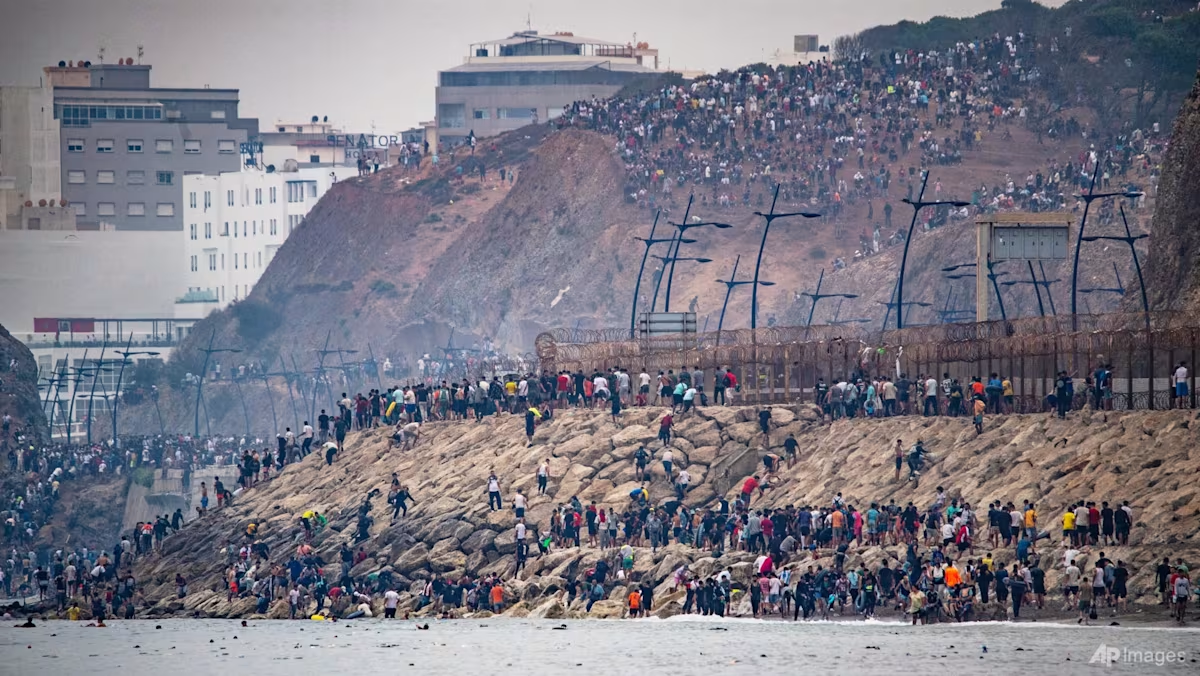
The Ceuta border crossing that opened on Thursday morning did not open by any official announcement. It opened on social media, and within hours roughly fifty thousand people had poured into a Spanish town of just 84,000 residents.
By Friday evening almost all of them had gone back, hungry, sunburnt and disillusioned.
How Word Spread
Mohammed Ahmidho, 37, saw it on his feeds like everyone else. The heavily fortified frontier separating Morocco from the Spanish territory was reportedly passable.
What he found on arrival astonished him. Moroccan police, by his account, were encouraging the crowd to go, telling them to come to Spain.
People crossed by whatever means presented itself. Some climbed the fence. Others squeezed through gaps torn in chain-link. Many swam, some in wetsuits and flippers, others floating in orange life preservers or pink inflatable rings.
At least sixty people died in the chaos.
A Surge Beyond 2015
Spain’s interior ministry put the number at approximately fifty thousand arrivals across Thursday and early Friday.
That figure exceeds anything recorded during a comparable window at the height of the European migration crisis in 2015, the episode that reshaped the continent’s politics and fuelled the rise of its anti-immigration parties. Eleven years later, Ceuta produced the scene European governments had spent a decade trying to prevent.
The City Shut Down
Residents responded by disappearing indoors. Shops closed. Businesses locked their doors.
Outside, young men with nowhere to go filled public squares, avenues, residential courtyards, hillside viewpoints and the spaces beneath bridges. Some swam in water patrolled by a Spanish naval vessel. Others waded through drifting refuse caught in the current.
The beach told its own story, scattered with items abandoned during the crossing: single shoes, a discarded wetsuit, phone cases, an identity card issued in Casablanca.
Spanish soldiers mobilised the previous day stood atop tanks watching people drink from beach showers, each branded with a tourism slogan inviting visitors to feel the emotions of Ceuta.
Nothing Waiting on the Other Side
The expectation that drove the crossing collided almost immediately with reality.
Ahmidho, standing bare-chested with his shirt over his shoulder and his feet cut from scrambling across rocks, said he had come looking for work and found soldiers and police pressing him to leave. There was no water, no food, nowhere to sleep. Nothing at all.
Douae Tabit, 19, described hearing about the open border online and watching the news go viral before spreading by word of mouth across the country. Fluent in English, French and Spanish and working as a nurse and photographer, she made the decision on impulse. She climbed a fence and swam ashore expecting something more welcoming. She found the same absence of food, water and shelter. Even so, she said she would not go back.
Residents Caught in Between
Francisco Pérez, 68, emerged briefly to load his grandchildren into their car seats while migrants walked past. His granddaughter had asked why they could not visit the beach and why there were so many Moroccans.
Locals, he said, were frightened and angry at a national government they felt had abandoned them.
Sulayman Ahmed, 15, a Ceuta resident of Moroccan descent, said he could not understand why Morocco was permitting the flow. He wanted more resources committed to stopping it and dismissed the visits by politicians to the border as theatre.
Madrid’s Response
Prime Minister Pedro Sánchez travelled to Ceuta on Friday morning, expressing support for residents while condemning the influx as a violation of Spain’s territorial integrity.
His critics on the right, in Spain, across Europe and at the White House, treated the scenes as vindication. They pointed to his government’s decision this year to allow more than a million migrants living in Spain without authorisation to apply for legal residency, arguing it functioned as an invitation.
Sánchez placed responsibility on human traffickers who he said had misled people about how straightforward claiming asylum in Spain would be. He also noted that Spain has received fewer irregular arrivals in recent years than several European neighbours.
The Unanswered Question
Nobody has explained why the border became passable.
Among those wandering Ceuta on Friday, the prevailing theory was political. Morocco has previously been accused of using migration flows as leverage in disputes with Madrid.
Ajoub el-Arrot, 24, said he did not know why they were allowed through and suspected a political motive. When there are political problems, he said, Morocco opens the doors and tells people to go.
Hours of Aimlessness
As Friday wore on and the sun burned through the cloud cover, the scene turned from chaotic to listless.
Men walked barefoot or in a single sandal in what resembled a directionless parade. A teenager knocked softly on the shutter of a closed food market. Crowds hovered near locked supermarkets. Groups sheltered beneath a large statue of Hercules near the port, leaned against petrol pumps or lay under tents left standing from a local food fair. Some searched bins. Others asked passers-by for water. A woman collapsed outside a Zara.
The Return
The exodus began before the day ended. Along the boardwalk, Spanish soldiers connected a mobile phone to speakers broadcasting messages in Arabic instructing people to go home. Others waved batons to push crowds toward the frontier. In town, a group of young Spanish men chased down and intimidated stragglers.
By 6 p.m., the interior ministry counted 48,300 people back across the border.
They funnelled through a narrow beach between the two sets of fences, its sand covered in discarded clothing and plastic bags, while soldiers shouted at them to keep moving. Then past iron gates topped with barbed wire and floodlights, into Morocco.
Ahmidho walked in that line, describing the trip as a disappointment. They had nothing for us, he said, and they were screaming at us to get out of Spain.
Author
-
Lucienne Albrecht is Luxe Chronicle’s wealth and lifestyle editor, celebrated for her elegant perspective on finance, legacy, and global luxury culture. With a flair for blending sophistication with insight, she brings a distinctly feminine voice to the world of high society and wealth.