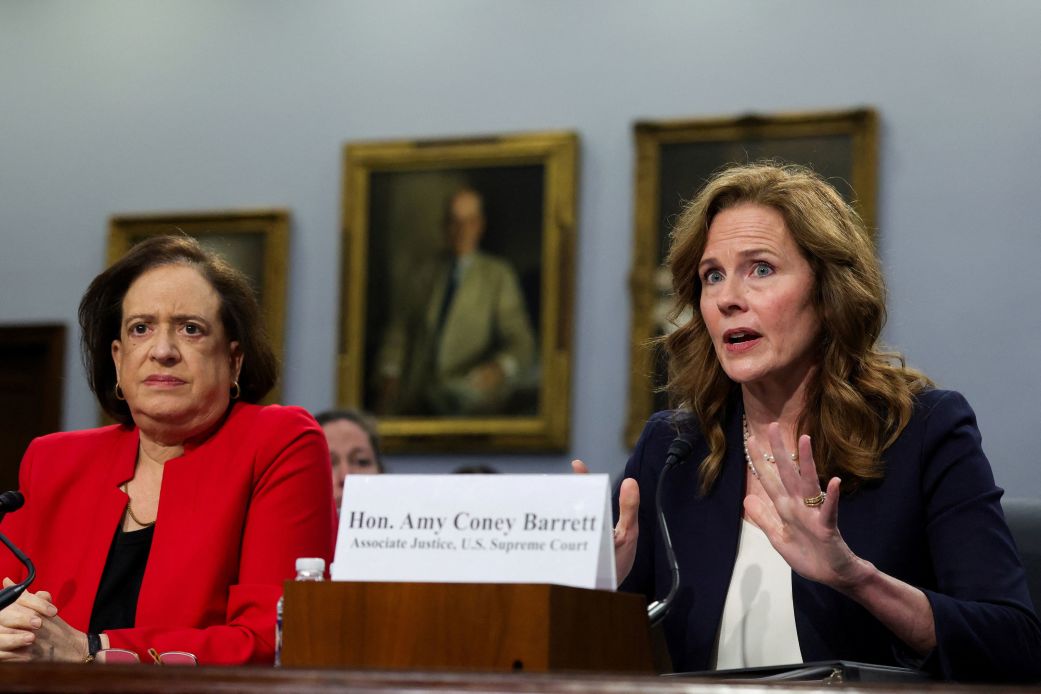
Barrett and Kagan testify before Congress in a rare and revealing appearance that drew national attention on Tuesday, as two Supreme Court justices from opposite ends of the ideological spectrum sat before lawmakers to discuss everything from courtroom security to political intimidation. The session offered an unusual glimpse into the personal toll of serving on the nation’s highest court, along with pointed exchanges over ethics and heated political rhetoric.
An Unusual Pairing on Capitol Hill
The primary purpose of the hearing was straightforward: to make the case for the Supreme Court’s budget request for the coming year. That request includes an increase of roughly $14 million dedicated largely to security measures.
But the conversation quickly expanded beyond dollars and cents. Lawmakers also pressed the justices on other pressing matters, including growing calls to establish a way to enforce an ethics code for members of the court.
The pairing itself raised eyebrows. Justice Amy Coney Barrett, a conservative nominated by President Trump, and Justice Elena Kagan, a liberal appointed by former President Obama, might seem like an odd match. Yet their personal rapport was strikingly warm throughout the day, with the two often deferring to one another and echoing each other’s points. Here are the five biggest takeaways.
- Barrett Delivers a Vivid Account of Threats
Both justices voiced deep concern about the rising tide of violence directed not only at the Supreme Court but at the judiciary as a whole. Lawmakers largely shared that alarm. Rep. Rosa DeLauro noted that 370 threats had been made against federal judges as of July 1, translating to a 31 percent year-over-year increase.
Kagan, who has served since 2010, described how dramatically security had escalated during her tenure. She recalled a time when she drove herself to and from work and walked freely on the street, calling it an entirely different world.
Barrett, however, offered the most personal and striking account. She revealed that she had been issued a bulletproof vest a few years ago due to threats against her life. In one memorable moment, she described bringing the vest home and setting it down in her bedroom, only to turn and find her then-12-year-old son standing in the doorway, curious about what it was. She admitted she never expected the job would require explaining to her children what a bulletproof vest was and why she needed one.
She also recounted a more recent “swatting” incident, in which a false emergency is reported to harass someone. One of her teenage sons opened the front door to leave, only to find the street filled with police cars responding to a fake report of gunshots and shouting inside their home.
- Kagan Takes Implicit Aim at Trump’s Attacks
The theme of inflammatory rhetoric surfaced repeatedly, and one of the most telling moments came when Sen. Jack Reed read aloud several comments Trump had made about the Supreme Court. Reed cited Trump calling justices who ruled against him on tariffs a “disgrace to our nation,” along with a social media post claiming the Court had “unnecessarily RANSACKED” the country.
Kagan responded immediately. She emphasized that such comments would be wrong no matter which political figure or party they came from. Then, in what appeared to be a direct if unspoken jab at Trump, she drew a clear line: criticism is fair game, but intimidation is something else entirely. When political figures try to pressure judges into ruling the way they prefer, she said, that’s where a line has truly been crossed.
- The Justices Avoid Rising to Political Bait
Kagan’s remarks on intimidation stood out precisely because they were the exception. For most of the day, both justices carefully steered clear of the political fray.
Lawmakers from both parties tried to draw them in with partisan framing. Rep. Michael Cloud complained about “lawfare” against Trump, while Rep. Steny Hoyer warned of the current administration’s “theory of executive supremacy.” In each case, Barrett and Kagan let the comments pass without engaging.
- Lawmakers Press on Ethics and the Shadow Docket
Two issues came up again and again: the absence of any enforcement mechanism for the court’s ethical guidelines, and the increasing use of the so-called shadow docket, through which justices issue expedited rulings, often with little or no explanation.
Some lawmakers pushed hard, especially on ethics enforcement. Sen. Chris Van Hollen said he wanted the Supreme Court to act on its own to make its ethics rules enforceable, warning that Congress might eventually have the votes to do so if the court didn’t.
Neither justice showed much willingness to commit. Among their concerns, they suggested that any enforcement body could risk becoming a partisan tool. On the shadow docket, Kagan argued the court had improved in offering at least basic information but acknowledged to Sen. Patty Murray that there was still room to do better.
- Kagan Pays Tribute to Lindsey Graham
The day carried a somber note as well. Kagan opened her appearance before the House subcommittee by extending the entire Court’s condolences to the family of Sen. Lindsey Graham, who died suddenly on Saturday at age 71.
She then offered a few personal reflections, recalling that the conservative Graham had voted to confirm her despite her liberal credentials. Kagan praised his wide-ranging knowledge and well-known sense of humor, noting wryly that during her confirmation hearing he had somehow managed to make her look funny, which she called a far harder feat. Graham, she said, was a vivid person.
A Rare Window Into the Court
The joint testimony offered more than a budget discussion. It pulled back the curtain on the personal risks justices now face, the tensions surrounding political attacks on the judiciary, and the unresolved debates over ethics and transparency. In a polarized moment, the warm dynamic between Barrett and Kagan served as a quiet reminder that collegiality can still cross ideological lines, even as the challenges facing the court grow more serious.
Author