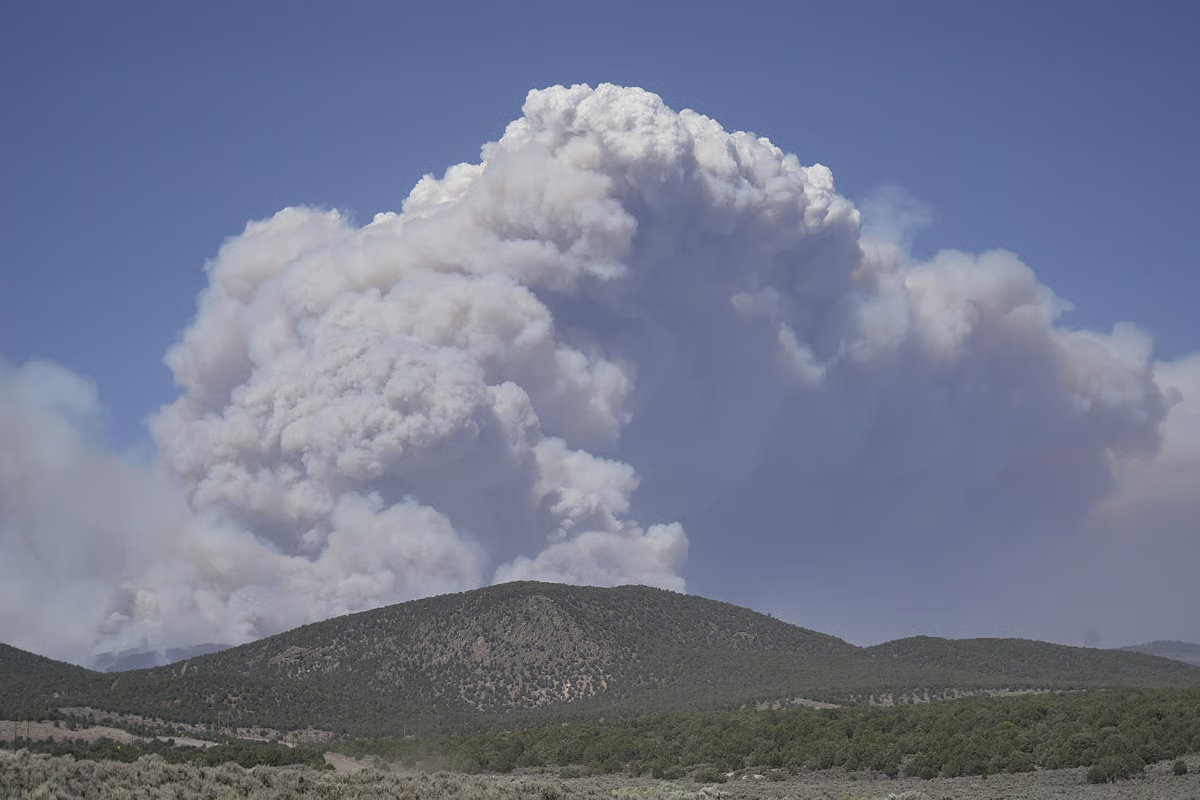
Utah wildfire emergency reached a critical point this week as state officials declared a state of emergency and clamped down on fireworks just days before the nation’s July Fourth festivities. The decision comes as the country’s biggest active wildfire keeps tearing through bone-dry forestland, while exhausted crews scramble to contain a string of new blazes igniting across the parched state.
The National Weather Service underscored the gravity of the moment by issuing an uncommon “Particularly Dangerous Situation” alert, citing the toxic mix of low humidity and gusty winds feeding fire growth throughout the western United States.
A Fire That Refuses to Slow Down
The Cottonwood Fire ignited Monday in a thinly populated stretch of southern Utah. Within days it exploded to more than 112 square miles, spreading without resistance as fierce winds kept firefighting aircraft on the ground. It stands as one of six major fires raging in the state and has already wrecked much of the Eagle Point ski resort in Beaver County, prompting mandatory evacuation orders.
By Friday evening, Utah was facing ten active wildfires consuming over 144,700 acres. The Cottonwood Fire alone had scorched close to 72,000 acres and remained entirely uncontained.
A fire spokesperson described conditions on the ground as severe, noting that the forecasted sustained winds of 35 miles per hour, along with gusts hitting 45, had dramatically intensified the flames. Crews reported extreme behavior, including fire racing through treetops and embers leaping ahead to start new spot fires.
Smoke Drifting Across State Lines
The dense smoke has been carried eastward and to the northeast, sending haze toward popular destinations. So far, the air quality at beloved parks like Zion and Bryce Canyon, both well to the south, has stayed relatively clear aside from some haze near Bryce. Even so, tourists at Bryce have shared online clips capturing the towering plume rising in the distance.
That plume has been visible for hundreds of miles, reaching as far as Colorado. Meanwhile, roughly 1,300 people living in Marysvale, Junction, and Circleville have been warned to stay ready to evacuate should the fire advance.
Utah’s state forester described the situation as unlike anything witnessed in recent years, explaining that the fires are moving faster and reaching farther than historical patterns would suggest.
Lives and Memories Lost
For residents, the destruction is deeply personal. A 76-year-old man traveled alongside the sheriff only to discover his cabin and neighboring properties reduced to ash, leaving behind a charred, lifeless landscape with toppled power poles scattered through the canyon.
Another resident, a 27-year-old woman, lost her family’s cabin too. It held special meaning as the final spot where the family had gathered for photos with her grandmother before the woman passed away from cancer. Her brother had even planned to hold his wedding there within two months. As she put it, some things simply can’t be rebuilt.
A Different Kind of July Fourth
Governor Spencer Cox rolled out temporary fireworks restrictions running through July 5, acknowledging that the timing carries extra weight as the nation marks its 250th anniversary. He emphasized that this year demands a different approach.
For the first time ever, the Salt Lake City weather office issued a “Particularly Dangerous Situation” warning covering five Utah counties, including the Cottonwood Fire zone. The alert, originally designed to warn of tornado threats, urged residents to brace for rapid fire spread. A red flag warning was also extended across most of the state.
A comparable warning had previously been used during the 2025 Palisades Fire in Los Angeles. Notably, a federal judge declared a mistrial Friday in the arson case tied to that disaster after jurors couldn’t reach a unanimous decision.
Though investigators haven’t determined what sparked the Cottonwood Fire, the governor’s order highlighted a sobering statistic: people have been responsible for the vast majority of fires in Utah this year. Of the 376 wildfires recorded, 273 were human-caused.
The order also hands the state forester authority to limit or ban fireworks displays in Utah communities, taking that decision out of local hands.
The Threat Spreads Across the West
As dangerous conditions linger, Rocky Mountain Power issued a public safety power shut-off watch and warning for parts of central, southern, and eastern Utah throughout the weekend.
Firefighters were also confronting the Iron Fire southwest of Salt Lake City, which briefly forced the evacuation of Eureka, a town of about 1,000 residents.
Red flag warnings, signaling extreme fire risk from low humidity, heat, and strong winds, stretched from Idaho down through southern Arizona and New Mexico. Those alerts pushed into Saturday, with forecasters expecting winds of 25 to 35 miles per hour and exceptionally dry air. The harshest conditions were anticipated from northern Arizona into central and southern Utah.
Much of Utah is already gripped by severe to extreme drought, while portions of Colorado, Arizona, and New Mexico face severe drought as well.
A climate research director warned that the danger of explosive fire behavior will persist as long as the heat, dryness, and wind continue. He cautioned that anyone heading into forested campgrounds or grasslands needs to stay alert to their surroundings.
The concern reaches beyond the West. Even in Florida, where several brush fires have broken out, officials are pleading with residents to skip backyard fireworks and leave the displays to trained professionals.
As a precaution, federal land managers shut down public areas near the Cottonwood Fire, and forest officials in New Mexico closed trails and campgrounds near a fire burning in the Jemez Mountains.
Nationally, nearly 3 million acres have already burned this year, pushing the country past its ten-year average. Still, fire officials report that crews are gaining ground on containment efforts stretching from Alaska to Florida.
Author