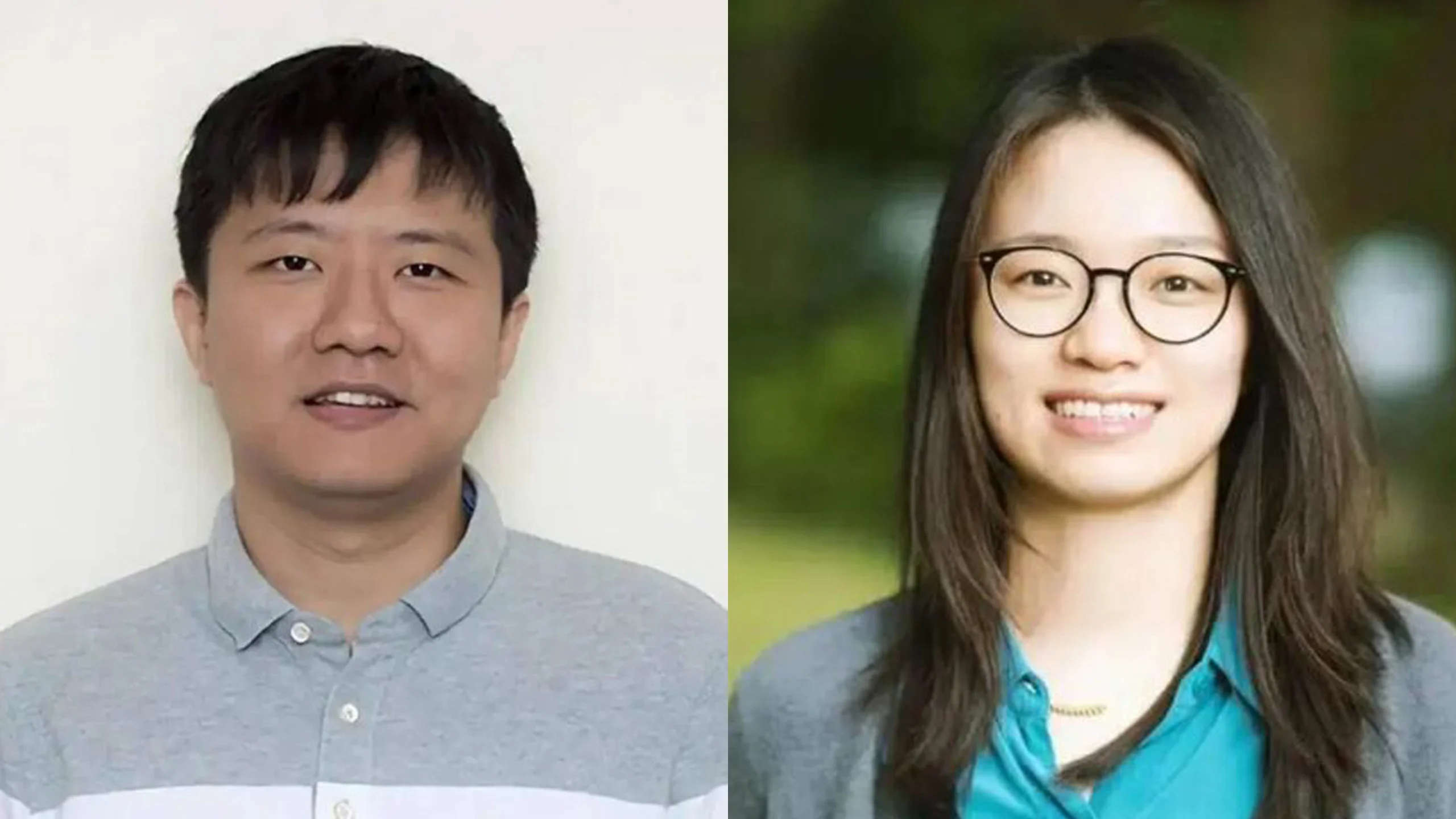
Chinese Fields Medal Winners Make History With Century-Spanning Breakthroughs
For the first time, mathematicians from China have received the Fields Medal, the discipline’s most prestigious honour. Hong Wang and Yu Deng were named among this year’s recipients, alongside John Pardon of the United States and Jacob Tsimerman of Canada.
Each laureate received 15,000 Canadian dollars — roughly $10,500 or £8,000.
Both Chinese recipients were recognised for resolving questions that had resisted solution for more than a hundred years. Wang, 35, who holds positions in both the United States and France, becomes only the third woman ever to receive the award.
The medal was presented Thursday in the United States, at a moment when the value of human mathematical reasoning is being tested against rapidly advancing artificial intelligence.
A National Celebration Online
The response across Chinese social media was immediate and enormous.
Hashtags referencing the Fields Medal and the first Chinese winners drew millions of views across platforms including Weibo and Rednote. Commenters described the moment in sweeping terms — one called it a source of pride for all Chinese people, while another wrote simply that they were witnessing history.
Chinese outlets covered both academics exhaustively, publishing detail on their schooling, their personal interests, and what the recognition represents for the country’s scientific standing.
Shing-Tung Yau, the first ethnic Chinese mathematician to win the medal, framed it as the fulfilment of something long awaited — a dream the Chinese mathematics community had held for decades.
The Pencil Problem: Wang’s Contribution
Working with colleague Josh Zahl, Wang resolved a question first posed by Japanese mathematician Soichi Kakeya in 1917.
The problem sounds deceptively simple: if you rotate a pencil so that it turns completely around, what is the smallest area it can sweep through?
Wang and Zahl approached it by treating the pencil as suspended in three-dimensional space rather than lying on a flat plane. Their paper appeared last year.
Wang explained the enduring fascination in practical terms, telling AFP that this kind of phenomenon surfaces naturally across problems from entirely different fields — which is precisely why it draws so much attention.
Her broader research sits in harmonic analysis, the study of how waves move.
From Particles to the Whole: Deng’s Achievement
Yu Deng, 37, a mathematics professor at the University of Chicago, was honoured for cracking a different century-old puzzle.
In 1900, German mathematician David Hilbert posed what became known as Hilbert’s Sixth Problem: how can the behaviour of an entire system be derived from the motion of its individual particles?
Deng found his answer by examining the behaviour of gases.
He described the recognition as a real honour, noting the weight of having his name placed alongside mathematicians he has long admired.
How the Prize Works
The Fields Medal is frequently described as mathematics’ equivalent of the Nobel Prize, though its structure differs in two important ways:
- It is awarded every four years rather than annually
- Recipients must be under the age of 40
That age restriction makes the honour a recognition of early-career achievement rather than lifetime contribution, and it means candidates effectively have one or two chances at eligibility.
Two Parallel Paths
The biographies of both winners follow a strikingly similar arc: born and educated in China, then trained and established abroad.
Wang was born in 1991 in Guilin, a tourist city in the southern region of Guangxi. She skipped two grades during primary school and entered Peking University in 2007 at just 16 years old.
Mathematics was not her first choice. She initially enrolled in earth sciences before switching departments a year later.
Her subsequent education traced a route through France and the United States — Paris-Sud University, the École Polytechnique, and a doctorate at MIT. She now holds a professorship at New York University along with a permanent position at France’s Institut des Hautes Études Scientifiques.
Deng entered Peking University the same year as Wang, having competed in mathematics contests since primary school. He transferred to MIT in 2009, completed his doctorate at Princeton, and has taught at the University of Chicago since 2024.
France Makes Its Pitch
Wang received a congratulatory phone call Thursday night from French President Emmanuel Macron.
Macron used the occasion to promote French research institutions, posting on X that she embodies the excellence of the country’s research and training, and adding an appeal to scientists to choose France.
The moment captured something beyond ceremony. Both laureates were educated in China and built their careers in Western institutions, and multiple countries now have a plausible claim to their success.
Why the Timing Resonates
The award arrives during a period of genuine uncertainty about the future of mathematical work.
AI systems are increasingly capable of handling computation and, in some cases, generating proofs. Against that backdrop, two researchers spending years on problems that had defeated the field since 1900 and 1917 carries a particular kind of significance.
Neither the Kakeya conjecture nor Hilbert’s Sixth Problem yielded to brute calculation. They required someone to reconsider the framing — Wang by shifting into three dimensions, Deng by looking at gases. That remains difficult to automate.
Author
-
Lucienne Albrecht is Luxe Chronicle’s wealth and lifestyle editor, celebrated for her elegant perspective on finance, legacy, and global luxury culture. With a flair for blending sophistication with insight, she brings a distinctly feminine voice to the world of high society and wealth.