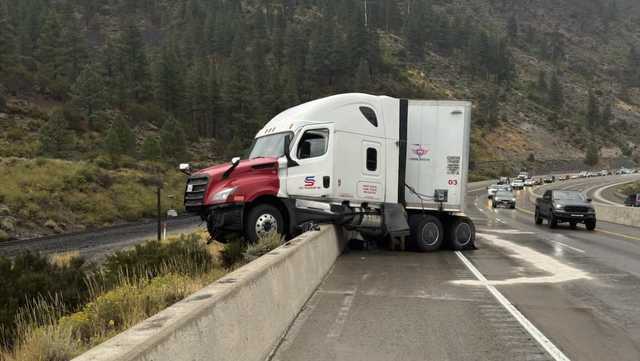
An I-80 big rig crash near the California-Nevada border shut down eastbound lanes for hours Friday, leaving the truck’s cab suspended over the side of a bridge and its driver seriously injured.
The California Highway Patrol confirmed the single-vehicle wreck closed the interstate near Truckee for much of the day.
What Happened
According to CHP, the big rig lost control while crossing a bridge near Floriston in Nevada County. The crash occurred around 10:45 in the morning.
The cab went over the bridge railing. The driver was ejected from the vehicle and struck the embankment below, sustaining major injuries.
No other vehicles were involved.
Traffic Backed Up for Miles
Closing an interstate in the Sierra Nevada creates problems that ripple outward quickly, because there is very little alternative.
Authorities initially held traffic at Hirschdale before moving the hold point back to Overland Trail as the closure stretched on. Drivers heading east toward Reno found themselves stopped with no practical detour available — the mountain terrain leaves few options for rerouting significant volumes of traffic.
By four in the afternoon, crews had reopened a single lane, allowing traffic to begin moving again.
Why This Stretch Is Difficult
The section of I-80 running through Truckee and toward the Nevada line is among the more demanding pieces of interstate in California.
The route climbs through the Sierra Nevada with sustained grades, tight curves, and bridges spanning the Truckee River canyon. It carries heavy commercial traffic year-round, connecting the Bay Area and Sacramento to Reno and points east.
For a loaded tractor-trailer, the combination of elevation change and curvature demands constant attention to speed and braking. Weight, momentum, and grade work against a driver in ways they do not on flat ground, and mistakes escalate quickly.
The Recovery Challenge
A cab hanging over a bridge presents an unusually complicated recovery operation.
Standard tow equipment is designed to pull vehicles across pavement, not lift them from a suspended position over open space. Crews must stabilize the vehicle before anything else, then determine how to bring it up without dropping it or damaging the structure supporting it.
Bridge inspection typically follows any incident where a vehicle strikes or goes over a railing. Engineers need to confirm the deck and barriers remain sound before full traffic loads return, which is often what extends closures beyond the point where wreckage is cleared.
That sequence explains why one lane reopening took more than five hours.
The Human Cost
Behind the traffic impact is a driver who was thrown from a vehicle and landed on an embankment below a bridge.
Ejection in a commercial vehicle crash is a serious circumstance. Truck cabs are built with substantial structural protection, and drivers who leave that protection during a wreck face injuries considerably worse than those who remain inside.
CHP described the injuries as major. No further details on the driver’s condition have been released.
What Investigators Will Look At
Single-vehicle commercial crashes prompt a specific set of questions.
Investigators typically examine speed relative to conditions, mechanical condition of the vehicle including brakes and steering, driver hours of service and fatigue, load distribution and securement, and road surface conditions at the time.
For a bridge crossing specifically, wind can also become a factor. Elevated spans in mountain terrain expose high-profile vehicles to crosswinds that do not affect traffic at ground level, and a loaded trailer presents a large surface area to push against.
None of these factors has been identified as a cause in this case. CHP has not stated what led to the loss of control.
For Drivers Using the Route
Anyone traveling I-80 through the Sierra should expect intermittent restrictions while recovery and inspection work continues.
Conditions on this corridor change fast in any season, and closures can appear with little notice. Checking Caltrans conditions before departing remains the practical approach, particularly for anyone on a schedule.
The reopened lane restores movement but not capacity. Delays are likely to persist until full lanes return.
Author