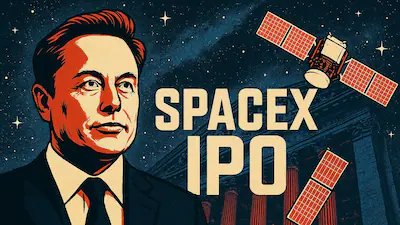
The SpaceX IPO is shaping up to be one of the most consequential market debuts in history, and it is arriving on Elon Musk’s own unconventional terms. On Wednesday, the company filed the formal terms of its initial public offering, laying out a plan that would not only raise an enormous sum but also rewrite some of Wall Street’s long-standing rules along the way.
A Deal of Staggering Scale
According to the filing, SpaceX intends to sell roughly 555.6 million shares of Class A common stock priced at $135 each. If the offering proceeds as planned, it would bring in close to $75 billion and place the company’s valuation at approximately $1.75 trillion.
That figure is difficult to overstate. A raise of that size would be the largest IPO in history, roughly three times bigger than Alibaba’s 2014 record. It would comfortably surpass Saudi Aramco’s 2019 listing, which previously held the title at $29.4 billion. At its target valuation, SpaceX would instantly become one of the ten most valuable companies listed in the United States, leapfrogging giants such as Meta Platforms, Berkshire Hathaway, and even Musk’s own Tesla. Tesery
Musk Rejects the Wall Street Playbook
What makes the offering especially notable is not just its size but the way it is being structured. SpaceX has chosen to break from standard practice by announcing a single fixed price rather than the preliminary price range that companies typically publish.
Under the usual approach, a firm floats a tentative range before meeting with investors, leaving itself room to nudge the final number up or down based on demand. SpaceX skipped that step entirely. It took the rare step of announcing the fixed price before the investor roadshow had even begun, a decision with few if any precedents among major U.S. listings. Yahoo Finance
Reporting suggests the company settled on one firm number partly to remove the uncertainty that usually clouds the pricing process and to make its upcoming investor meetings cleaner and more straightforward. The roadshow begins Thursday, with trading on the Nasdaq scheduled to start June 12 under the ticker symbol SPCX. The price could still shift before the listing is finalized.
Musk Keeps a Tight Grip
The structure of the deal also ensures that control of the company stays exactly where Musk wants it. Only newly issued shares are being sold, meaning existing shareholders cannot cash out during the offering itself. Every dollar raised flows directly into SpaceX rather than into the pockets of early investors.
Musk, who holds the roles of CEO, chief technology officer, and chairman, will command roughly 82.4 percent of the company’s voting power once the offering is complete. His shares are bound by a 366-day lockup. The dual-class share structure mirrors the architecture used by founder-led companies such as Meta and Google to separate economic ownership from voting control. In practice, public investors will own a piece of the company’s economic future without gaining meaningful say over its direction. Tesery
The Numbers Behind the Valuation
The financials reveal a company growing fast while spending heavily. SpaceX brought in $18.674 billion in total revenue for 2025, a 33 percent jump from the previous year. Within that figure, Starlink contributed the largest share at $11.387 billion, the core space business added $4.086 billion, and the newer AI division accounted for $3.201 billion. Yahoo Finance
Profitability, however, moved in the opposite direction. The company swung to a net loss of $4.937 billion, driven by aggressive spending on new rockets, additional satellites, and AI data centers, while closing the year with $24.7 billion in cash. At the targeted $1.75 trillion valuation, the price works out to roughly 93.7 times trailing sales, an extraordinarily rich multiple that reflects how much future growth investors are being asked to price in. For context, Morningstar’s independent valuation pegged the company at around $780 billion based on its launch and satellite businesses alone, far below the IPO target. Yahoo FinanceFortune
Opening the Door to Everyday Investors
In another departure from the norm, SpaceX is making room for ordinary investors to participate from the very first day. The filing disclosed that individuals will be able to buy shares through a range of consumer brokerage platforms, including Schwab, Fidelity, Robinhood, SoFi, and E*Trade.
The company is reportedly weighing whether to set aside as much as 30 percent of the offering for individual investors, an unusually large allocation for a debut of this magnitude. A heavy lineup of banks is steering the process, with Goldman Sachs, Morgan Stanley, Bank of America, Citigroup, and JPMorgan Chase leading alongside 18 other firms.
From Rocket Company to AI Powerhouse
The IPO also marks a moment of reinvention. When SpaceX filed back on May 20, it pitched investors on its transformation from a rocket and satellite internet provider into a broader artificial intelligence and infrastructure company.
That shift became concrete earlier this year when SpaceX folded Musk’s xAI venture into its portfolio, absorbing both the Grok chatbot and the X social media platform. The company has also reserved up to 5 percent of its outstanding common stock for select employees and individuals chosen by its executives through a directed share program, with those participants exempt from the usual lockup restrictions.
A Debut Worth Watching
Taken together, the offering reflects a company unwilling to play by conventional rules, led by an executive who has built a career on defying expectations. Whether investors embrace the steep valuation or balk at the losses beneath it, the SpaceX listing is poised to be one of the most closely watched market events in recent memory, and a defining test of just how much faith Wall Street is willing to place in Musk’s vision.
Author